
Ask any group of new drivers which maneuver makes them sweat, and the Three-Point Turn comes up fast. You have to stop, steer, reverse, and watch traffic in a tight space while an examiner takes notes. One shaky move can feel like the whole test is slipping away.
The good news is that this maneuver follows a simple, repeatable pattern. This guide breaks it into clear steps, shows the mistakes examiners notice most, and explains how to practice until it feels routine before your Florida driving test.
The three-point turn lets you reverse direction on a narrow street when a U-turn is not possible. On the skills test, examiners use it to check several abilities at once: steering control, smooth speed, use of mirrors, awareness of other traffic, and the ability to stay calm under pressure. Passing it shows that you can handle a real situation safely, not just follow a script.
Along with the turn, the road test checks other common tasks, such as parking, quick stops, and backing up. Since February 2026, all Florida knowledge and skills exams are given only in English, and interpreters are no longer allowed. That makes it even more important to understand common examiner instructions, such as “pull to the right curb” or “turn the car around,” before test day.
Practice these steps slowly at first. Speed comes later. Accuracy and safety matter far more than finishing quickly.
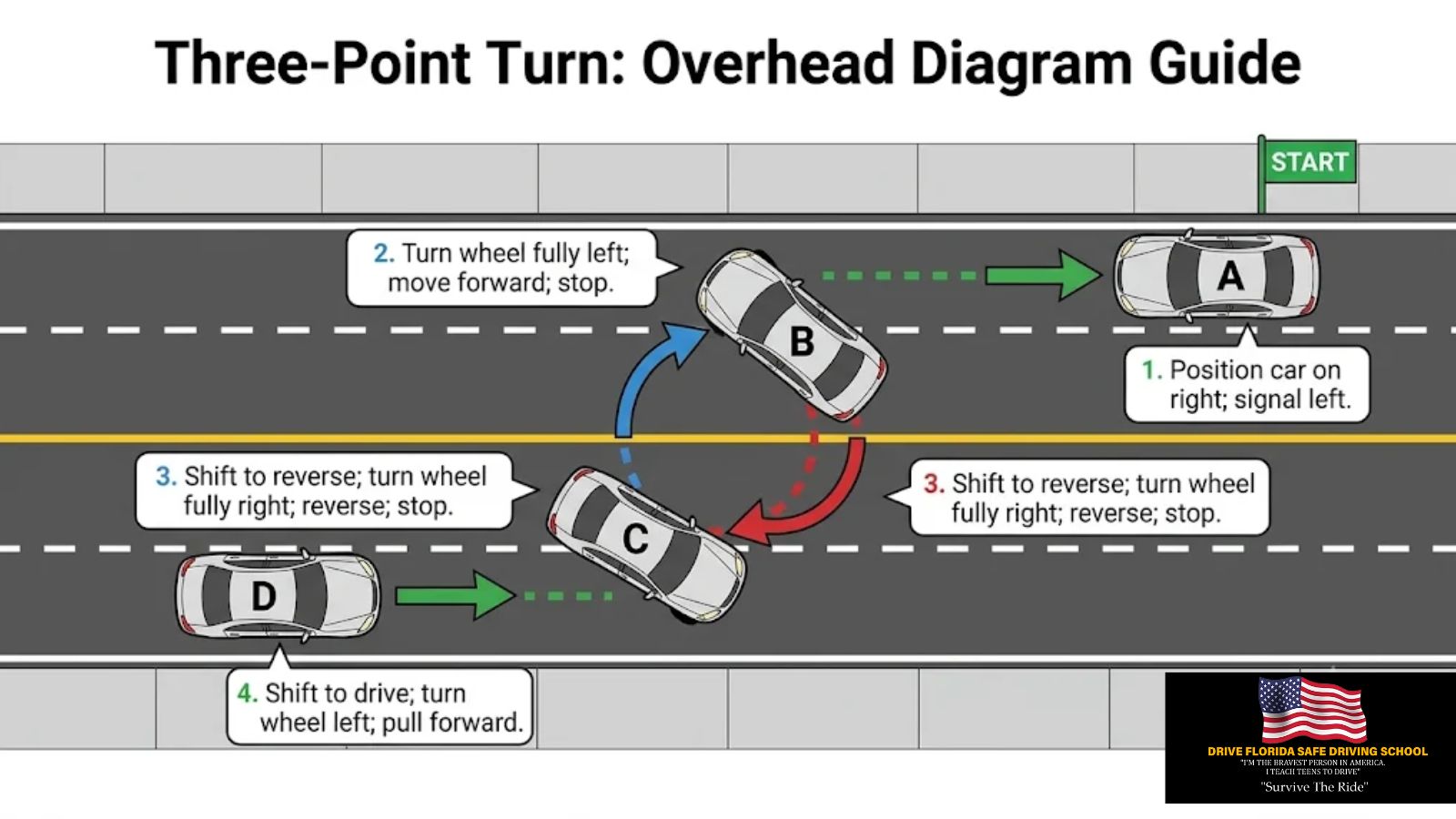
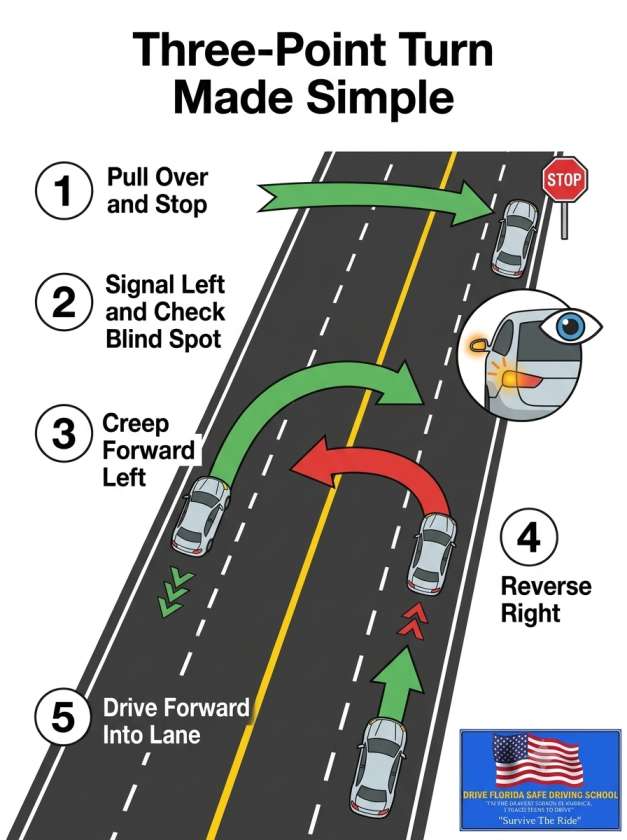
When the examiner asks you to turn around, check your mirrors, signal right, and pull close to the right curb. Come to a full, smooth stop. Leave a little space so your tires do not scrape the curb. This first stop sets the tone, so take your time and show the examiner calm control.
Before you move, signal left. Check your mirrors, then turn your head to look over your left shoulder for your blind spot. Make sure no cars, cyclists, or pedestrians are coming from either direction. Many test-takers lose points here simply because they forget the shoulder check.
Turn the steering wheel fully to the left and let the car creep forward at a very slow speed. Keep your eyes moving between the road ahead and the opposite curb. Stop smoothly before your front tires touch the far curb. Bumping the curb is one of the most common reasons drivers lose points on this maneuver.
Shift into reverse. Check all mirrors, then look over your right shoulder through the rear window. Turn the steering wheel fully to the right and back up slowly. Keep checking for traffic on both sides. Stop before your rear tires touch the curb behind you, leaving enough room to drive forward into your lane.
Shift into drive. Check traffic again, then turn the wheel left and move forward into the correct lane. Straighten the wheel and accelerate smoothly to a normal speed. Your turn is complete when you are driving in the right lane in the new direction, with full control of the car.
Use this table during practice to check each part of the maneuver.
| Step | Key Action | What Examiners Watch |
|---|---|---|
| 1 | Signal right, stop near curb | Smooth, full stop |
| 2 | Signal left, check mirrors and blind spot | Head turn and full traffic check |
| 3 | Full left turn, creep forward | Slow speed, no curb contact |
| 4 | Reverse with full right turn | Looking back, controlled speed |
| 5 | Drive forward into lane | Correct lane, smooth finish |
Picture a teen who practices the turn on a quiet street with a parent. On the first try, she rushes, bumps the curb, and forgets to look back while reversing. After a few slow repetitions, she starts saying each step out loud: “Signal, check, turn, creep, stop.” By the end of the week, the whole maneuver feels natural, and her confidence grows with every clean attempt.
Once you hold a permit, practice on a quiet residential street with little traffic and clear visibility. Start in daylight, and add a few repetitions each practice session until the steps feel automatic. Once your teen handles a wide street well, try a slightly narrower one. This builds precision without adding stress too early. Always practice with a licensed adult in the passenger seat.
An online driving course can teach the theory behind a three-point turn, including when it is legal and safe. However, reading about steering is not the same as feeling the car respond. Hands-on practice builds the muscle memory that test day demands. The strongest preparation combines classroom knowledge with real practice behind the wheel.
Every new driver follows a clear path. Teens under 18 first complete a Florida learners permit course before applying for a permit, while first-time adult drivers complete their own required course. These courses cover traffic laws and road signs, so students understand when a turnaround is legal and safe.
Good driver education Florida families rely on then continues behind the wheel, where knowledge turns into real control.
A beginner driving course with an instructor helps teens master maneuvers like the three-point turn long before the road test, one calm step at a time.
Examiners see the same mistakes again and again. Knowing them helps you avoid easy point losses.
These tips come from common situations instructors see during test preparation.
The Three-Point Turn looks tricky at first, but it becomes simple with a clear method and steady practice. Signal, check, turn slowly, look back while reversing, and finish in the correct lane. Master these habits, and you will walk into your Florida driving test with far more confidence.
If you want expert help, Drive Florida Safe Driving School offers patient lessons that cover test maneuvers step by step, including the three-point turn. Our instructors at Drive Florida Safe Driving School use mock road tests to help new drivers practice under real test conditions. Reach out to Escuela de manejo seguro de Drive Florida to plan lessons that fit your goals and prepare you for test day.
Examiners can include several maneuvers, and turning the car around in a limited space is a common one. Because you cannot know the exact route or tasks in advance, you should prepare for every core skill, including parking, quick stops, backing up, and the three-point turn. Practicing all of them builds confidence and prevents surprises when the examiner gives instructions.
Touching the curb usually costs points, and climbing or hitting it hard can count as a more serious error. Examiners want to see that you control the car’s position at slow speed. To avoid this, stop earlier than you think you need to. Leaving a small gap is always safer than guessing how close you can get to the curb.
A camera can help, but it should never replace looking back over your shoulder. Examiners expect you to turn your head and check behind the car directly while reversing. Use mirrors and the camera only as extra safety tools. Building the habit of physically looking back keeps you safer and shows the examiner that you understand proper, safe reversing technique.
There is no magic number, but most new drivers need many repetitions across several sessions before the turn feels automatic. Practice until you can complete it smoothly on different streets without reminders. A good test is whether you can do it calmly while someone talks to you. When the steps feel natural under light pressure, you are likely ready for test day.
Not always, but lessons help many new drivers learn faster and avoid bad habits. An instructor can spot small issues, such as late signals or poor reversing posture, that parents may miss. Instructors also run mock tests that mirror real exam conditions. Combining a few professional lessons with regular family practice usually gives the best and most confident results. Teens who already finished a Florida learners permit course know the rules, and lessons turn that knowledge into skill.
En Drive Florida Safe Driving School, estamos dedicados a ayudar a nuestros estudiantes novatos a convertirse en los conductores más seguros. Siempre nos esforzamos para que usted o su ser querido reciban las técnicas, los conocimientos y las normas de manejo defensivo más actualizados.




 Spanish
 English

