

Choosing where to learn to drive is about much more than finding the closest instructor or the lowest lesson price. The habits developed during the first few hours behind the wheel can influence how a driver handles traffic, intersections, parking, lane changes, distractions, and unexpected situations for years.
For families and new drivers in Harrison Ranch, Parrish, selecting the Right Driving School means looking beyond advertisements and asking practical questions about instructors, lesson structure, vehicle safety, communication, scheduling, and preparation for Florida’s licensing requirements.
Harrison Ranch is a large residential community in Parrish, Florida, with families, students, working adults, and newer drivers sharing the surrounding roads and communities. That makes convenient, structured driver education especially valuable for people who want to build confidence without developing bad habits.
Whether you’re searching for a Driving School in Harrison Ranch for a teenager getting behind the wheel for the first time or an adult returning to driving after years away, this guide explains what to look for—and what questions to ask before booking your first lesson.
A good driving school should do more than teach someone how to move a vehicle from one location to another.
Effective driver education develops judgment, observation, vehicle control, defensive driving habits, and decision-making. A student should gradually learn how to anticipate what other road users might do rather than simply react to situations as they happen.
The quality of instruction also matters because every student learns differently.
For example:
The Right Driving School recognizes these differences rather than forcing every student through exactly the same routine.
Before choosing a school, take time to evaluate the actual learning experience you will receive.
Price is important, but it should not be the only deciding factor.
One of the most important questions to ask is who will actually be teaching the student.
When researching a Certified Driving Instructor Harrison Ranch, ask about the instructor’s qualifications, experience, teaching approach, and familiarity with local driving conditions.
A knowledgeable instructor should be able to explain why a particular action is appropriate—not simply tell the student what to do.
For example, instead of saying:
“Slow down here.”
A good instructor can explain that the student should reduce speed because visibility is limited, another vehicle could enter the roadway, or the upcoming intersection requires additional observation.
That explanation helps students transfer the lesson to future situations.
The first lesson should not feel like a test.
A sensible initial session usually gives the instructor an opportunity to understand the student’s existing ability, comfort level, and areas that need development.
The instructor may evaluate:
For a complete beginner, the lesson may begin in a lower-pressure environment before gradually introducing more complex traffic conditions.
Random practice can help someone become comfortable with a car, but structured instruction is much more effective for developing consistent driving skills.
A quality Driving Lessons Harrison Ranch program should progressively introduce skills rather than throwing a new driver into difficult traffic before they are ready.
A typical progression may look like this:
Students learn the basic controls and understand how the vehicle responds to steering, braking, and acceleration.
Practice may include:
Once basic control improves, instruction can focus more heavily on surrounding traffic, intersections, following distances, and identifying hazards.
Students gradually encounter situations such as:
Eventually, the instructor should reduce unnecessary prompting.
This is an important milestone. A student who can only drive when the instructor says “turn left,” “brake,” or “change lanes” has not yet developed complete independence.
The goal is for the driver to recognize the situation and make the appropriate decision independently.
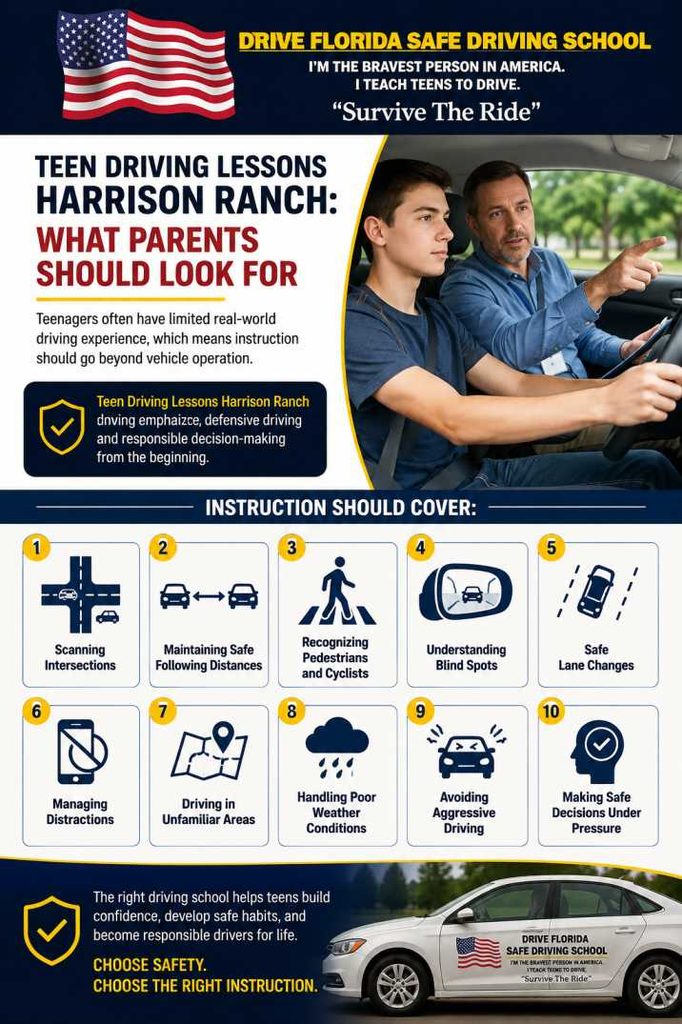
Teenagers often have limited real-world driving experience, which means instruction should go beyond vehicle operation.
Teen Driving Lessons Harrison Ranch should emphasize defensive driving and responsible decision-making from the beginning.
A teenager may know how to steer, accelerate, and brake but still struggle with judging the speed of approaching vehicles or recognizing hazards early enough.
Parents should look for instruction covering:
Passing the licensing exam is an important milestone, but it is not the ultimate measure of driving ability.
A student can memorize procedures and pass a test while still needing considerable real-world practice.
Florida’s official driver handbook states that applicants seeking a learner’s license must complete the required education and testing steps, while applicants under 18 face additional requirements before obtaining a driver license. The handbook also notes that qualifying minors must accumulate supervised driving experience, including nighttime driving.
Parents should therefore think of professional instruction as one part of a larger learning process that includes supervised practice.
Adult learners have different needs from teenagers.
Someone taking Adult Driving Lessons in Harrison Ranch may already understand basic vehicle controls but lack confidence in certain situations. Others may have driven for years but want to improve specific skills.
Common reasons adults seek instruction include:
An experienced instructor should avoid assuming that every adult learner needs beginner-level instruction.
Instead, the instructor can identify the student’s current abilities and concentrate practice where it will produce the greatest improvement.
For example, an adult may be completely comfortable driving on residential roads but become uncomfortable when changing lanes on a multi-lane roadway. In that situation, spending an entire lesson practicing basic starts and stops would not be the best use of time.
Targeted instruction is more efficient.
Before booking lessons, make a short list of questions and contact the school directly.
Consider asking:
Ask what credentials the instructor holds and whether those qualifications are current.
Find out whether the training vehicle is properly maintained and whether it has features that support safe instruction.
A lesson advertised at a low price may not represent the best value if the actual instructional time is significantly shorter.
Ask whether the program can adapt to beginner, teen, adult, nervous, or test-preparation students.
Constructive feedback should explain what needs improvement and how to correct it.
A responsible school should prioritize actual driving ability rather than encouraging a student to test simply because a certain number of lessons has been completed.
The instructor’s behavior during lessons can tell you a great deal about the quality of the program.
A strong instructor typically:
One particularly useful sign is whether the instructor gradually reduces assistance.
If an instructor continues giving every instruction throughout the entire course, the student may become dependent on prompts.
Good instruction should ultimately make the instructor less necessary, because the student is becoming capable of making decisions independently.
A cheaper lesson is not automatically a better value.
Compare what is included, how long lessons last, instructor experience, vehicle condition, scheduling flexibility, and the overall training structure.
Quantity alone does not guarantee quality.
Ten poorly structured lessons may be less beneficial than a smaller number of focused sessions combined with appropriate supervised practice.
Convenience matters, but the nearest provider may not necessarily be the best fit.
Look at qualifications, reviews, teaching approach, lesson structure, and communication before making a decision.
A road test evaluates specific driving skills, but everyday driving requires much broader judgment.
A good school should prepare students for life after the test, not just the test itself.
A nervous driver may need a different teaching pace than someone who already has substantial experience.
Pushing a nervous student into challenging traffic too quickly can undermine confidence rather than build it.
A productive lesson should be challenging without being overwhelming.
Imagine a student who has learned basic turns and stops but is struggling with lane changes.
Instead of repeatedly telling the student exactly when to move over, the instructor can teach a repeatable process:
The student can then use that process independently.
This is one of the biggest differences between simply practicing driving and actually learning how to drive.
Professional instruction works best when students reinforce the skills during supervised practice.
Parents or other qualified supervising drivers can help students repeat techniques introduced during lessons.
After each lesson, write down two or three areas that felt difficult.
For example:
Bring those concerns into the next lesson.
This creates a more focused learning process.
Students sometimes try to avoid telling instructors about situations that made them uncomfortable.
That can be counterproductive.
If a student says, “I wasn’t sure whether I had enough space to change lanes,” the instructor knows exactly what skill needs attention.
Strong drivers do not simply watch the vehicle directly in front of them.
They continuously scan the road, intersections, mirrors, traffic patterns, pedestrians, cyclists, and potential hazards.
Developing this habit early can make a substantial difference.
Learning to drive in Harrison Ranch is not simply about practicing inside the community.
Students should eventually develop the ability to transition between residential streets and the broader road network around Parrish and Manatee County.
Harrison Ranch is located in Parrish and includes a substantial residential community with numerous homes and amenities.
That makes it useful for developing basic vehicle-control and neighborhood-driving skills, while broader instruction can help students become comfortable with busier roads and more varied traffic environments.
A well-rounded program should therefore expose students to progressively different situations as their skills improve.
Progress should be measured by ability rather than simply by the number of lessons completed.
A student may be ready for more complex traffic when they can consistently:
If these skills are inconsistent, more practice at the current level may be more beneficial than immediately moving into difficult traffic.
Learning to drive is a skill-building process, not a one-day event.
The Right Driving School should help a student progress from basic vehicle control to confident, independent decision-making. It should also recognize that teenagers, adults, nervous beginners, and experienced drivers returning to the road may require different approaches.
For anyone researching a Driving School in Harrison Ranch, look beyond price and convenience. Consider instructor qualifications, lesson structure, vehicle safety, communication, personalized instruction, and whether the school focuses on long-term driving ability rather than simply passing an examination.
Florida’s licensing requirements can change, so students and parents should also verify current requirements directly through the Florida Department of Highway Safety and Motor Vehicles before testing or applying for a license.
For local learners considering their options, Drive Florida can be part of the research process. The most important decision is ultimately choosing instruction that gives the driver the knowledge, practice, and judgment needed to handle real roads safely.
Don’t choose a driving school simply because it is nearby or inexpensive. Choose the Right Driving School based on the quality of instruction, safety practices, instructor qualifications, personalized learning, and the driver’s long-term ability to make sound decisions behind the wheel.
Start by comparing instructor qualifications, lesson length, vehicle condition, scheduling options, teaching methods, and student feedback. Ask how the school evaluates beginners and whether lessons are customized to individual needs. A good school should be willing to explain its training process clearly rather than relying only on promotional claims.
There is no universal number because students begin with different levels of experience and confidence. A complete beginner may need substantially more practice than someone who has already driven under supervision. The more useful measure is whether the student can consistently control the vehicle, recognize hazards, make appropriate decisions, and drive with minimal prompting.
Parents should look for instruction that covers much more than basic vehicle operation. Defensive driving, hazard recognition, safe following distances, blind spots, lane changes, intersections, distractions, and responsible decision-making are particularly important. Parents should also continue supervised practice outside professional lessons.
Yes. Adult learners can begin from the same fundamental skills as any new driver, but instruction can be adjusted to their learning pace and specific concerns. Adults who already have some driving experience can also receive targeted training instead of repeating skills they already perform confidently.
A qualified instructor should provide structured instruction, clear explanations, constructive feedback, and safety-focused coaching. You should also expect the instructor to adapt the lesson to your current ability and gradually encourage independent decision-making. Before enrolling, verify the instructor’s current credentials and ask what type of training they provide.
En Drive Florida Safe Driving School, estamos dedicados a ayudar a nuestros estudiantes novatos a convertirse en los conductores más seguros. Siempre nos esforzamos para que usted o su ser querido reciban las técnicas, los conocimientos y las normas de manejo defensivo más actualizados.




 Spanish
  English
