
Learning to drive is a big step towards independence, but knowing when you are ready for your road test can be difficult. Some learners feel comfortable behind the wheel after a few lessons, while others need more time to manage traffic, judge distances, park confidently, and make safe decisions at junctions.
If you are considering a driving school in Ellington, you may be wondering how many lessons you should book before scheduling your test. The honest answer is that there is no single number that suits every learner. Your experience, confidence, ability to follow traffic rules, and consistency of practice all influence how quickly you become a safe driver.
The goal is not simply to complete a certain number of lessons. It is to develop the skills and judgement needed to drive safely without constant instructions from an instructor.
In this guide, we explain how to estimate your lesson requirements, recognise the signs of readiness, prepare for the road test, and make the most of every practice session. Whether you are starting from scratch or have already spent time behind the wheel, you will learn how to build a realistic plan for your driving journey in Ellington.
The number of lessons you need depends on your starting point and how consistently you practise. A learner with previous driving experience may need fewer professional lessons than someone who has never operated a vehicle.
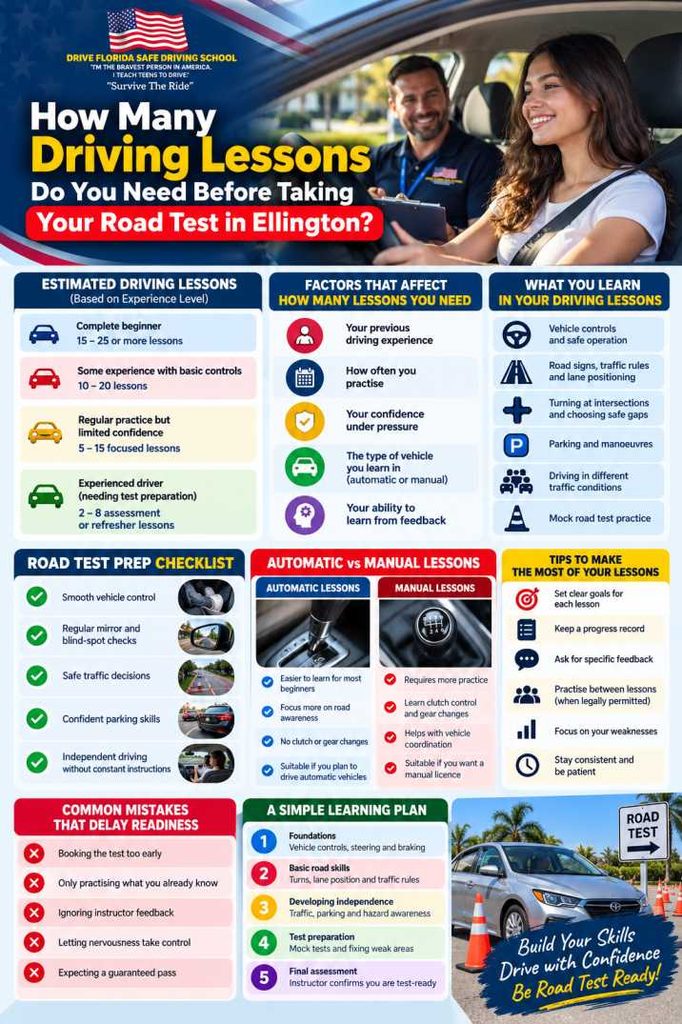
As a starting point, you can use the following estimates to plan your training. These are illustrative planning ranges, not official requirements or guarantees of passing.
| Learner experience | Possible lesson-planning range |
|---|---|
| Complete beginner | 15–25 or more lessons |
| Some experience with basic controls | 10–20 lessons |
| Regular practice but limited confidence | 5–15 focused lessons |
| Experienced driver needing test preparation | 2–8 assessment or refresher lessons |
For this table, one lesson means a professional session of approximately 45–60 minutes. Your actual needs may be higher or lower, particularly if you practise between lessons or have difficulty with specific manoeuvres.
These estimates should not be confused with Florida’s legal requirements. Depending on your age and licence status, you may need to complete specific supervised driving hours, driver education, or other steps before becoming eligible for a road test.
A qualified instructor can assess your current ability and recommend a more accurate plan after observing you drive.
Imagine two learners who have each completed ten lessons.
The first learner has practised steering, braking, junctions, lane positioning, parking, and independent driving. They can explain why they check their mirrors and demonstrate appropriate observations without being reminded.
The second learner has spent most sessions repeating familiar routes but still needs frequent instructions when approaching intersections.
Although both have completed the same number of lessons, their readiness is different.
This is why effective training focuses on measurable progress rather than simply counting sessions. Each lesson should address a skill, correct an identified weakness, and prepare you for more independent driving.
Before deciding how many lessons to book, consider the factors that influence your learning speed. Understanding these factors helps you avoid paying for unnecessary sessions while ensuring you do not rush into a road test before you are ready.
If you have never driven before, your first lessons will usually focus on fundamental skills, including:
These skills need time to become familiar. Early lessons may feel mentally demanding because you are learning to control the vehicle while paying attention to everything happening around you.
Learners with previous experience may progress more quickly, but experience alone does not guarantee readiness. Someone who has practised informally may have developed habits that need correcting.
Consistency makes a significant difference. Practising twice a week, for example, can help you retain recently learned skills more effectively than taking several lessons in one week and then stopping for a month.
When lessons are spread too far apart, you may spend part of each session repeating tasks you previously learned. Regular practice helps you build familiarity and frees up more lesson time for advanced skills.
A practical schedule for many beginners could include:
Do not practise without appropriate supervision or outside the conditions permitted by your learner’s licence.
Driving in a quiet area is different from navigating traffic while making several decisions at once.
You might steer and brake comfortably on a familiar road but struggle when approaching a busy intersection, merging into traffic, or responding to another driver’s unexpected action.
This does not necessarily mean you are a poor driver. It means you need practice managing more demanding situations.
A good instructor will gradually introduce complexity rather than placing a beginner in difficult conditions before they have developed the necessary control.
Automatic and manual vehicles require different levels of coordination.
In an automatic car, you can concentrate more quickly on road awareness because you do not need to operate a clutch or change gears manually. Manual driving adds tasks such as clutch control, gear selection, and preventing the vehicle from rolling backwards on a hill.
Your choice should depend on the vehicle you intend to drive, your licence goals, and the applicable testing requirements.
Learners progress faster when they understand why an instructor corrects a mistake.
For example, if your instructor reminds you to check your blind spot before changing lanes, simply repeating the action is useful. Understanding that mirrors do not show every vehicle is even more valuable because it helps you apply the lesson in unfamiliar situations.
After each session, ask yourself:
This simple reflection can make your next lesson more productive.
Your first few sessions should establish safe habits rather than focus on passing a test quickly. Beginners need enough time to become comfortable with the vehicle before tackling complicated traffic situations.
During your first session, an instructor will generally introduce the vehicle’s controls, seating position, safety checks, and basic operation. Depending on your readiness and the training environment, you may also practise moving off, steering, stopping, and maintaining control at low speeds.
It is normal to feel nervous. You do not need to understand everything immediately.
For example, a learner may initially turn the steering wheel too sharply when making a simple turn. With explanation and repetition, they can learn to make smoother adjustments while keeping their attention on the road.
Once you can control the vehicle reliably, lessons can introduce more complex skills, such as:
The instructor should adjust the pace to your progress. Moving forward is important, but so is revisiting a skill when you have not yet mastered it.
When evaluating Drive Florida Safe Driving School or another local provider, ask how the instructor assesses beginners, tracks progress, and decides when a learner is ready for test-focused practice.
Look for lessons that include clear feedback, realistic goals, and opportunities to practise weaker skills. A provider should be willing to explain why additional training may be useful rather than promising that a fixed number of lessons will guarantee a pass.
Completing your planned lessons does not automatically mean you are ready for the road test. Readiness should be based on what you can demonstrate consistently.
Use the following checkpoints to assess your progress.
Vehicle control
You can accelerate, brake, steer, and maintain your lane smoothly without frequent corrections.
Observation and awareness
You check mirrors, scan for hazards, and check blind spots when appropriate without needing repeated reminders.
Traffic decisions
You select safe gaps, yield when required, obey traffic controls, and respond appropriately to changing conditions.
Parking and manoeuvres
You can perform the manoeuvres required for your test safely, using appropriate observations and vehicle control.
Independent driving
You can follow directions and make routine driving decisions without depending on your instructor to tell you what to do next.
A mock test is one of the most useful ways to evaluate your readiness. Ask your instructor to simulate the testing conditions as closely as practical, including giving directions without providing routine coaching.
The instructor can then explain which errors would need attention and whether you are ready for the next step.
For example, you might drive well throughout the session but repeatedly forget to check for pedestrians before turning. That is a specific, correctable weakness. Several targeted lessons may help you address it more effectively than repeating an entire familiar route.
A mock test should identify gaps, not simply reassure you that you are doing well.
Do not prepare exclusively on roads you already know. Familiar routes can make driving feel easier because you anticipate every turn and junction.
Your preparation should include a reasonable variety of legal, supervised driving situations, such as quieter streets, busier intersections, changing speed limits, and different traffic patterns.
The objective is to develop transferable skills that work on unfamiliar roads, not to memorise a route.
The best way to estimate your training needs is to divide your learning into stages. This makes progress easier to track and helps you identify when additional lessons are genuinely useful.
Here is an example of how a beginner’s training plan might look.
| Learning stage | Main focus | Signs of progress |
|---|---|---|
| Stage 1: Foundations | Controls, steering, braking, and starting | You control the car safely at low speeds |
| Stage 2: Basic road skills | Turns, lane position, signs, and intersections | You follow road rules with fewer reminders |
| Stage 3: Developing independence | Traffic, parking, hazard awareness, and judgement | You make routine decisions independently |
| Stage 4: Test preparation | Mock tests and correction of weak areas | You drive consistently without coaching |
| Stage 5: Final assessment | Remaining weaknesses and test requirements | Your instructor considers your performance test-ready |
The duration of each stage depends on your progress. One learner might need several sessions to become comfortable with intersections, while another may need additional time to improve parking or observation habits.
Consider a learner who has never driven before and wants to take a road test in approximately two months.
They begin with two lessons each week. During the first two weeks, the focus is on basic vehicle control and road awareness. In the following weeks, they practise intersections, lane changes, parking, and more independent driving.
During the final weeks, their instructor conducts mock assessments and identifies any remaining weaknesses.
This is a planning example, not a promise that eight weeks or a particular number of lessons will be enough. If the learner still makes serious observation errors, postponing the test may be the safer decision.
A useful rule: Set your target date around your demonstrated ability, not the other way around.
Manual lessons can require additional practice because you must coordinate the clutch, accelerator, brakes, and gear changes while observing the road.
Beginners may initially struggle with stalling, selecting the wrong gear, or moving away smoothly on an incline. These difficulties are common during the early stages of learning.
With consistent practice, the actions become more familiar, allowing you to devote more attention to traffic and hazards.
Focus on mastering one skill at a time:
Do not measure your progress against someone learning in an automatic vehicle. The vehicles demand different skills, and your training should reflect the licence you want and the vehicle you intend to drive.
Before booking a test, also confirm that the vehicle you use meets the testing requirements and that the test will result in the type of licence you need.
When comparing driving classes in Ellington, look beyond the advertised lesson price. A useful lesson should have a clear purpose and leave you knowing what to improve.
Ask your instructor to identify the main skills you will practise. For example, a lesson might focus on safe lane changes and mirror checks rather than attempting to cover every possible driving situation.
This approach makes it easier to notice progress and understand where you need more help.
After every lesson, record:
Over several weeks, this record can reveal whether you are improving consistently or repeating the same mistakes.
Instead of asking, “Was my driving good?”, ask questions such as:
Specific feedback gives you something measurable to work on.
Supervised practice can reinforce what you learn during professional instruction. However, it should be legal, safe, and appropriate for your current ability.
If a family member or other permitted supervisor helps you practise, explain what you worked on with your instructor. Consistent guidance can help you avoid developing conflicting habits.
Some learners need more lessons not because they cannot operate a vehicle, but because small mistakes continue to appear in different situations.
Feeling comfortable on familiar roads does not necessarily mean you are ready for independent driving under assessment conditions.
Book when you can demonstrate the required skills consistently, not simply when you have completed a particular number of sessions.
Repeating easy manoeuvres can build confidence, but it will not correct weaknesses you avoid.
If parking is difficult, dedicate practice time to parking. If you hesitate at intersections, work on observation, right-of-way rules, and safe gap selection with your instructor.
A learner may repeatedly make the same mistake because they forget the correction after leaving the vehicle.
Writing down the feedback and reviewing it before the next lesson can help you recognise the issue sooner.
Some nervousness before a road test is normal. The important question is whether anxiety interferes with safe driving.
If nerves cause you to rush, overlook signs, or forget observations, targeted practice and mock tests may help. If you can drive safely and consistently despite feeling nervous, you may be closer to readiness than you think.
No responsible instructor can guarantee a road test result. Traffic conditions, assessment performance, and individual decisions all matter.
A good training programme prepares you to manage these factors rather than promising an outcome that cannot be controlled.
A few practical habits can make your preparation more effective and help you become a safer driver beyond the test itself.
1. Learn to anticipate hazards. Do not focus only on the vehicle immediately ahead. Scan the road, watch for pedestrians, and notice potential hazards early enough to respond safely.
2. Develop consistent observation habits. Mirror checks, blind-spot checks, and looking for pedestrians should become part of your normal driving routine, rather than actions you remember only when an instructor prompts you.
3. Understand the reason behind road rules. Knowing why you must yield, maintain a safe following distance, or adjust your speed makes it easier to apply the rules in unfamiliar situations.
4. Do not rush manoeuvres. Safe positioning, observation, and vehicle control are more important than completing a manoeuvre quickly. If you need to correct your position, do so safely and according to the applicable rules.
5. Protect your concentration. Get adequate rest before lessons and your test. If you are tired, distracted, or unusually anxious, your decision-making may suffer.
6. Confirm the official requirements. If you are testing in Florida, check the latest eligibility, documentation, driver education, supervised practice, and vehicle requirements with the Florida Department of Highway Safety and Motor Vehicles. Requirements can differ according to age and licence status.
There is no universal answer to how many driving lessons you need before taking your road test in Ellington. Your experience, practice frequency, confidence, and ability to drive independently all influence the answer.
Start with a realistic training plan, work on your weaknesses, and review your progress after every session. Use mock tests to identify gaps and make sure you understand the official testing requirements before scheduling your assessment.
If you are comparing a driving school in Ellington, look for an instructor who prioritises safe driving habits, provides clear feedback, and helps you recognise when you are genuinely ready.
With consistent practice and a structured approach, you can prepare for your road test while developing the judgement and confidence needed for everyday driving.
A complete beginner might use 15–25 or more professional lessons as an initial planning estimate, assuming sessions last around 45–60 minutes. However, this is not an official standard or a guarantee of readiness. Some learners need fewer lessons, while others require substantially more practice. Your instructor should assess your vehicle control, observation, road awareness, manoeuvres, and independent decision-making before recommending a test date.
It is possible for someone with previous experience to need only a few refresher lessons, but five lessons may not be enough for a complete beginner. You need to demonstrate safe driving consistently, not simply become familiar with the vehicle. Ask your instructor for an honest assessment and a mock test. If you still need frequent prompts or make important observation errors, further practice is advisable.
For many learners, one or two lessons per week provides a useful balance between practice and time to reflect on feedback. More frequent lessons may work well if you have the time, energy, and budget to benefit from them. However, daily lessons are not automatically better if you become tired or struggle to absorb feedback. Consistency, lesson quality, and appropriate practice between sessions matter more than following a rigid schedule.
You may need additional lessons if you regularly forget mirror checks, struggle to maintain lane position, misjudge gaps, overlook road signs, or rely on your instructor for routine decisions. Another useful indicator is whether you can complete a mock test safely without coaching. If your mistakes are becoming less frequent and you can correct minor errors independently, you may be progressing well. Your instructor can help determine which weaknesses need attention before you book.
Drive Florida Safe Driving School is a provider to consider when looking for structured driving instruction. Before enrolling, ask whether the instructor offers an initial skills assessment, progress feedback, targeted practice, and mock road tests. These features can help you understand your current ability and plan your remaining lessons. Discuss your experience, test timeline, and specific concerns so that your training plan reflects your needs rather than relying on a fixed package.
En Drive Florida Safe Driving School, estamos dedicados a ayudar a nuestros estudiantes novatos a convertirse en los conductores más seguros. Siempre nos esforzamos para que usted o su ser querido reciban las técnicas, los conocimientos y las normas de manejo defensivo más actualizados.




 Spanish
 English

