
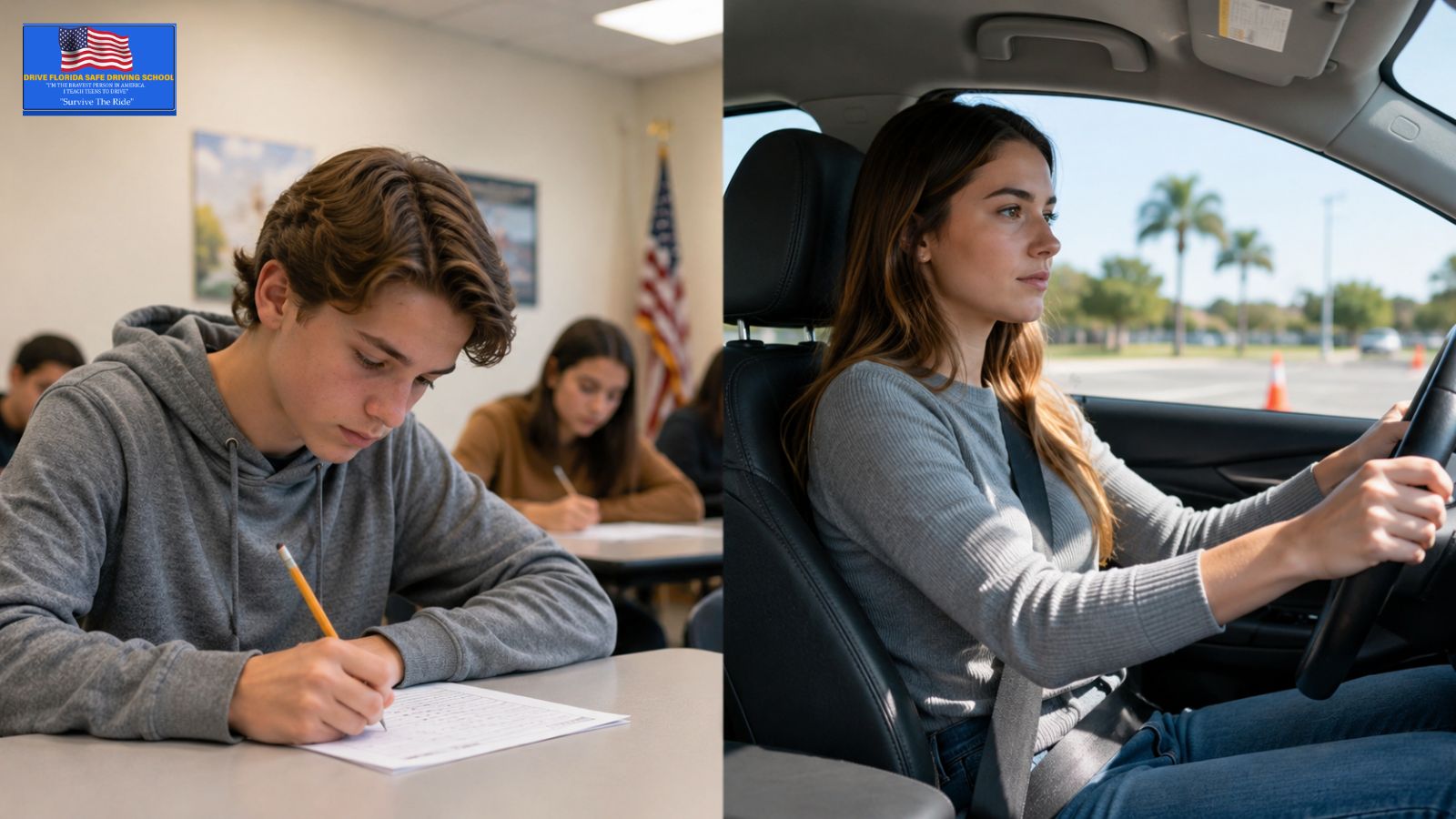
Getting behind the wheel in Florida involves more than learning how to operate a vehicle. New drivers need to understand the difference between the knowledge exam required for a learner’s license and the testing involved in obtaining full driving privileges. The Florida learner’s permit test vs driver’s license test distinction is particularly important because the two stages assess different aspects of driving readiness. Knowing what each test covers, when it applies and how preparation changes can help first-time drivers approach the process with greater confidence.
Florida’s licensing system is designed to introduce new drivers to traffic laws and responsible driving progressively. For many first-time drivers, the process starts with a learner’s licence, followed by supervised practice and eventually the requirements for a regular Class E driver licence.
According to the Florida Department of Highway Safety and Motor Vehicles (FLHSMV), applicants seeking a learner’s licence must generally be at least 15 years old, complete the required Traffic Law and Substance Abuse Education (TLSAE) course, provide appropriate identification and pass the vision and Class E Knowledge exams.
The full license stage adds another important component: the Driving Skills Test. Original Florida driver license applicants are generally required to complete vision screening, the Class E Knowledge Exam and the Driving Skills Test unless an applicable exemption applies.
That difference is the foundation for understanding the Florida learner’s permit test vs driver’s license test.
The learner’s licence knowledge examination is primarily designed to determine whether a new driver understands Florida traffic laws, road signs and fundamental safe-driving principles before beginning supervised driving.
It is not a practical demonstration of whether you can control a car on the road. Instead, it tests the knowledge you are expected to have before you start developing real-world driving skills.
Preparation should cover areas such as:
A common mistake is to treat the knowledge exam like a memory exercise. In practice, understanding why a particular rule exists is more useful than memorising isolated answers. When a question describes a complicated intersection or traffic situation, understanding right-of-way principles gives you a much stronger foundation for selecting the correct response.
The Florida Driver License Handbook is an important starting point because it reflects the rules and information used by the state licensing system. Third-party practice tests can be useful for familiarising yourself with question formats, but they should supplement—not replace—official material.
The FLHSMV handbook also explains that the Class E Knowledge Exam is available through approved third-party providers, and students under 18 may take the knowledge exam online through an approved provider.
That means prospective drivers should verify that any online testing option they choose is actually authorised rather than assuming that every website advertising a Florida permit test provides an official examination.
A driving school can provide something that online studying cannot: supervised practical experience in a vehicle. Reading about defensive driving is useful, but applying that knowledge while approaching an intersection, changing lanes or judging following distance requires repetition.
Professional instruction can be particularly valuable for nervous first-time drivers or students who have limited access to a suitable practice vehicle. A structured lesson can also reveal habits that are difficult to identify when practising with family members.
For example, a learner may believe they are checking mirrors correctly but fail to establish a consistent scanning routine. An experienced instructor can observe the behaviour and correct it immediately. That type of feedback can make practical preparation more efficient.
Qualified driving instructors should focus on more than simply helping a student get through an examination. Strong instruction develops habits that remain useful after the test.
Important skills include:
The goal should be competent, predictable driving rather than simply learning an examination route.
The biggest distinction between the learner knowledge stage and the full licence stage is the practical assessment of driving ability.
A person can understand every traffic rule in a handbook and still struggle to apply those rules behind the wheel. The Driving Skills Test addresses this gap by evaluating practical vehicle operation and driving behaviour.
The FLHSMV identifies the Driving Skills Test as one of the examinations associated with an original Florida driver licence. The department also permits approved third-party providers to administer testing under its requirements.
The exact experience can vary according to the authorised testing provider and circumstances, but applicants should be prepared to demonstrate fundamental vehicle-control and traffic-management skills.
A student may need to demonstrate appropriate control while:
The important point is that the practical examination is not simply another version of the written test. It evaluates whether knowledge has become safe, repeatable driving behaviour.
The most effective preparation normally treats the two stages as connected rather than completely separate.
Consider a teenager who has successfully studied road signs and right-of-way rules. They may know that they must yield in a particular situation. However, when approaching the actual intersection, they still need to identify the sign, scan for traffic, adjust speed and make the decision safely.
This is where classroom-style preparation and professional vehicle instruction complement each other.
A florida driving school can help bridge the gap between knowing a rule and applying it. The strongest preparation combines handbook study, realistic practice questions, supervised driving and professional feedback where appropriate.
The term florida driver improvement course can sometimes cause confusion because driver education and driver improvement are not necessarily the same thing.
A driver improvement course is generally associated with improving an existing driver’s knowledge or addressing certain traffic-related requirements. It should not automatically be treated as a substitute for the requirements involved in obtaining a first Florida learner’s or driver license.
Similarly, searching for a 4 hour basic driver improvement course online does not mean you have found a replacement for the learner’s license knowledge exam or the practical Driving Skills Test. Course requirements and eligibility can depend on the driver’s circumstances and the specific course approved for the intended purpose.
Before enrolling, confirm what the course is designed to satisfy and whether it applies to your particular situation. This simple check can prevent a common problem: completing a course that is legitimate but does not fulfil the requirement you actually need.
The quality of instruction can significantly influence how efficiently a learner develops safe habits. Driving instructor training Florida programmes and professional standards exist because teaching someone to drive involves more than sitting in the passenger seat and giving directions.
An effective instructor needs to understand risk recognition, instructional techniques, vehicle control, communication and assessment. They also need to know how to adapt instruction to different learners.
For students, this means it is reasonable to ask how an instructor is qualified and what the lesson structure looks like. A good lesson should have clear objectives rather than simply involve driving around for an hour without targeted feedback.
One of the most useful indicators of effective instruction is specific feedback. Instead of simply saying, “That was wrong,” an instructor should be able to explain what happened, why it created risk and what the learner should do differently next time.
For example, if a student changes lanes without adequate observation, useful instruction might focus on the sequence of mirror checks, signalling, blind-spot observation and lane positioning. That creates a repeatable process instead of simply correcting one mistake.
Several misunderstandings can make the licensing process more stressful than necessary.
Passing the knowledge exam does not mean a new driver immediately has unrestricted driving privileges. A learner’s licence comes with conditions, and younger drivers have additional requirements and restrictions.
For applicants under 18, FLHSMV states that the learner must generally hold the learner’s licence for 12 months or until turning 18, whichever comes first, and meet additional requirements before progressing to a driver licence. A parent, guardian or responsible adult aged 21 or older must also certify at least 50 hours of driving experience, including 10 hours at night, under the stated requirements.
Practical testing should be approached seriously. Vehicle control, observation and compliance with traffic rules need to become consistent habits before test day.
Trying to memorise a particular route without developing broader driving skills can leave a learner unprepared when traffic conditions change.
This is another important distinction. An online course, a knowledge examination and a driver improvement programme can serve different purposes. Always identify the exact requirement before paying for a course or test.
Preparation works best when it is structured over time rather than concentrated into one long study session.
Start with the official Florida Driver License Handbook. Make notes about rules you find difficult, especially right-of-way, signs, speed regulations and situations involving vulnerable road users.
Then use practice questions to identify weak areas. If you repeatedly miss questions about one subject, return to the underlying rule instead of memorising the answer.
Once supervised practice begins, focus on consistency. A learner should develop predictable routines for mirror checks, signalling, positioning, speed control and intersection scanning.
Professional driving instructors can be especially helpful when a learner has developed habits that family members may not notice or know how to correct.
Driving practice should not always happen on quiet residential streets. As competence improves, learners should gain experience with different road environments while remaining within the conditions of their learner’s licence.
That can include busier intersections, multi-lane roads, parking areas and unfamiliar routes. The objective is to build adaptable decision-making rather than route memorisation.
The best way to approach the Florida learner’s permit test vs driver’s license test is to recognise that both are stages in the same learning process.
The knowledge test asks, in effect, “Do you understand the rules?” The practical assessment asks, “Can you apply those rules safely while controlling a vehicle?”
Those are different abilities, and both matter.
A learner who studies only to pass may remember enough information to get through an examination but still lack confidence when faced with real traffic. Conversely, someone who practice extensively without learning Florida’s rules may develop habits that are unsafe or legally incorrect.
Understanding the Florida learner’s permit test vs driver’s license test makes the licensing journey much easier to navigate. The learner stage focuses heavily on traffic-law knowledge and establishing a foundation for supervised practice, while the full license process adds practical assessment of driving ability. Preparing for both stages with the right balance of study, supervised experience and professional guidance can help new drivers become safer and more confident on Florida roads.
For learners who want structured preparation, Drive Florida can be considered alongside other educational resources when comparing options for learning and practising. The priority should always remain the same: understand Florida’s requirements, develop genuine driving skills and approach the licensing process as preparation for responsible driving—not simply as a test to pass.
No. The learner stage includes the Class E Knowledge Exam and vision screening, while obtaining an original driver licence generally also requires the Driving Skills Test. The knowledge examination evaluates understanding of traffic laws and safe-driving information, whereas the practical test evaluates driving ability. FLHSMV identifies these as separate components of the licensing process.
Some applicants can use approved third-party providers for the Class E Knowledge Exam. FLHSMV states that students under 18 may take the knowledge exam online through an approved provider. However, applicants should verify the provider’s authorisation and confirm that the testing arrangement applies to their circumstances before registering.
A driving school is not universally required simply because someone wants to obtain a Florida driver licence. However, professional training can be valuable for developing practical skills, particularly for first-time drivers. The official requirements should always be checked against the applicant’s age, previous licensing history and individual circumstances.
Not necessarily. A 4 hour basic driver improvement course online may serve a specific traffic-related or driver-improvement purpose and should not automatically be assumed to satisfy the requirements for obtaining a learner’s licence. Before enrolling, check the course’s approved purpose and whether it applies to your situation.
Start with the official FLHSMV handbook, learn the underlying traffic rules and use practice questions to identify weak areas. Then build practical experience through supervised driving and, where useful, professional lessons. The goal should be to develop safe, repeatable driving habits rather than simply memorising answers or an examination route.
En Drive Florida Safe Driving School, estamos dedicados a ayudar a nuestros estudiantes novatos a convertirse en los conductores más seguros. Siempre nos esforzamos para que usted o su ser querido reciban las técnicas, los conocimientos y las normas de manejo defensivo más actualizados.



 Spanish
  English
