

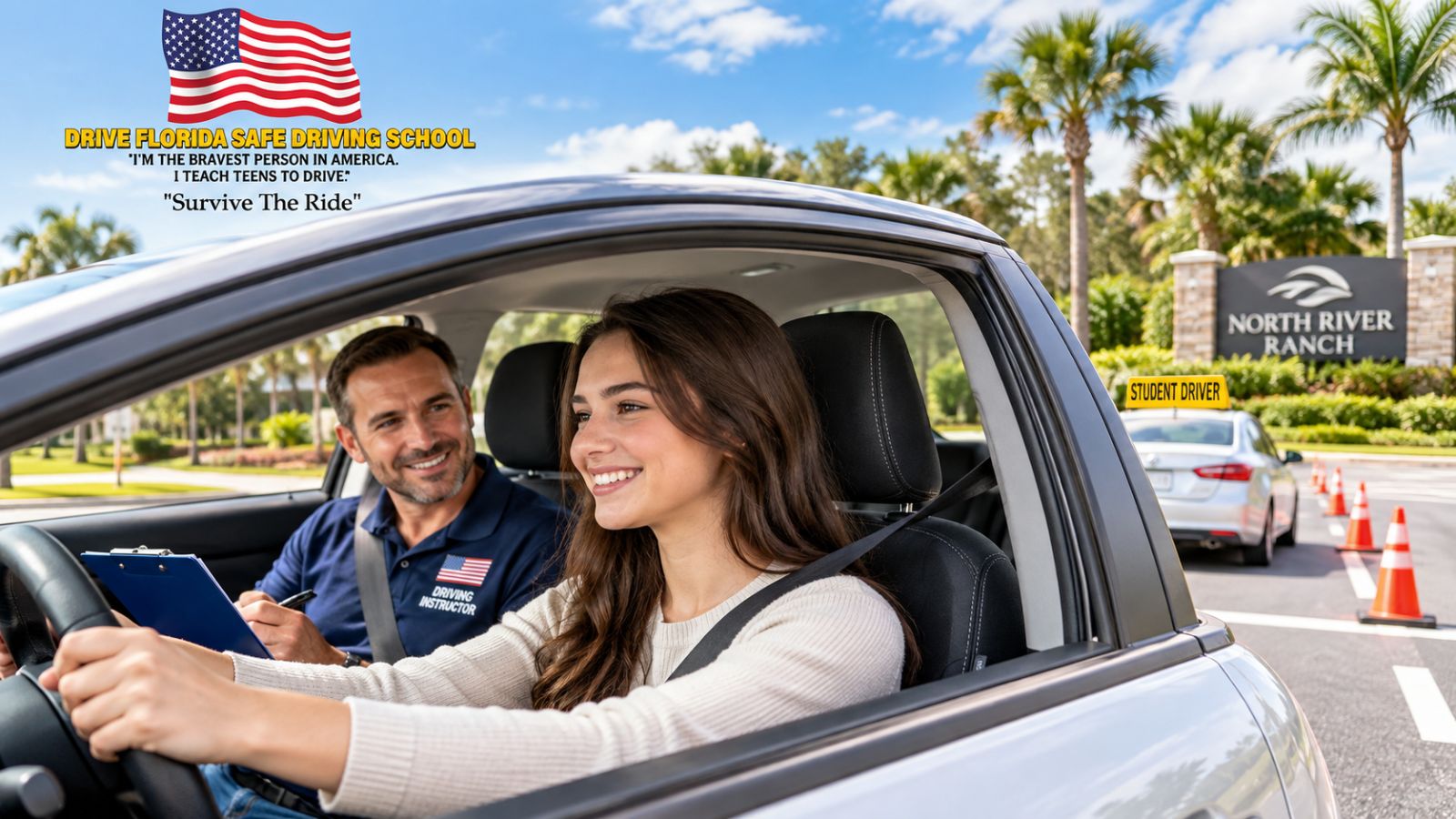
Passing a driving test is about more than remembering road rules. You need to demonstrate that you can control the vehicle, observe traffic, make safe decisions and respond calmly when conditions change. For learners preparing with a Driving School in North River Ranch, structured practice can make the process much less intimidating. The goal should not be to memorise a test route, but to develop repeatable driving habits that continue to work when you are driving independently.
Before preparing for a test, it helps to understand what a driving skills examination is designed to measure. Florida’s Class E driving skills examination assesses an applicant’s ability to operate a motor vehicle, and approved examination routes are used for the practical assessment.
That means preparation should focus on genuine driving ability rather than trying to predict exactly what an examiner will ask you to do. You should be comfortable controlling the car, checking your surroundings, obeying traffic controls, communicating your intentions and making appropriate decisions. Confidence develops naturally when these behaviours become consistent rather than something you consciously remember only because a test is approaching.
Florida’s current driver handbook states that applicants seeking a Class E driver licence must meet eligibility requirements and pass the applicable vision, knowledge and driving skills examinations. For applicants under 18, additional requirements include holding a learner’s licence for the required period and meeting supervised driving experience conditions. The handbook also states that a parent, guardian or responsible adult must certify at least 50 hours of driving experience, including 10 hours at night, for qualifying minors.
Requirements can change, so learners should verify their personal eligibility and current documentation requirements with the Florida Department of Highway Safety and Motor Vehicles before test day. Good driving preparation is important, but it should be accompanied by checking the administrative requirements so you do not arrive prepared to drive but missing something needed for the examination.
Many new drivers make the mistake of thinking confidence should come first. In practice, confidence usually follows competence. When you have repeatedly practised steering, braking, turning, lane positioning, observation and parking in different situations, you have fewer reasons to panic when something unexpected happens.
A structured Beginner Driver Training North River Ranch programme can help break these skills into manageable stages. A learner might initially concentrate on vehicle control in a quiet environment before progressing to intersections, multi-lane roads, busier traffic and more complicated decision-making. This gradual progression gives the brain time to turn individual techniques into automatic habits.
Good behind-the-wheel training should prepare you for situations you will encounter after obtaining your licence, not simply help you reproduce a particular route. An instructor can observe details that learners frequently overlook, such as late mirror checks, inconsistent following distances, positioning too close to a kerb or failing to scan sufficiently far ahead.
For example, imagine a learner approaching a busy intersection. They may know that they need to stop for a red light, but competent driving involves much more than stopping. They should identify the signal early, check surrounding traffic, position the vehicle correctly, maintain appropriate speed and remain alert for pedestrians, cyclists and other road users. These layers of observation are what practical training should develop.
Repeating a skill under different conditions is more useful than performing it perfectly once. A learner who can execute a turn on an empty street may still struggle when traffic is waiting behind them. Similarly, someone who can park successfully in a quiet car park may need more practice when there are other vehicles nearby.
Use repetition to build consistency. Practise the same manoeuvre from different approaches, at different times and in varying traffic conditions. The objective is to make the correct response familiar enough that you can perform it without becoming overwhelmed by the pressure of the test.
Effective Road Test Preparation North River Ranch should cover the practical behaviours that demonstrate safe vehicle operation. Instead of spending every lesson repeating one manoeuvre, create a balanced practice routine that includes ordinary driving and specific skills.
Steering control, braking, acceleration, lane changes, turns, intersections, parking, observation and traffic awareness should all become part of normal driving. Your instructor can identify which areas require more attention and gradually introduce more demanding conditions. This approach also makes preparation more useful beyond the examination because you are learning how to manage real traffic rather than simply completing a checklist.
Observation is one of the easiest areas to underestimate. A learner may physically look at a mirror but fail to gather useful information from it. Effective observation involves checking mirrors regularly, scanning the road ahead, noticing hazards and understanding what other road users may do next.
Develop a consistent observation routine without turning it into a rigid sequence that distracts you. Before changing direction or position, make sure you understand what is around the vehicle. Look for vehicles in blind spots, pedestrians near crossings, cyclists, parked cars and changing traffic conditions. An examiner needs to see that your decisions are based on what is happening around you.
Communication is another important part of safe driving. Use indicators appropriately and give other road users enough time to understand what you intend to do. Avoid treating an indicator as a substitute for checking the road. Signalling tells others what you intend; observation tells you whether the manoeuvre is safe.
This distinction becomes especially important during lane changes and turns. A learner should not simply indicate and move. They should assess the surrounding traffic, establish an appropriate gap and make the manoeuvre smoothly. Practising this sequence repeatedly helps reduce rushed decisions when the test environment becomes more demanding.
A learner’s final practice sessions should not consist entirely of quiet streets. Real driving involves changing traffic conditions, different road layouts, pedestrians, cyclists, parked vehicles and drivers who do not always behave predictably. Beginner Driver Training North River Ranch should therefore progress from simple environments to situations that require more active observation and decision-making.
A useful exercise is to ask yourself what you would do before you actually need to do it. If a vehicle ahead begins slowing, identify the reason before you are forced to brake sharply. If you approach a congested intersection, look beyond the nearest vehicle to understand what is happening further ahead. This forward planning makes driving smoother and reduces last-second reactions.
Parking often causes unnecessary anxiety because learners focus too heavily on getting the vehicle into the space immediately. Instead, slow the process down and concentrate on observation, positioning and controlled steering.
Practise different parking situations rather than relying on one familiar space. Understand how the vehicle moves as you turn the wheel and how its position changes relative to surrounding vehicles. If you make a mistake during practice, stop, reassess and correct it safely. Learning how to recover from a small positioning error is more valuable than believing every parking manoeuvre must be perfect on the first attempt.
Working with a Private Driving Instructor North River Ranch can provide another useful layer of preparation because personalised feedback can identify habits that are difficult to notice yourself. A learner might feel that their lane changes are smooth while an instructor notices that the mirror check occurs too late. Another driver may brake safely but consistently approach intersections too quickly.
The important part is what you do with that feedback. Do not simply try to remember an instructor’s comments for the next lesson. Turn each correction into a repeatable behaviour. If observation is the problem, practise deliberate scanning during ordinary driving. If speed control is inconsistent, work on reading the road earlier so braking becomes gradual rather than sudden.
One common mistake is concentrating so intensely on the examiner that the learner stops driving naturally. The examiner is there to assess driving ability, not to become the centre of the driver’s attention. Continue scanning the road, checking mirrors and making decisions based on the traffic environment.
Another problem is rushing because the learner believes hesitation automatically means failure. Safe decision-making sometimes requires waiting for a suitable gap. A cautious, well-observed decision is generally preferable to forcing a manoeuvre simply because you are worried about appearing slow. Good preparation teaches you to distinguish appropriate caution from unnecessary hesitation.
Route memorisation can create false confidence. If you only know where a particular turn occurs, an unfamiliar road can suddenly feel much harder. Instead, learn how to recognise signs, road markings, intersections and changing traffic conditions.
This approach is particularly valuable because practical driving assessments are designed to evaluate driving skills rather than simply a learner’s ability to recite a sequence of turns. Florida’s official materials describe the Class E driving skills examination as an assessment of the applicant’s ability to operate a motor vehicle, reinforcing the importance of developing transferable driving skills.
The final week before a driving test should focus on consistency rather than trying to learn everything from scratch. Identify the two or three skills that still require the most attention and practise them deliberately. At the same time, maintain ordinary driving practice so that your broader skills remain comfortable.
A useful final lesson can resemble normal driving rather than a constant series of corrections. Drive through varied road environments, practise parking and lane changes, manage intersections and allow the instructor to observe how you respond without excessive prompting. If you can complete these activities while maintaining observation and control, you are building the type of confidence that is more useful than simply feeling excited about the test.
Arrive with enough time to avoid starting the examination already stressed. Make sure the vehicle you intend to use is appropriate and that any required documents or arrangements have been checked beforehand. Florida’s official materials specify requirements surrounding Class E examinations, including verification of a valid Florida learner’s licence for applicants taking the driving skills examination through approved driver education arrangements.
Once the test begins, focus on one situation at a time. You do not need to predict what will happen several minutes from now. Observe the road, follow the applicable rules and make deliberate decisions. If you make a small mistake, do not assume the entire examination is lost. Continue driving safely and respond appropriately to the next situation.
Real confidence behind the wheel comes from knowing that you can manage ordinary problems without immediately becoming overwhelmed. During practice, deliberately expose yourself to manageable challenges. Drive in moderate traffic, practise unfamiliar roads, handle different intersections and work on parking in realistic environments.
At the same time, avoid turning every practice session into a test. Learners need opportunities to make mistakes safely, ask questions and understand why something went wrong. An instructor’s correction is most useful when the learner understands the reason behind it. Knowing why a particular action is safer helps the skill remain useful after the examination is finished.
Preparing for a driving test is ultimately about developing safe habits that remain useful after you receive your licence. A quality Driving School in North River Ranch approach should combine practical experience, structured feedback and realistic road situations rather than focusing exclusively on memorising manoeuvres. Consistent observation, controlled vehicle handling, appropriate speed, clear communication and calm decision-making are the foundations of confident driving.
For learners looking for professional instruction, Drive Florida Safe Driving School can be considered as part of the process of comparing local training options. Drive Florida Safe Driving School can provide a starting point for discussing lesson structure, practical skill development and preparation needs, while learners should choose instruction based on their experience level, goals and the type of support they need.
When comparing training providers, ask about instructor qualifications, lesson structure, vehicle arrangements, practice environments and how progress is assessed. Drive Florida Safe Driving School may be one option to evaluate alongside other suitable providers, with the final decision based on practical requirements and the learner’s individual preparation needs rather than promotional claims alone.
There is no universal number because learners begin with different levels of experience and develop skills at different speeds. Someone who has regularly practised with a qualified supervising driver may need a different amount of professional instruction from someone who has very little road experience. Focus on whether you can consistently control the vehicle, observe traffic, complete manoeuvres and make safe decisions without frequent instructor intervention.
Prioritise the skills that demonstrate safe, controlled driving rather than concentrating on one specific manoeuvre. Practise observation, mirror use, turns, lane changes, speed control, stopping, parking, intersections and responding to traffic. You should also practise in different environments so you can transfer your skills to unfamiliar roads. The purpose of preparation is to build reliable habits that remain effective when conditions change.
Yes, structured instruction can help because it gives learners repeated opportunities to practise skills and receive specific feedback. Confidence tends to improve when a learner understands what to do and has successfully repeated the behaviour in different situations. The goal should not be to eliminate every feeling of nervousness. Instead, preparation should make you capable of continuing to drive safely even when you feel some test-day pressure.
It is useful to become familiar with the types of roads and traffic environments in the area, but relying on memorisation is not a strong preparation strategy. A learner should be able to respond to signs, markings, intersections and traffic conditions even when the route changes. Florida’s examination system uses approved routes for Class E driving skills examinations, but the underlying purpose remains assessing driving ability rather than simple route recall.
Do not automatically assume that one mistake means you have failed. Continue paying attention and make the safest decision for the situation in front of you. Panicking after a minor error can create additional problems because your attention shifts away from the road. Take a moment to regain focus, continue observing properly and follow the examiner’s instructions. Your preparation should help you recover calmly rather than allowing one imperfect moment to affect the rest of your driving.
En Drive Florida Safe Driving School, estamos dedicados a ayudar a nuestros estudiantes novatos a convertirse en los conductores más seguros. Siempre nos esforzamos para que usted o su ser querido reciban las técnicas, los conocimientos y las normas de manejo defensivo más actualizados.




 Spanish
  English
