

Becoming a professional driving instructor in Florida can be a rewarding career for someone who enjoys teaching, understands road safety, and wants to help new drivers become confident behind the wheel. But being a good driver and being a good instructor are not the same thing.
A professional instructor must know how to explain driving concepts clearly, recognize unsafe habits, manage nervous students, demonstrate defensive-driving techniques, and follow Florida’s regulatory requirements. Most importantly, instructors work with people who may have very little experience behind the wheel, so patience and consistency matter just as much as technical driving ability.
If you are researching driving instructor training in florida, one of the first things to understand is that Florida requires professional driver-training instructors to obtain an instructor certificate before providing compensated instruction. Florida Statutes also specify testing and qualification requirements for instructor applicants.
This guide explains the training pathway, certification basics, skills you need, and what the career can look like in practice.
Driving Instructor Training prepares experienced drivers to teach other people how to operate a vehicle safely and responsibly.
The training is about much more than demonstrating how to turn, park, change lanes, or merge. A professional instructor needs to understand how to teach those skills.
For example, imagine a student who repeatedly checks the rearview mirror but forgets to check blind spots before changing lanes. Simply telling the student, “Check your blind spot,” may not solve the problem.
An effective instructor might:
That difference between knowing how to drive and knowing how to teach driving is at the heart of instructor training.
Florida law requires a person acting as a professional driver-training school instructor for compensation to hold an instructor’s certificate issued by the Florida Department of Highway Safety and Motor Vehicles (FLHSMV). The statute also requires applicants to complete eye, written, and road testing and provide evidence of their qualifications and ability as an instructor.
Before enrolling in a training program, prospective instructors should understand that certification is regulated at the state level.
Florida Statutes Chapter 488 governs commercial driving schools and their instructors. Under the current 2026 statute, professional instructors cannot receive compensation for driving instruction without the required instructor certificate.
The instructor certificate is issued by FLHSMV. The current statute establishes:
The certificate is also tied to the driver school or schools listed on the certificate, rather than functioning as an unrestricted authorization to teach anywhere.
This is an important distinction for people researching driving instructor training florida: completing a course by itself should not be assumed to be the same thing as obtaining the state-required instructor certificate.
Because administrative requirements can change, applicants should verify the current application process and documentation requirements directly with FLHSMV before submitting an application.
A typical career path starts with becoming a strong, responsible driver and then developing the instructional skills needed to work with learners.
Before teaching others, you need to be comfortable handling ordinary and challenging traffic situations yourself.
A future instructor should be able to confidently demonstrate:
The goal isn’t to drive aggressively or impress students. It is to demonstrate predictable, legal, defensive driving.
The next step is understanding the certification process and requirements that apply to professional instructors.
Do not rely solely on information from old blog posts, social media groups, or outdated course advertisements. Florida’s current statute and administrative requirements should be checked before beginning the certification process. Chapter 488 remains the key statutory framework for commercial driver schools and instructors.
A quality Driving Instructor Training program should teach more than basic vehicle operation.
It should help an instructor develop skills such as:
Florida law specifically identifies eye, written, and road testing as part of the instructor certification process. Applicants must also furnish proof of their qualifications and ability to instruct.
This means preparation should cover both driving competence and teaching competence.
Once properly certified and associated with an eligible driving school, an instructor can begin building practical teaching experience.
This is where classroom knowledge becomes real-world instructional ability.
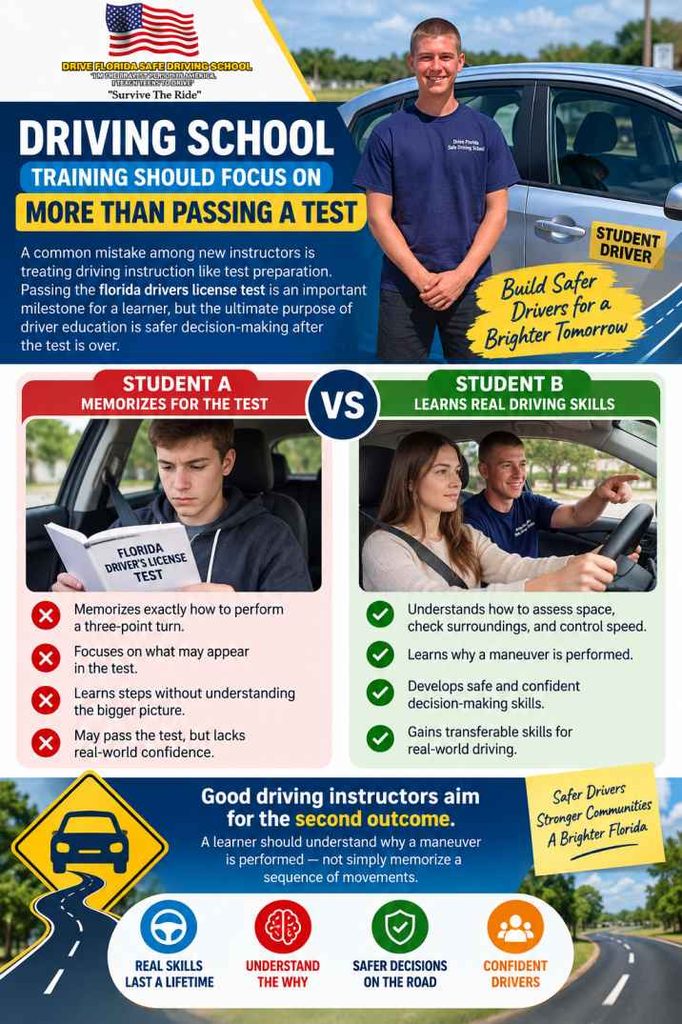
A common mistake among new instructors is treating driving instruction like test preparation.
Passing the florida drivers license test is an important milestone for a learner, but the ultimate purpose of driver education is safer decision-making after the test is over.
Consider two students.
Student A memorizes exactly how to perform a three-point turn because they know it may appear during testing.
Student B understands how to assess space, check surroundings, control speed, and complete the maneuver safely.
Student B has learned a transferable driving skill.
Good driving instructors aim for the second outcome.
A learner should understand why a maneuver is performed—not simply memorize a sequence of movements.
Technical driving knowledge is essential, but teaching ability determines how effectively students learn.
For example:
An instructor needs to give instructions that are short, clear, and timely.
“At the next intersection, prepare to turn right.”
is usually more useful than giving five instructions at once.
Too much information can overwhelm a beginner, particularly in busy traffic.
Students make mistakes. Some repeat the same mistake several times.
An instructor’s response matters.
Constant criticism can make a nervous learner even less confident. Calm correction creates a better learning environment.
An instructor should continuously monitor:
Good observation allows the instructor to correct a problem before it becomes dangerous.
Not every student learns at the same speed.
One learner may understand a maneuver after two demonstrations. Another may need several sessions.
Effective instructors adjust their explanations and exercises instead of using exactly the same lesson for everyone.
One of the most important parts of instructor development is learning how to structure practical florida driving lessons.
A useful lesson often follows a progression:
Tell the learner what they are going to practice and why it matters.
Show the correct technique while explaining the relevant safety checks.
Allow the student to perform the task while the instructor observes.
Identify errors and provide specific guidance.
Give the learner another opportunity to apply the correction.
Determine whether the student can perform the skill consistently rather than successfully completing it once.
This approach is particularly useful for skills such as:
A strong driver safety course mindset helps instructors teach beyond basic vehicle control.
Defensive driving focuses on anticipating hazards rather than reacting to them at the last possible moment.
For example, an instructor might teach a student to recognize:
The objective is to help learners develop a habit of asking:
“What could happen next?”
That question can influence safer decisions throughout a driver’s lifetime.
The terms can sometimes be confusing.
A florida driver improvement course generally serves drivers who need or want additional driver education, depending on the specific course and circumstance.
Instructor training has a different purpose.
| Driver Improvement Course | Instructor Training |
|---|---|
| Designed for drivers | Designed for prospective instructors |
| Focuses on improving driving knowledge/behavior | Focuses on teaching driving effectively |
| May address traffic-related education | Covers instructional competency |
| Student remains the learner | Trainee learns to teach others |
| Does not automatically make someone an instructor | Supports the instructor-certification pathway |
The important takeaway is that completing a driver improvement course should not automatically be interpreted as qualification to work as a professional driving instructor.
Not every training experience provides the same practical value.
Before choosing a program, ask questions such as:
A future instructor should learn how to structure lessons, explain concepts, assess learners, and correct errors.
Driving instruction is hands-on. A program that focuses exclusively on theory may leave important gaps.
This is particularly important because laws, administrative rules, forms, and procedures can change.
Students need skills that remain useful after they receive their license.
Anxiety is common among new drivers. Instructor training should address communication and confidence-building techniques.
This is a critical question. A course provider should clearly explain what its training does and does not authorize you to do.
It doesn’t.
Someone can be a highly skilled driver but struggle to explain basic concepts to a beginner.
Beginners have limited attention while operating a vehicle.
Long explanations during complex traffic situations can create cognitive overload.
Keep instructions concise while the vehicle is moving and provide deeper explanations when the vehicle is safely stopped.
Saying “Wrong” isn’t instruction.
Instead, explain:
The test is a checkpoint, not the end goal.
Students should leave training capable of making safe decisions independently.
A nervous learner may make mistakes that they would not make in a calm environment.
An instructor should recognize whether the problem is a lack of knowledge, lack of practice, or anxiety.
Florida requirements should always be verified against current official sources.
The state maintains Chapter 488 for commercial driving schools, including instructor certification requirements.
New instructors sometimes try to cover too much material in one lesson.
It is better to teach fewer skills thoroughly than rush through a long checklist.
If a learner encounters a confusing intersection, don’t simply give the answer. When it is safe to do so, explain how to analyze the situation.
This develops independent decision-making.
Track areas such as:
Documentation can help create continuity between lessons.
If an instructor calls the same action by three different names, a beginner may become confused.
Choose simple terminology and use it consistently.
One of the strongest habits an instructor can develop is teaching students to look ahead.
A learner should gradually move from:
“What do I do right now?”
to:
“What is likely to happen in the next few seconds?”
That shift represents meaningful progress toward independent driving.
There isn’t one universal answer that applies to every prospective instructor because the overall timeline depends on eligibility, training arrangements, testing, documentation, and the applicable certification process.
This is another reason to be cautious about websites promising a guaranteed instructor license in a specific number of days.
A responsible training provider should explain:
The current Florida statute clearly establishes the instructor certificate and required testing framework, but applicants should verify current administrative procedures with FLHSMV before acting.
For the right person, it can be.
Driving instructors spend much of their working day helping people develop a skill that affects their independence, employment, education, and everyday life.
The work can be particularly satisfying when an instructor sees a learner progress from:
However, the career also requires patience and responsibility.
You may work with teenagers driving for the first time, adults who have never driven, people returning to driving after years away, or learners who are extremely anxious.
That variety can make the work rewarding—but it also means instructors must remain professional and adaptable.
Becoming a professional instructor is about more than knowing how to operate a vehicle. It requires the ability to teach, observe, communicate, assess risk, and develop safe decision-making habits in other drivers.
For anyone researching driving instructor training florida, the best starting point is to understand the state’s certification requirements and then choose training that develops genuine instructional ability.
A successful instructor doesn’t simply prepare someone to complete a maneuver or pass a test. They help learners understand how to make safer decisions when the instructor is no longer sitting beside them.
That is ultimately what quality driver education should accomplish.
Drive Florida Safe Driving School encourages prospective instructors to approach the profession with the same principle they should teach their students: safety first, preparation matters, and good habits make a lasting difference.
Yes. Florida law states that a person may not receive compensation for providing motor-vehicle instruction or act as a professional driver-training school instructor without first obtaining the required instructor certificate from FLHSMV. The statute also identifies special eye, written, and road testing as part of the application process.
No. They serve different purposes. A driver improvement course is generally intended to improve a driver’s knowledge or behavior, while Driving Instructor Training prepares an individual to teach other drivers. Completing one should not automatically be treated as satisfying all requirements for professional instructor certification.
No. Passing the florida drivers license test demonstrates that you have met the requirements for obtaining a driver’s license; it does not by itself establish professional instructor qualification.
Instructor applicants have additional certification and testing requirements under Florida law.
Patience, communication, observation, consistency, defensive-driving knowledge, and the ability to remain calm are particularly important. A strong instructor also knows how to adapt lessons to individual learners.
Being able to identify why a student is making a mistake is often more valuable than simply pointing out that the mistake occurred.
Start by developing strong driving habits and learning Florida’s current instructor-certification requirements. Then choose training that addresses both instructional theory and practical teaching skills.
Before enrolling, confirm what the course provides versus what you must complete separately for state certification. Florida’s official statute and FLHSMV materials should be treated as the final reference for current requirements.
En Drive Florida Safe Driving School, estamos dedicados a ayudar a nuestros estudiantes novatos a convertirse en los conductores más seguros. Siempre nos esforzamos para que usted o su ser querido reciban las técnicas, los conocimientos y las normas de manejo defensivo más actualizados.



 Spanish
  English
