
Preparing for a driving test can be stressful, especially when you understand the rules of the road but worry about making mistakes behind the wheel. You might feel comfortable driving during a lesson, yet become nervous when you imagine an examiner observing your every move. Concerns about parking, changing lanes, approaching intersections or responding to unexpected traffic situations can make the experience feel overwhelming.
Driving anxiety is not necessarily a sign that you are incapable of becoming a good driver. In many cases, it develops because of limited experience, fear of failure or uncertainty about how to handle unfamiliar situations. The key is to understand what causes your nervousness and develop practical strategies to manage it.
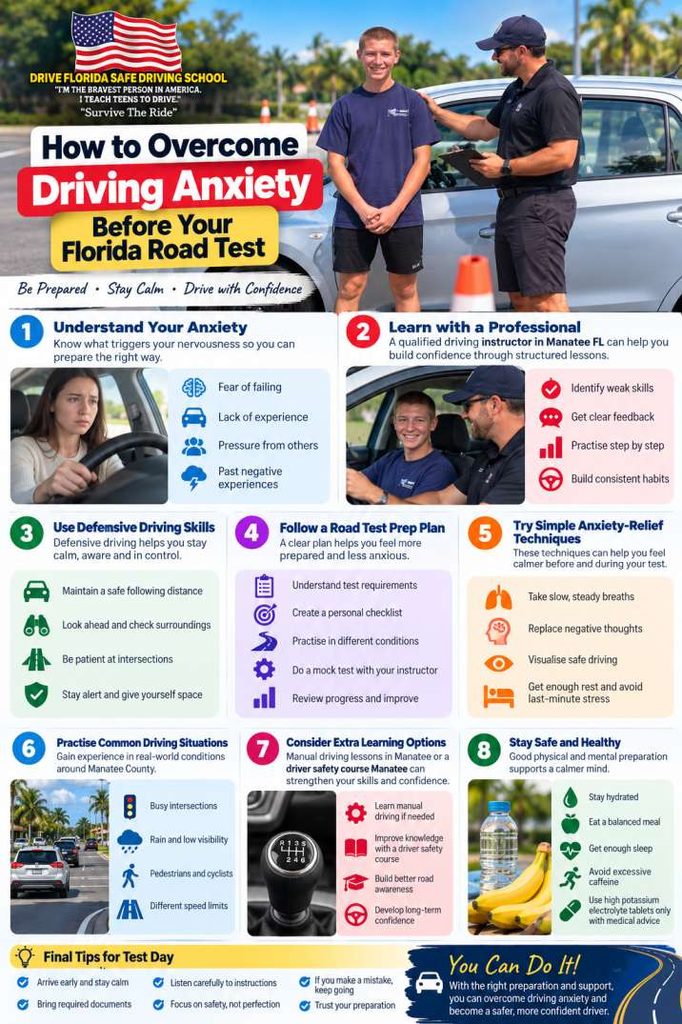
Working with a driving instructor in Manatee FL can help you identify areas that need improvement, practise challenging manoeuvres and build confidence through structured driving experience.
At Drive Florida Safe Driving School, the goal of effective driving education is to help learners develop the knowledge, awareness and practical skills needed for responsible driving. Rather than focusing only on passing an examination, learners should prepare to make safe decisions in everyday traffic.
This guide explains how to overcome driving anxiety, improve your road test preparation and approach your Florida driving test with a more confident mindset.
Driving anxiety can affect beginners and learners who already have some experience. The pressure of being evaluated may make familiar tasks feel more difficult than usual.
Understanding the reasons behind your anxiety can help you choose the right preparation strategy.
One of the most common concerns is the possibility of failing. Some learners believe that every mistake will automatically result in an unsuccessful test, which can make them overthink even simple actions.
For example, you might become so focused on making a perfect turn that you forget to maintain a comfortable speed or check your surroundings properly.
Instead of aiming for perfection, focus on safe and consistent driving. Observe traffic, follow road rules, communicate your intentions clearly and make decisions based on the conditions around you.
A minor mistake does not mean you should panic or stop concentrating. Continue driving safely and follow the examiner’s directions.
Driving on quiet residential streets is useful when learning basic vehicle control, but it may not prepare you for every situation encountered on the road.
Manatee County learners may need to practise intersections, changing traffic conditions, lane changes, pedestrian awareness and roads with different speed limits.
If you have only practised in familiar locations, unfamiliar situations may increase your anxiety. Gradually expanding your practice environment can help you become more adaptable.
Start with situations you can manage safely, then introduce more challenging conditions as your skills improve.
Learners sometimes feel that they must pass on their first attempt to satisfy family expectations or avoid embarrassment.
This pressure can turn a learning experience into a source of unnecessary stress. It may also discourage learners from asking questions or taking additional lessons when they need them.
Remember that safe driving requires practice, judgement and experience. Your progress should be measured by your ability to control the vehicle and respond safely to traffic, not by how quickly someone else obtained a licence.
A previous accident, a stressful lesson or an uncomfortable experience in heavy traffic can make some situations feel intimidating.
If you become nervous whenever you approach an intersection or change lanes, identify the exact part of the situation that concerns you.
You may be uncertain about judging gaps, checking blind spots or deciding when it is safe to proceed. Once you identify the problem, you can practise that skill with appropriate supervision instead of avoiding the situation completely.
If anxiety is severe or persistent, professional healthcare support may also be appropriate.
Structured driving instruction can help you replace uncertainty with practical knowledge and repeatable skills.
A useful lesson should have clear objectives, constructive feedback and enough time to practise the situations that cause difficulty.
Before your next lesson, write down the situations that make you nervous. Being specific helps you and your instructor develop a more useful practice plan.
Common concerns include:
Choose one or two priorities for each session rather than trying to correct everything at once.
For example, if you struggle with lane changes, begin by reviewing mirror use, blind-spot checks, signalling and gap selection. Practise these actions in suitable conditions before moving on to busier roads.
Breaking a difficult task into smaller steps makes it easier to understand what needs improvement.
Feedback is most useful when it explains what happened, why it matters and how to improve.
Suppose you begin slowing down too late when approaching a stop sign. Simply hearing that you made a mistake may increase your nervousness without helping you correct it.
More useful feedback would explain how to recognise the intersection earlier, assess the road ahead and reduce speed smoothly before stopping completely.
Ask questions whenever an instruction is unclear. Understanding the reason behind a correction helps you apply the lesson in different driving situations.
Confidence develops when you can perform important driving tasks safely and consistently.
For example, before changing lanes, practise checking mirrors, assessing the blind spot, signalling and moving only when a suitable gap is available.
These actions should become familiar without turning into a mechanical routine that prevents you from observing the road.
The objective is to combine good driving habits with continuous awareness of traffic, road markings and potential hazards.
Defensive driving involves anticipating potential hazards, maintaining adequate space and adjusting your actions to reduce risk.
It is particularly valuable for anxious learners because it encourages you to focus on what you can control instead of worrying about the behaviour of other drivers.
Following too closely can increase pressure because you have less time to respond when traffic slows.
Choose a fixed reference point beside the road. When the vehicle ahead passes it, count the seconds until your vehicle reaches the same point.
A following distance of at least three to four seconds is a useful starting point under suitable conditions. Increase the gap when visibility is poor, the road is wet, traffic is unpredictable or other conditions require additional stopping space.
Avoid focusing exclusively on the vehicle directly ahead. Scan the road further forward so you can recognise slowing traffic and respond smoothly.
Intersections require you to assess several things at once, including traffic signals, road markings, pedestrians and other vehicles.
Approach at an appropriate speed and look for potential hazards early. Check the relevant directions before proceeding and respect right-of-way rules.
Do not rush through an intersection simply because another driver is waiting behind you.
If you are unsure whether a manoeuvre is safe, wait until you can proceed legally and safely.
Another motorist may follow too closely, sound their horn or appear impatient when you are waiting to turn.
Their behaviour does not mean you should take an unsafe gap or exceed the speed limit.
Maintain a predictable driving pattern, leave enough space around your vehicle and allow other road users to pass when appropriate.
Developing these habits is an important part of defensive driving Manatee learners should practise before driving independently.
Suppose you realise that you are in the wrong lane shortly before an intersection. An anxious driver might attempt a sudden lane change to correct the mistake.
A safer response is to remain in your lane, follow the road markings and take an appropriate alternative route when possible.
Similarly, if you miss a turn, do not make an abrupt manoeuvre to return to the planned route.
Learning how to respond calmly to unexpected situations can reduce the fear of making mistakes during the driving test.
Effective road test prep involves more than repeating a familiar route. You need to demonstrate safe vehicle control, awareness of surrounding traffic and the ability to follow instructions.
A structured preparation plan helps you identify weaknesses and measure progress.
Review the current requirements for the Florida driving skills test before beginning your final preparation.
Depending on the applicable examination, you may need to demonstrate skills such as:
Do not assume that memorising a list is enough. You should understand why each action is necessary and be able to perform it safely.
A checklist can help you focus your practice on specific skills.
Divide your checklist into three categories:
Skills that need improvement: Tasks you cannot yet perform consistently or safely.
Skills that are improving: Tasks you can complete but still need reminders or additional practice to perform reliably.
Skills that are consistent: Tasks you can perform safely across relevant situations without repeated correction.
Update the checklist after each lesson. Ask your instructor to assess your performance so your progress reflects actual driving ability rather than confidence alone.
Once you are comfortable with basic vehicle control, practise a range of appropriate driving situations.
These may include residential streets, intersections, roads with different speed limits and areas with moderate traffic.
During practice, concentrate on recognising hazards early, selecting the correct lane, maintaining space and responding calmly to changing conditions.
The purpose is not to memorise one particular route. It is to develop the ability to apply safe driving principles wherever you are directed to go.
When your basic skills are reliable, complete a practice session that follows a similar structure to a driving examination.
Listen carefully to directions, complete the requested manoeuvres and maintain awareness throughout the drive.
After the session, review any errors and identify what caused them. Were you distracted, uncertain about a rule or struggling with vehicle control?
This helps you focus your next lesson on the underlying problem instead of repeating the entire practice session without a clear objective.
Avoid unnecessary stress by preparing the practical details in advance.
Confirm your appointment, required documents, eligibility and vehicle arrangements. If you are providing the vehicle, make sure it meets the applicable safety and documentation requirements.
Knowing what to expect can prevent avoidable last-minute problems.
Mental preparation can support driving practice, but it should never replace learning the skills needed to operate a vehicle safely.
The following techniques can help you manage ordinary nervousness before a lesson or test.
When you feel anxious, your breathing may become faster and shallower.
Before starting the vehicle, sit comfortably while parked and breathe gently. You can try inhaling for approximately four seconds and exhaling for approximately six seconds if that feels comfortable.
Repeat for a minute or two without forcing your breathing or holding your breath.
The goal is to settle yourself before driving. Never close your eyes or perform a distracting relaxation exercise while the vehicle is moving.
If you become too distressed to concentrate while driving, prioritise vehicle control and pull over somewhere appropriate when it is safe and lawful to do so.
Thoughts such as “I am going to fail” can make you focus on the possible outcome instead of the task in front of you.
Replace these thoughts with instructions that support safe behaviour.
For example:
These statements do not guarantee success. They help redirect your attention towards actions you can control.
Before a lesson, imagine yourself completing familiar driving tasks calmly.
Picture yourself checking mirrors, observing traffic, signalling appropriately and stopping smoothly. Then visualise how you would respond if a situation did not go exactly as expected.
For example, imagine missing a turn and continuing safely until you can change your route.
This kind of mental rehearsal is most useful when combined with real practice. If a particular situation remains difficult, make it a priority for your next supervised session.
Trying to learn several new manoeuvres immediately before your test can increase pressure and fatigue.
Use the final practice sessions to reinforce familiar skills and address specific weaknesses. Allow yourself enough time to rest, eat normally and prepare your documents.
A clear, rested mind can make it easier to concentrate on traffic and instructions.
Local driving preparation should reflect the situations you are likely to encounter, while recognising that road and traffic conditions vary.
Depending on your regular routes, you may need to practise intersections, changing traffic volumes, pedestrian crossings, shopping-area traffic and roads with different speed limits.
Busy intersections can feel overwhelming because several things happen at once.
Approach carefully, identify your intended direction and select the appropriate lane in advance. Observe traffic signals and road markings, check for pedestrians and assess whether it is safe to proceed.
Avoid making last-minute lane changes or rushing through a turn because another vehicle is waiting.
Repeated practice can help you manage these tasks more systematically.
Rain can reduce visibility, affect tyre grip and increase stopping distances.
During appropriate supervised practice, learn to adjust your speed and following distance to the conditions. Use your headlights and windshield wipers appropriately, and avoid sudden braking or steering movements.
If the weather creates conditions beyond your current ability, postpone the lesson until it is safe to continue.
Driving instruction should build competence progressively rather than expose learners to unnecessary risk.
Pedestrians and cyclists can be difficult to notice when your attention is focused entirely on other vehicles.
Scan crossings and roadside areas, check carefully before turning and remain alert for people entering the road.
Pay particular attention near intersections, driveways, schools and areas where people may cross unexpectedly.
Maintaining awareness of vulnerable road users is an essential part of responsible driving.
Manual driving lessons in Manatee may be useful if you specifically want to learn clutch control, gear selection and driving a manual-transmission vehicle.
However, learning a manual vehicle is not automatically necessary for every learner preparing for a Florida driving test.
If your main concern is road test anxiety, first identify which skills are causing difficulty. You may need additional practice with parking, lane changes, observation, braking or traffic decisions rather than transmission control.
If manual driving is one of your goals, ask about the availability of suitable instruction and the type of vehicle used.
The best preparation plan should reflect your learning objectives, current ability and the requirements of your intended test.
A driver safety course Manatee learners consider may help strengthen their understanding of traffic laws, hazard awareness and responsible driving decisions.
However, educational instruction and practical driving experience serve different purposes.
Reading about safe following distances does not automatically make it easier to judge the distance between moving vehicles. Understanding intersection rules does not guarantee that you will apply them correctly in changing traffic conditions.
Use driving education to reinforce your knowledge, then practise the relevant skills under appropriate supervision.
Before enrolling in a course, make sure it suits your circumstances and confirm any eligibility or licensing requirements that apply to your situation.
The phrase high potassium electrolyte tablets relates to electrolyte supplementation rather than driving instruction. It is important to understand the difference between maintaining normal hydration and treating anxiety.
Potassium is an essential electrolyte that supports normal nerve and muscle function. However, high-potassium electrolyte tablets are not an established treatment for driving anxiety and should not be used as a substitute for appropriate driving preparation.
If you are preparing for a driving test, focus on practical strategies that directly address your concerns.
Taking extra potassium is not automatically beneficial. Excess potassium can cause serious health problems, particularly in people with certain kidney conditions or those taking medications that affect potassium levels.
Keep these precautions in mind:
If nervousness is affecting your ability to concentrate, a more relevant approach is to identify your driving triggers, practise the necessary skills and seek appropriate support when needed.
The key takeaway is that supplements should not be presented as a shortcut to driving confidence. Safe driving depends on preparation, attention, judgement and responsible decision-making.
Some preparation habits can increase anxiety rather than improve driving performance.
A familiar route may feel reassuring, but it cannot prepare you for every possible direction or traffic situation.
Instead, practise reading signs, selecting lanes, observing right-of-way rules and responding safely to instructions.
These skills are useful regardless of which route you take.
Every learner starts with a different level of experience and develops skills at a different pace.
Comparing your number of lessons with someone else’s does not tell you whether you are ready.
Measure progress by your ability to control the vehicle, observe hazards, follow traffic laws and complete required manoeuvres consistently.
It can be uncomfortable to hear that a driving skill needs improvement. However, useful feedback gives you a chance to correct errors before driving independently.
Ask your instructor to explain the correction, practise it carefully and review your progress during subsequent lessons.
Booking a test before you can demonstrate the necessary skills consistently may create additional pressure.
Discuss your readiness with your instructor and review the applicable examination requirements. You should be able to demonstrate safe driving across relevant situations, not just perform well on a familiar road.
A simple routine can help you approach your appointment with fewer distractions.
Arrive with enough time to avoid rushing. Eat and drink normally according to your needs, and avoid excessive caffeine if it makes you feel nervous or shaky.
Before driving, adjust your seat and mirrors, fasten your safety belt and familiarise yourself with the vehicle’s controls.
Take a moment to settle yourself while parked, then focus on driving safely rather than trying to predict the result.
Listen carefully to instructions and ask for clarification if you genuinely cannot hear or understand a direction.
Observe the road, identify hazards and complete each manoeuvre when it is safe. Maintain appropriate speed, follow traffic laws and avoid rushing because you feel under pressure.
If you make a mistake, continue concentrating on safe driving. Do not assume that a single error automatically means you have failed.
Your priority should always be to protect yourself and other road users.
Overcoming driving anxiety takes preparation, practice and a realistic understanding of your abilities. By identifying your concerns, strengthening defensive driving habits and following a structured road test preparation plan, you can work towards becoming a calmer and more capable driver.
If you are preparing for your Florida driving test in Manatee County, Drive Florida Safe Driving School can be a starting point for exploring suitable driving instruction.
Focus on learning skills that you can apply beyond the examination: observing hazards, maintaining safe distances, following traffic laws and responding calmly when conditions change.
Ready to take the next step? Contact Escuela de manejo seguro de Drive Florida to discuss your driving education needs and explore available preparation options. Build your skills gradually, address your concerns and work towards safer, more confident driving.
Start by identifying the situations that make you nervous, such as parking, lane changes or busy intersections. Practise those skills with appropriate supervision and ask for specific feedback after each attempt.
You can also use slow breathing while parked, realistic self-talk and a consistent pre-test routine. If anxiety regularly prevents you from concentrating or driving safely, consider additional instruction and professional healthcare support.
There is no universal number of lessons that guarantees readiness. Your requirements depend on previous experience, current skills, practice opportunities and your ability to respond safely to different road conditions.
Ask your instructor to assess your progress against the relevant driving test requirements. Focus on consistent performance and safe decision-making rather than completing a fixed number of lessons.
Begin with the skills required for your examination and the areas where you make repeated mistakes. These may include vehicle control, stopping correctly, turning, signalling, reversing, parking, observing traffic and maintaining safe distances.
Practise each skill until you can perform it safely and consistently. Confirm the current test requirements before your appointment so your preparation reflects the applicable assessment.
A suitable instructor can help you practise difficult manoeuvres, understand driving corrections and gradually become more comfortable with different road situations.
Structured lessons may be particularly useful when anxiety is connected to limited experience or uncertainty about driving skills. However, severe or persistent anxiety may require support from a qualified healthcare professional as well.
High potassium electrolyte tablets are not an established treatment for driving anxiety, and there is no sound basis for using them as a way to guarantee better driving test performance.
Potassium is important for normal bodily functions, but excessive supplementation can be dangerous for some people. Focus on practical driving preparation, adequate rest and appropriate stress management. Consult a healthcare professional before taking potassium supplements.
En Drive Florida Safe Driving School, estamos dedicados a ayudar a nuestros estudiantes novatos a convertirse en los conductores más seguros. Siempre nos esforzamos para que usted o su ser querido reciban las técnicas, los conocimientos y las normas de manejo defensivo más actualizados.



 Spanish
 English

