
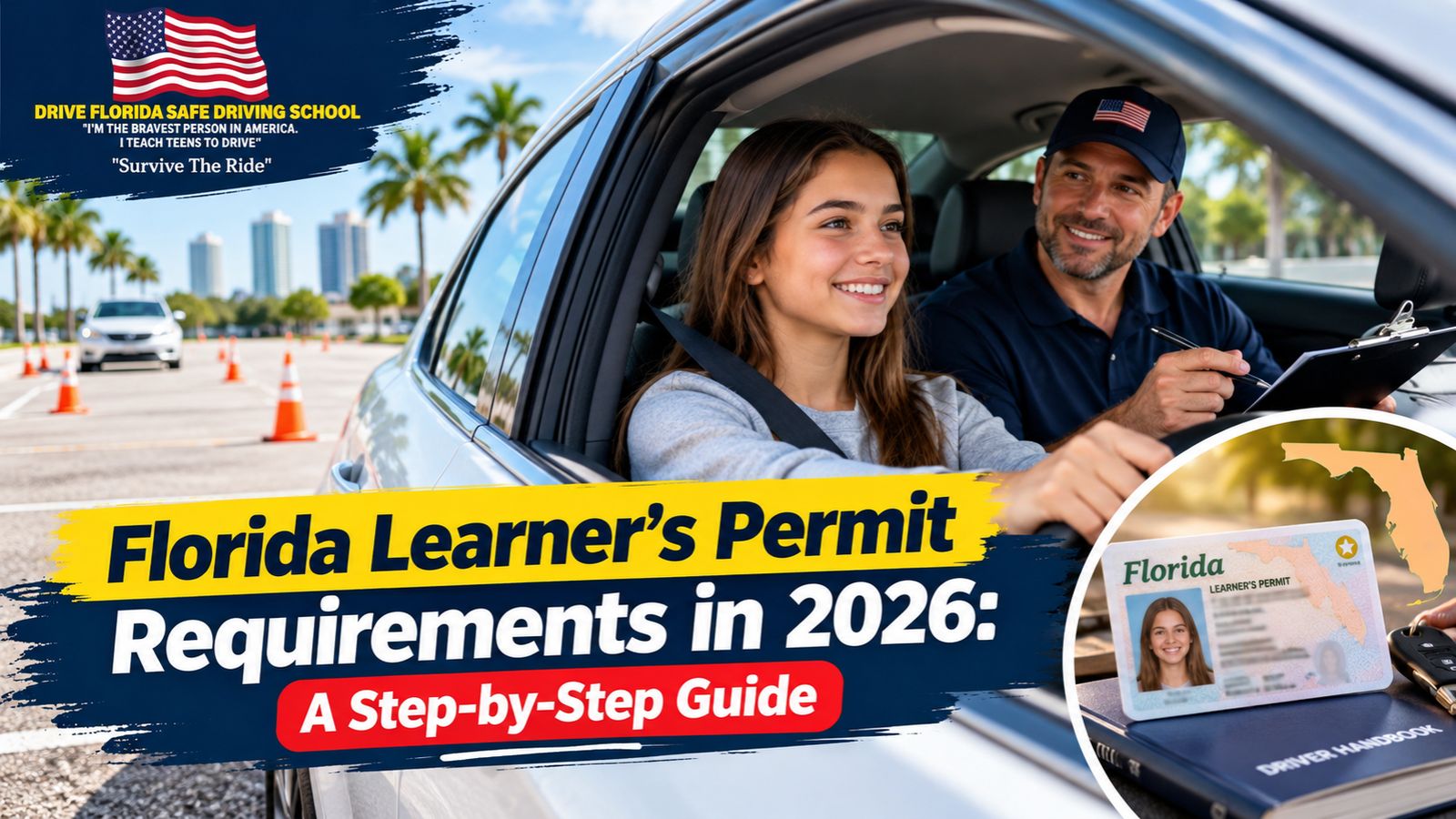
Getting a learner’s permit is an exciting first step towards driving independently. For teenagers in Florida, it also comes with important responsibilities, including completing the correct driver education course, passing the knowledge test, providing identification documents and learning how to drive safely under supervision.
Understanding the Florida learner’s permit requirements in 2026 before starting the application can save time, reduce stress and prevent unnecessary delays. The process is easier when you know which course applies to your age, what documents to prepare and what restrictions you must follow after receiving your permit.
For families preparing for this milestone, a reputable Florida driving school can help turn the licensing process into a structured learning experience. At Drive Florida Safe Driving School, the focus is on helping learners understand the importance of road rules, responsible decision-making and practical driving preparation.
This guide explains the main requirements, the application process, supervised driving rules, common mistakes and practical ways to prepare for becoming a safe driver.
Florida calls its learner’s permit a learner’s driver license. It allows an eligible beginner to practise driving while accompanied by a qualified licensed driver. It is not the same as a full Class E driver license.
The state uses a graduated licensing system for young drivers. This approach gives teenagers time to develop their knowledge, judgement and vehicle-control skills before receiving broader driving privileges.
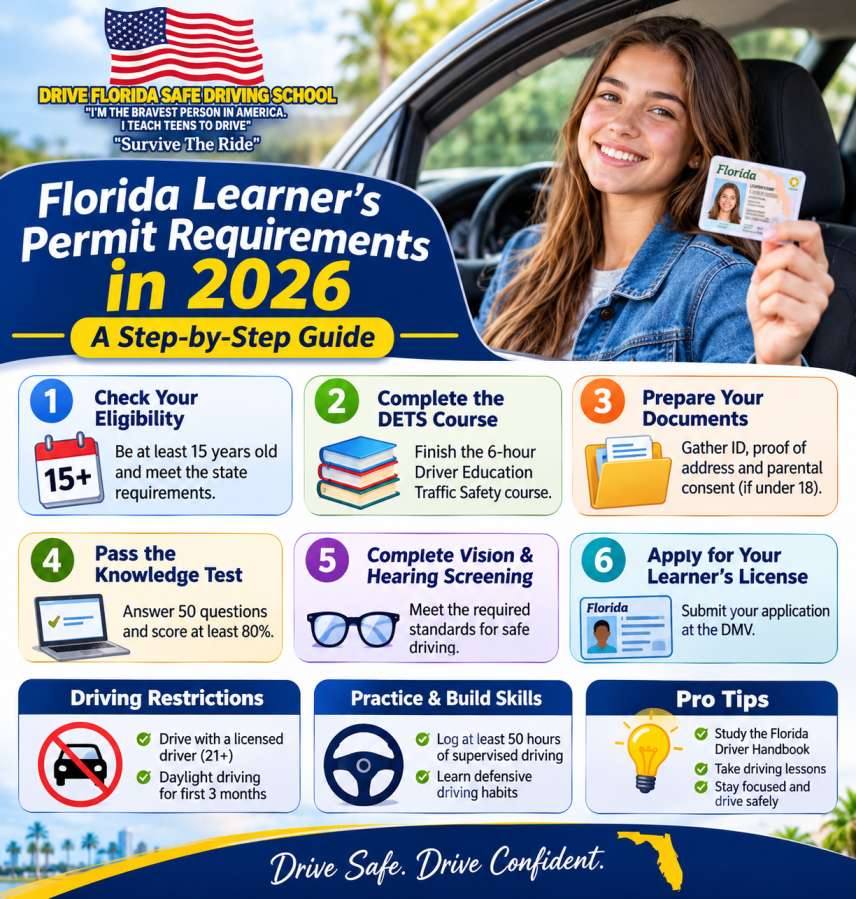
Under Florida law, applicants must be at least 15 years old to receive a learner’s license. They must also meet the applicable education, testing, vision, hearing and documentation requirements. For teenagers applying under the rules introduced in 2025, the required course is generally the six-hour Driver Education Traffic Safety (DETS) course. Applicants aged 18 or older generally follow the separate Traffic Law and Substance Abuse Education (TLSAE) requirements when applicable. Some transitional exemptions apply.
Because course requirements can depend on age and previous licensing or course completion, check your eligibility before enrolling.
Before booking an appointment or beginning a course, confirm that you meet Florida’s minimum eligibility requirements.
Teenagers seeking their first Florida learner’s license generally need to:
The DETS requirement took effect for new teen applicants from August 1, 2025. Teenagers who completed the earlier TLSAE course before the change may qualify for a limited exemption, subject to the applicable validity period and other conditions. Applicants who already held a Florida learner’s license before the change may also fall under an exemption.
Adults applying for their first Florida driving credential generally follow different education requirements. A first-time applicant who has never held a driving licence may need to complete an approved TLSAE course.
Adults are not generally required to hold a learner’s license for the same fixed period as teenagers before applying for a full license. However, they must satisfy the applicable testing and licensing requirements.
Practical tip: Do not automatically enrol in a course simply because a friend or family member completed it. Confirm that the course matches your age and licensing history.
Driver education introduces learners to the responsibilities that come with operating a vehicle. It covers subjects such as traffic laws, road signs, driver attention, impairment, sharing the road and strategies for reducing crash risks.
For most first-time applicants aged 15 to 17, the six-hour DETS course is now the relevant educational requirement. The course is intended to build an understanding of traffic safety before a learner begins practising on public roads.
Completing a course is not simply about obtaining a certificate. A learner needs to understand how to apply traffic rules in real situations.
For example, knowing that a driver must stop at a stop sign is only the starting point. A safe driver also learns to check for pedestrians, observe other vehicles, identify potential hazards and proceed only when it is safe and lawful.
Similarly, understanding speed limits involves more than memorising numbers. Drivers must recognise that rain, poor visibility, traffic congestion and road conditions may require additional caution.
A structured driver safety course can help reinforce these concepts, although learners should verify that any course they choose satisfies the specific legal requirement for their application.
Some teenagers who completed TLSAE before August 1, 2025, may qualify for an exemption if they meet the applicable conditions. The exemption is not a general rule for every applicant under 18.
If your course was completed before the change, check its completion date and confirm whether it remains valid for your circumstances before relying on it.
Keep any course completion confirmation available, even when the provider submits the result electronically.
Missing or unacceptable documents can delay an otherwise straightforward application. Preparing your paperwork before the appointment helps you avoid a second visit.
First-time applicants who have not previously established their identity with the licensing authority generally need documentation covering the following categories:
Accepted documents vary by category and personal circumstances. For example, a certified birth certificate or valid passport may be acceptable for identity, while qualifying financial statements, residential agreements or utility records may be accepted as address evidence.
Do not assume that a school ID, photocopy or single address document will satisfy every requirement. Review the current document checklist before attending your appointment.
Create a folder containing your original documents, any required supporting paperwork and your course confirmation. Check that names and addresses are consistent across documents.
If a parent or guardian provides the address documents, confirm in advance whether additional evidence or an affidavit is required for your situation.
This simple preparation step can prevent avoidable delays, particularly for teenagers applying for their first government-issued identification credential.
The Class E knowledge examination tests your understanding of Florida traffic laws and road signs. It checks whether you know the rules that help keep drivers, passengers, pedestrians and cyclists safe.
The standard examination consists of 50 multiple-choice questions, and the passing score is generally 80%, meaning at least 40 correct answers. Confirm the current testing arrangements when you book.
Rather than memorising answers alone, study the reasons behind each rule.
Focus on:
Practise in short sessions and revisit questions you answer incorrectly. If you consistently confuse two signs or right-of-way situations, write down the difference and test yourself again later.
Imagine reaching an intersection where another vehicle arrives at approximately the same time. Knowing the applicable right-of-way rule helps you decide what to do, but you must also check that the intersection is clear and other road users are behaving predictably.
The safest decision is not always the quickest one. A learner should understand the rule, observe the surroundings and avoid moving until it is safe to proceed.
Approved online testing options may be available to eligible applicants under 18. Availability and conditions can vary, so verify the provider’s approval and the current rules before booking.
Some applicants who test through an authorised third-party provider may be selected for a state-administered retest. Passing an online examination should therefore not be treated as a guarantee that no further testing will be required.
Applicants must meet the required vision and hearing standards as part of the learner’s license process.
The vision screening helps establish whether you can see well enough to identify road signs, observe traffic and respond to hazards. If you normally wear glasses or contact lenses for driving, bring them to your appointment.
If you have difficulty hearing instructions or detecting relevant sounds, ask the licensing authority about the applicable assessment process and any permitted accommodations.
Do not leave these checks until the last minute. If you need corrective lenses or additional documentation, arranging them beforehand can make the application smoother.
For applicants under 18, parental or legal guardian involvement is an important part of the process.
Depending on the circumstances, a parent or legal guardian may need to sign the required consent form in person or provide a properly notarised form. Additional consent requirements can apply when a teenager takes the knowledge examination online, including parent-proctoring documentation where required.
Before the appointment, confirm:
A teenager should not assume that permission given informally at home replaces the formal consent process.
Parents can also use this stage to discuss driving expectations, including phone use, seat belts, passenger safety and the importance of reporting mistakes rather than hiding them.
Once you have completed the required education and prepared your documents, arrange the appropriate licensing appointment or follow the permitted application process.
At the appointment, be prepared to provide your documentation, confirm your course completion, complete the required screening and satisfy the knowledge examination requirement if it has not already been completed through an accepted process.
Fees, appointment procedures and accepted testing arrangements may vary or change. Check the current instructions before travelling to the licensing office.
Keep any receipt, confirmation or licence paperwork you receive. If you are told that additional information is needed, ask exactly what is missing and how it should be supplied.
Receiving a learner’s license is the beginning of supervised practice, not permission to drive independently.
Understanding the restrictions is essential before your first practice drive.
Florida law requires a learner’s license holder to be accompanied by a properly licensed driver who is at least 21 years old and occupies the front passenger seat closest to the learner.
The law also restricts driving hours. During the first three months after the learner’s license is issued, driving is limited to daylight hours. After those three months, driving may continue until 10 p.m., subject to the applicable legal conditions.
A supervising driver should do more than sit in the passenger seat. They should help the learner recognise hazards, explain decisions calmly and provide feedback after each drive.
For instance, if a learner approaches a busy junction too quickly, the supervising driver can explain the importance of reducing speed early, scanning for hazards and identifying a safe stopping point.
Choose practice routes that match the learner’s current ability. A quiet road may be suitable for initial vehicle familiarisation, while more complex intersections should be introduced gradually as competence improves.
Never allow a learner to drive alone, even for a short trip. The learner’s license conditions must be followed on every journey.
For teenagers progressing towards a full Class E license, Florida generally requires at least 50 hours of supervised driving experience, including at least 10 hours at night. Applicants under 18 must also meet the applicable learner’s-license holding period and driving-record conditions.
Keep a driving log that records:
A useful practice session has a clear objective. One day, focus on smooth braking and steering. On another, practise lane positioning, safe turns or scanning intersections.
Avoid rushing through the hours just to complete a log. Repeated, varied practice helps develop judgement and consistency.
Passing a knowledge examination demonstrates an understanding of road rules. It does not automatically mean a learner can handle every driving situation confidently.
Practical driver training can help learners develop vehicle control, observation habits, hazard awareness and decision-making. It can also help parents identify areas where a learner needs additional support.
Drive Florida Safe Driving School can be considered as part of a learner’s broader preparation, with instruction focused on responsible driving habits and readiness for real-world traffic situations. Before booking any lesson, confirm the services offered, instructor qualifications and whether the instruction meets your particular needs.
A progressive learning plan may include:
A qualified instructor should adapt lessons to the learner’s ability rather than following a rigid schedule that assumes everyone progresses at the same speed.
Good driving instructors teach learners to recognise risks before those risks become emergencies. They explain not only what action to take, but why it is appropriate.
For example, a learner might repeatedly brake too late when approaching traffic lights. An instructor can help identify whether the cause is poor observation, excessive speed, following too closely or delayed decision-making.
That diagnosis matters. Simply telling the learner to brake earlier may not solve the underlying problem.
When choosing instruction, look for clear explanations, patient feedback, appropriate safety procedures and lessons that match the learner’s current skills. Ask about instructor credentials and the scope of the service before booking.
For people interested in the profession, driving instructor training Florida is a separate topic involving instructor eligibility, training and applicable authorisation requirements. Becoming a driving instructor is not the same process as obtaining a learner’s license, so anyone pursuing that career should verify the relevant requirements before enrolling in training.
The principles of defensive driving Florida learners study should become part of everyday practice, not just something remembered for a test.
Defensive driving means anticipating possible hazards, maintaining an appropriate safety margin and avoiding unnecessary risks. It does not mean assuming that other drivers will always make the correct decision.
Helpful habits include:
Consider a learner driving in heavy rain. Even if the posted speed limit remains unchanged, visibility and tyre grip may be reduced. Slowing appropriately, increasing following distance and avoiding sudden manoeuvres can help reduce risk.
A formal florida driver improvement course may be relevant to certain drivers who need remedial education or who are seeking to improve their knowledge. However, it is not automatically a substitute for the DETS course required by most first-time applicants under 18. Check the course purpose and eligibility before enrolling.
Small oversights can cause unnecessary delays. These are some of the most common issues to address before applying.
The education requirement for a 16-year-old first-time applicant may differ from that for an adult applying for the first time. Confirm which course applies to your age and history.
Check every required document category in advance, including identity, Social Security and residential address evidence. Do not assume one document can satisfy every category.
Practice tests are useful, but they should support a proper understanding of traffic laws and signs. Learn why an answer is correct instead of memorising a sequence of answers.
A learner’s license does not permit solo driving. Follow the supervision and time restrictions from the first practice session.
Confidence should develop through demonstrated competence. A learner who can park in a quiet area may still need help with complex intersections or heavy traffic.
The permit is the start of a learning period. Safe driving requires ongoing practice, good judgement and an understanding of how road conditions change.
Staying comfortable and alert is part of preparing for a driving lesson. If you have spent time outdoors in hot weather, take appropriate breaks and drink fluids according to your needs.
The phrase Florida Learner’s Permit Requirements relates to hydration products, not Florida learner’s permit eligibility or licensing requirements. These tablets are not required for a learner’s license, and they should not be treated as a driving-performance aid.
Potassium supplements can be unsuitable for some people, particularly those with certain medical conditions or those taking medicines that affect potassium levels. Do not take high-potassium products simply because you are preparing for a driving test. If you are considering supplementation, ask a qualified healthcare professional whether it is appropriate for you.
If you feel dizzy, faint, unusually tired or otherwise unwell before a lesson, do not drive. Stop and address the problem before returning to the road.
A successful application begins with organisation, but becoming a safe driver requires consistent habits.
Start early. Review the course and document requirements before the date you hope to apply.
Use a checklist. Keep track of course completion, examination preparation, identification documents and parental consent.
Practise with purpose. Set one or two realistic goals for every supervised drive and review what went well afterwards.
Ask questions. If a traffic rule or manoeuvre is unclear, ask a qualified instructor or supervising driver to explain it in a practical context.
Build experience gradually. Progress from familiar, less demanding roads to more challenging conditions as your skills improve.
Keep records. A complete supervised-driving log helps you identify gaps and track your progress towards the required experience.
Confirm current rules. Requirements, fees and administrative procedures can change. Verify details with the relevant licensing authority before relying on older advice.
Drive Florida Safe Driving School supports the broader goal of helping learners approach driving with preparation, awareness and responsibility. Choosing appropriate instruction and practising consistently can help new drivers develop habits that remain useful long after the licensing process is complete.
Meeting the Florida learner’s permit requirements in 2026 involves more than passing a test. Applicants need to understand the course that applies to them, prepare the correct documentation, complete the required screening and follow the rules governing supervised driving.
For teenagers, the six-hour DETS course is generally the relevant education requirement under the rules introduced in 2025, although specific exemptions may apply. After receiving a learner’s license, supervised practice, careful record-keeping and gradual skill development are essential steps towards becoming a responsible driver.
A reliable Florida driving school can be a useful part of that journey by helping learners strengthen their road knowledge, practise safely and build confidence at an appropriate pace. Drive Florida Safe Driving School encourages learners and families to prioritise preparation, patience and safe driving habits from the very first lesson.
You must generally be at least 15 years old to receive a Florida learner’s license. Applicants must also meet the relevant education, examination, vision, hearing and documentation requirements. Teen applicants should confirm whether the DETS course or a recognised exemption applies to them before applying.
Generally, yes. First-time applicants aged 15 to 17 must complete the six-hour Driver Education Traffic Safety course under the rules effective from August 1, 2025. Certain teenagers may qualify for an exemption based on earlier TLSAE completion or existing licensing status. Confirm your specific circumstances before choosing a course.
The standard Class E knowledge examination has 50 multiple-choice questions covering road rules and traffic signs. The usual passing requirement is at least 40 correct answers, or 80%. Study the applicable driver handbook and use practice questions to identify topics that need further revision.
No. A learner’s license holder must be accompanied by a qualified licensed driver who is at least 21 years old and seated in the front passenger seat closest to the learner. Driving-hour restrictions also apply: daylight only during the first three months, followed by permission to drive until 10 p.m. under the applicable conditions.
A driving school can provide structured instruction that complements supervised practice. Lessons may help learners improve vehicle control, observation, lane positioning, hazard recognition and decision-making. When choosing a provider, confirm the services offered and instructor qualifications, and select lessons suited to your experience rather than assuming a fixed number of sessions will suit everyone.
En Drive Florida Safe Driving School, estamos dedicados a ayudar a nuestros estudiantes novatos a convertirse en los conductores más seguros. Siempre nos esforzamos para que usted o su ser querido reciban las técnicas, los conocimientos y las normas de manejo defensivo más actualizados.



 Spanish
 English

