

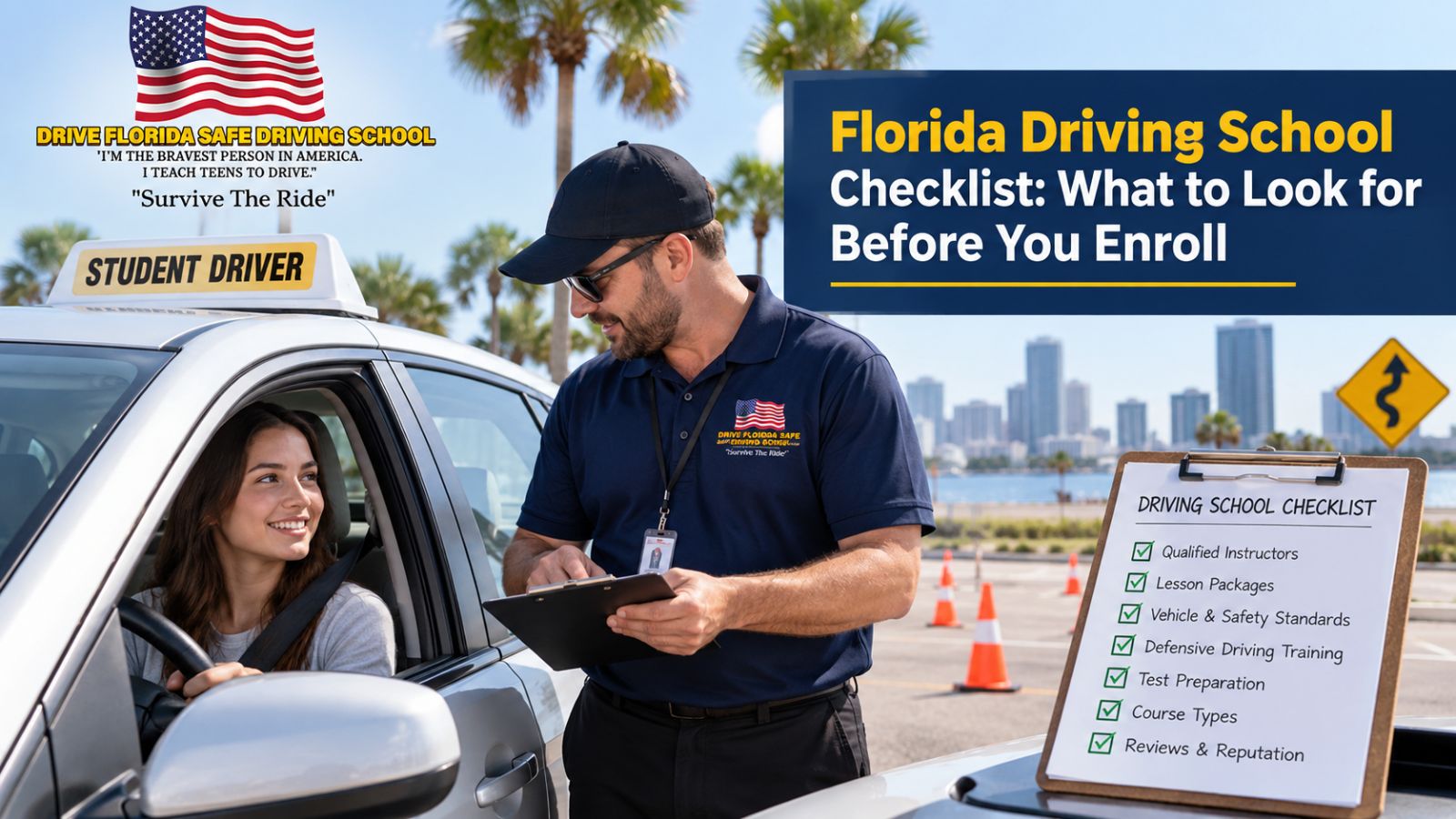
Picking a driving school sounds simple at first. Then you look at packages, the person who teaches you, the car you will use, the fees, and the course options. You may see one place push the lowest price. Another place may cost more but give you longer lessons on the road. So the main point is not just “How much does it cost?” It is about whether the lessons will shape you into a driver who stays calm, drives with care, and knows how to respond when traffic turns messy. A solid Florida driving school should do more than teach you how to steer, brake, and park. You should learn routines that still help after the test. That includes checking blind spots in a real way, handling crowded intersections, and choosing safer moves around other drivers.
Before you send any money for a deposit, use the list below. It helps you see what each school truly includes.
Florida learner driver training usually begins with simple vehicle skills. Then it adds harder scenes over time. For example, a learner may start with quiet area practice. Then the lessons can shift to neighborhood streets. After that, you might move to faster routes, busier roads, intersections, lane changes, and parking tasks.
The order of these steps matters. If you only practice in an empty lot, you might feel ready but still struggle on a wide multi-lane road with real traffic. Good lessons spot that gap and fill it step by step, not all at once.
Florida licensing rules also affect how you compare schools. FLHSMV says a learner’s permit applicant must be at least 15 years old. The applicant must finish the TLSAE course. They also need to show proper identification and pass the required vision test and the Class E Knowledge exam. If you are under 18, extra steps apply too. This can include parent or guardian consent and supervised driving practice before you can get a full licence.
Do not judge a driving school by its headline package price alone.
Before enrolling, ask:
A flyer that says “10 lessons” can be vague. It tells you almost nothing until you know two things: how long a lesson takes, and how much of that time is spent actually in the car.
A nice instructor can help you feel less tense. But being friendly is not the whole story.
The better driving instructors can explain the reason behind each move. They do not only give orders. Say an instructor tells you to check your mirror. A strong one adds when to do it, what to watch for, and how that view changes the next step you take.
You also want someone who stays steady when you mess up.
Think about a student taking a turn too fast. If the instructor jerks the wheel or snaps at the student, the bad moment may end. Still, the lesson learned can be small. A more useful method is to talk through what went wrong, why the speed created the risk, and how to spot the same setup sooner next time.
Before you pay, ask about credentials. Also ask if the driving school is allowed to run that type of training. In Florida, rules require certified instructors for commercial driving schools, and they list specific proof of qualification.
Passing a driving test and driving safely for years are two different goals.
Look for training that incorporates defensive driving Florida principles rather than focusing entirely on test manoeuvres.
That can include learning how to:
For example, if a vehicle is waiting at a side street, a good learner should gradually become aware that the vehicle might enter their path rather than assuming the other driver has seen them.
That kind of anticipation is difficult to learn from a checklist alone. It develops through guided practice and discussion.
Florida has several types of driver education and improvement courses, and they are not interchangeable.
A first-time applicant should understand the role of the Traffic Law and Substance Abuse Education course, commonly called TLSAE. FLHSMV identifies completion of TLSAE as part of the learner’s licence requirements for people who have never held, or do not have possession of, a licence from another jurisdiction.
The 4 hour basic driver improvement course online is different. BDI is different from basic instruction. BDI is often tied to traffic tickets, points issues, and court or improvement orders. Approved providers describe the four-hour BDI class as a traffic-school option. It is not the same as regular lessons for new drivers.
That matters when you compare what programs claim. If you are just starting out, do not assume a four-hour BDI course will cover the practical training or the licensing steps you still must meet.
A good school like Drive Florida Safe Driving School should know what the Florida drivers license test asks for. Still, the whole course should not be only about passing that one exam.
When you speak with them, ask what skills they will check. Also ask if you get hands-on practice that looks like real driving, not just the same rehearsed route over and over.
Some students can do a three-point turn. Yet they might not look well enough before moving. Another student can read road signs, but may freeze when they need to change lanes in heavy traffic.
Solid prep finds issues early, before test day.
You can also ask what happens if you fail. A fair instructor should talk through the mistake and suggest practice that fits the problem. They should not just try to push a new package at you.
Take a look at the training vehicle before committing.
It should be clean enough to operate comfortably, but appearance is less important than condition. Check whether the controls are clearly marked and whether the vehicle appears properly maintained.
Ask whether the instructor has access to dual controls where appropriate for the training setup.
The vehicle should also help the learner understand normal road driving. If every lesson takes place in an unusual or heavily modified vehicle, the transition to a family car may feel unnecessarily difficult.
A useful school should be able to tell you what you are working on.
After several lessons, you should have some idea of your progress. Perhaps parking is improving while lane positioning still needs attention. Maybe you are comfortable on quiet roads but need more experience with heavier traffic.
A simple progress record can make this obvious.
Without feedback, learners sometimes keep repeating what they already know while avoiding the situations they find uncomfortable. That creates a false sense of progress.
Before making a decision, have a short conversation with the school.
Explain whether you are a complete beginner, returning to driving after years away, preparing for the test or looking to improve a particular skill.
Then ask what they would recommend.
The response can tell you a lot. A thoughtful instructor will usually ask about your experience before suggesting a package. Someone who immediately pushes the largest package without understanding your needs may be less focused on individual training.
Also check cancellation policies, lesson rescheduling rules and whether unused sessions expire. These details are easy to overlook when you are concentrating on the advertised price.
Most importantly, choose a school where you feel comfortable asking questions. Learners improve faster when they can say, “I don’t understand why I need to do that,” and receive a clear explanation.
Choosing the right Florida driving school is less about finding the biggest package or the lowest advertised price and more about finding training that matches your actual needs.
Look closely at the instructors, practical lesson time, vehicle condition, progress feedback and approach to driver safety. Make sure you also understand which Florida course you are being offered and what requirement it is intended to satisfy.
The best Florida driving school like Escuela de manejo seguro de Drive Florida should leave you with more than a passed test. It should help you understand your vehicle, recognise hazards earlier and make calmer decisions when conditions change. Visit our website today and enquire now about our packages.
There is no universal number. A complete beginner may need considerably more practice than someone who already has supervised experience. The important measure is whether you can consistently perform essential skills safely and independently, not whether you completed a particular package.
No. A four-hour Basic Driver Improvement course is generally intended for traffic-ticket or driver-improvement situations. It is not a substitute for the practical training a new driver may need. Florida’s licensing process has separate requirements, including TLSAE for applicable first-time applicants.
If possible, consistency can be helpful. The instructor becomes familiar with your strengths and recurring mistakes. However, another instructor can sometimes provide useful feedback if you have become stuck on a particular skill.
Ask about instructor qualifications, lesson duration, vehicle condition, pickup arrangements, cancellation policies, test preparation and what happens if you need more practice. Also confirm exactly what each course or package includes.
En Drive Florida Safe Driving School, estamos dedicados a ayudar a nuestros estudiantes novatos a convertirse en los conductores más seguros. Siempre nos esforzamos para que usted o su ser querido reciban las técnicas, los conocimientos y las normas de manejo defensivo más actualizados.



 Spanish
  English
