
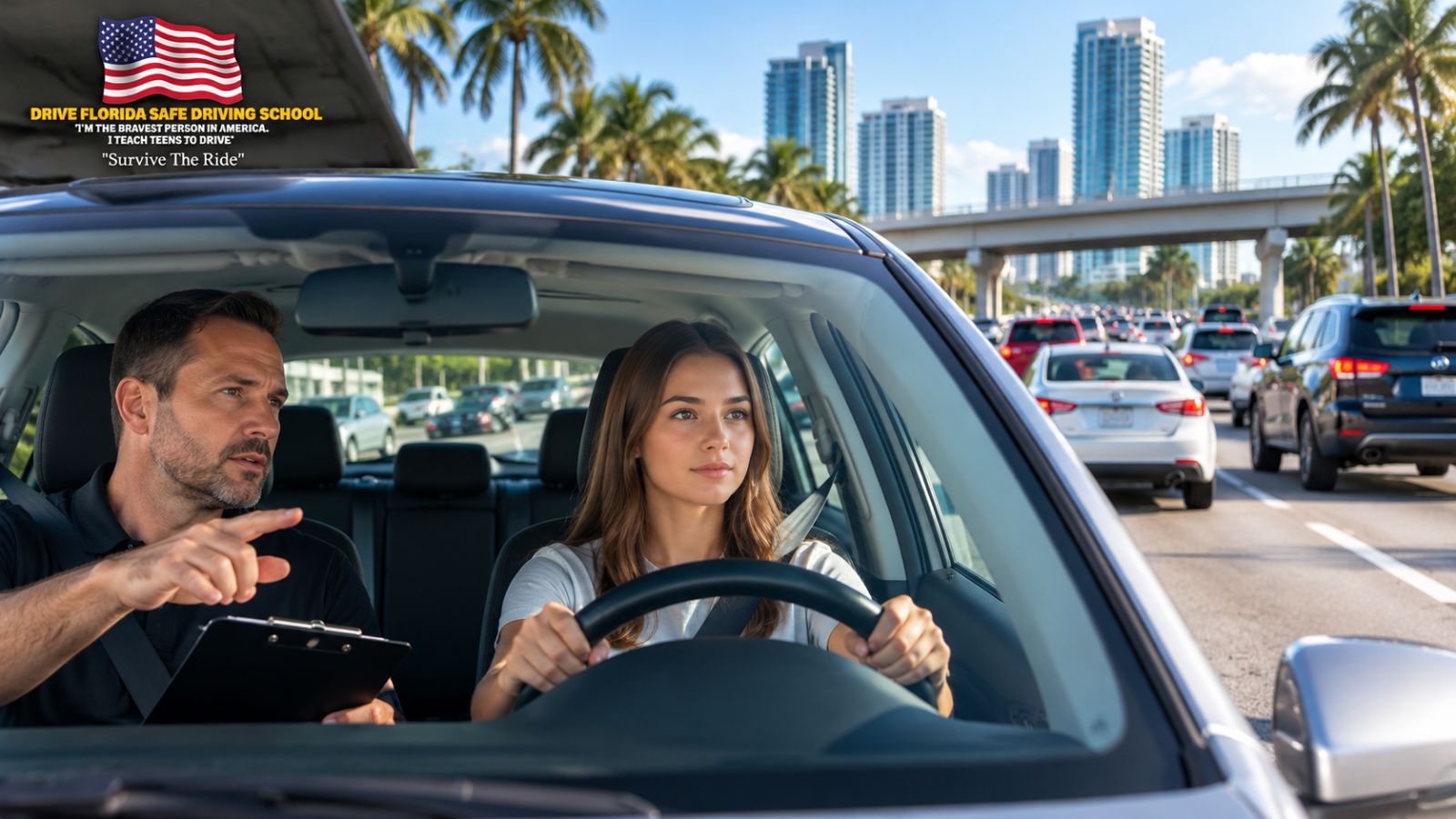
Driving in Florida can seem straightforward when roads are quiet. The experience changes quickly when traffic becomes heavy around busy intersections, highways, shopping centres, school zones, tourist destinations, and major urban roads.
New drivers must manage multiple things at once: changing lanes, merging, following traffic signals, watching pedestrians, responding to sudden braking, identifying blind spots, and dealing with drivers who may not behave predictably.
This is why quality driver education should go beyond teaching someone how to move, stop, park, and pass a test. A professional florida driving school helps students develop the judgement and awareness required to make safer decisions when traffic becomes complicated.
For learners, Safe Driving in Heavy Florida Traffic means developing practical habits that remain useful long after the instructor is no longer sitting beside them.
This guide explains how professional driving schools prepare learners for busy Florida roads, what skills matter most, common mistakes new drivers make, and how structured training can build genuine road confidence.
Florida offers a wide range of driving environments. A learner may practise on a quiet residential street during one lesson and encounter multilane traffic, highway ramps, busy commercial areas, or congested intersections during another.
Heavy traffic increases the amount of information a new driver has to process.
A learner may need to:
The difficulty is often not knowing individual driving rules. The challenge is applying several skills at the same time.
Professional driver training helps students develop these skills progressively. Instead of placing an inexperienced driver into the most complicated traffic immediately, a qualified instructor can increase the level of difficulty as the student’s control and judgement improve.
Effective training usually develops from simple situations toward more demanding ones.
Before dealing with heavy traffic, learners need to feel comfortable controlling the vehicle.
Early lessons may focus on:
This foundation matters because a driver who is still concentrating heavily on steering or braking has less attention available for surrounding traffic.
Once basic vehicle control becomes more consistent, the learner can practise on quieter roads.
The instructor can introduce:
The objective is to make these actions increasingly automatic.
The next step is learning how to deal with more vehicles and more decisions.
Students may practise around:
The instructor can introduce one challenge at a time so the learner develops confidence without becoming overloaded.
Eventually, learners need exposure to realistic traffic conditions.
Depending on their ability, this may include:
This progression makes Safe Driving in Heavy Florida Traffic a skill that is learned through practice rather than simply explained in a classroom.
One of the most common beginner habits is focusing almost entirely on the vehicle immediately ahead.
That is understandable. New drivers naturally concentrate on the most obvious object in front of them.
However, experienced drivers learn to scan the broader road environment.
An instructor may teach students to look several vehicles ahead whenever visibility allows.
Suppose the third vehicle ahead suddenly applies its brakes. A driver who notices the developing slowdown can begin reducing speed earlier.
A driver who only watches the vehicle directly ahead may not react until the situation has already become urgent.
This is why professional driving classes should teach anticipation, not simply reaction.
Learners should become comfortable checking:
This broader awareness gives drivers more time to make decisions.
Following too closely is a common problem in congested traffic.
Traffic may appear to be moving normally, but the vehicle ahead can suddenly brake because of a pedestrian, stopped vehicle, lane obstruction, or another driver’s mistake.
A professional instructor can help learners understand that following distance is not simply about maintaining a fixed number of feet.
Drivers should consider:
When traffic is moving slowly, drivers sometimes assume that very little space is needed.
However, maintaining an appropriate cushion remains important because stop-and-go traffic can change rapidly.
Imagine traffic suddenly stopping ahead.
If there is sufficient space, the driver can brake smoothly and maintain control.
If the driver is following too closely, there may be little choice except hard braking or evasive action.
Good florida driving lessons teach learners to create space rather than constantly depend on emergency reactions.
Lane changes can be one of the most stressful skills for a new driver.
The challenge becomes greater when several lanes are moving quickly and vehicles are entering or exiting at the same time.
Learners can practise a repeatable sequence:
The exact procedure should always be performed in accordance with applicable traffic laws and safe-driving principles.
A turn signal communicates an intention. It does not automatically give a driver the right to move into an occupied lane.
One common mistake occurs when a driver suddenly realises an exit is approaching.
A nervous learner may try to cross multiple lanes quickly because they do not want to miss the exit.
That is unnecessary.
Missing an exit is generally less problematic than forcing an unsafe lane change.
Professional instruction teaches learners to plan ahead and recognise that taking a different route is often safer than making a rushed manoeuvre.
A quality driver safety course should teach more than basic traffic rules.
Learners need to understand how to make decisions when circumstances change.
They should become comfortable asking themselves:
This type of thinking helps transform theoretical knowledge into practical driving judgement.
The florida drivers license test is an important milestone, but preparing only for the examination can leave a new driver underprepared for everyday traffic.
A better approach is to develop habits that naturally demonstrate safe driving.
Students should become comfortable with:
The current official Florida driver’s handbook should be used for licensing rules, requirements, and testing information because official procedures can change.
An instructor can eventually reduce assistance and allow the student to manage a normal route independently.
This provides an opportunity to identify problems such as:
This type of feedback is often more useful than simply practising isolated manoeuvres.
Almost every driver eventually encounters someone who is impatient, distracted, or aggressive.
A new driver may respond emotionally. They might speed up because another vehicle is following closely or refuse to let another driver merge because they believe they have the right of way.
Professional instruction should teach learners not to turn someone else’s poor driving into their own dangerous situation.
When another driver behaves aggressively, a safer response may involve:
Being technically correct does not make an unsafe confrontation worthwhile.
A mature driver understands that arriving safely is more important than proving another driver wrong.
Stop-and-go traffic can be surprisingly tiring for inexperienced drivers.
Repeated acceleration and braking may encourage impatience, particularly when traffic appears to move only a few metres at a time.
Where conditions allow, learners can practise:
For example, if several vehicles ahead are already slowing, there may be little benefit in accelerating hard toward them only to brake moments later.
Watching traffic farther ahead can help drivers make smoother decisions.
Highway merging can be intimidating for learners because it combines several skills.
The driver needs to consider:
A common beginner mistake is waiting too long because every gap looks unsafe.
Another mistake is entering too quickly without properly assessing the available space.
An instructor can help students understand how speed, distance, and traffic flow work together.
The key is to make decisions early enough that there is time to adjust.
A driver who identifies a suitable gap early has more options than a driver who waits until the end of the merge area.
Florida drivers may encounter heavy rain, reduced visibility, wet roads, and changing weather conditions.
Learners should understand that the posted speed limit does not mean the same driving behaviour is appropriate under every condition.
Depending on conditions, drivers may need to:
Safe driving requires adjusting to what is happening on the road rather than relying only on routine.
This limits the driver’s ability to anticipate what is happening farther down the road.
Better approach: Scan farther ahead while continuing to monitor mirrors and surrounding traffic.
Last-second lane changes often happen because the driver did not plan early enough.
Better approach: Read signs early, identify the correct lane, and make decisions before the exit or turn becomes urgent.
Tailgating leaves little room to react.
Better approach: Maintain a suitable space cushion and increase it when conditions require.
A posted speed limit does not eliminate the need to account for traffic, weather, visibility, or road conditions.
Better approach: Drive within the legal limit while adjusting speed appropriately to current conditions.
A navigation application can help with directions, but it should not become the driver’s primary focus.
Better approach: Set the route before driving whenever possible and prioritise the road environment.
New drivers sometimes become so focused on another driver’s behaviour that they stop concentrating on their own driving.
Better approach: Stay calm, create space, and focus on making the safest available decision.
A florida driver improvement course and initial driving instruction generally serve different purposes.
Initial driver training is designed to help learners develop practical driving knowledge and vehicle-control skills.
A driver improvement course may apply in particular traffic-related circumstances, depending on the driver’s situation and applicable Florida requirements.
These should not be treated as interchangeable.
Someone learning to drive for the first time may require practical instruction, while an experienced driver dealing with a particular traffic matter may have different educational requirements.
Drivers should always confirm current eligibility, course requirements, and legal consequences through official Florida sources rather than relying on outdated information.
Do not measure progress by how quickly you can drive into the busiest road.
Instead, consider whether you can consistently make sound decisions.
Good drivers try not to place themselves in situations where only one response is available.
Maintain space, observe early, and plan ahead.
If you realise that you followed too closely or noticed a lane change too late, use the experience as feedback.
Ask what you could have noticed earlier.
Traffic pressure can cause inexperienced drivers to abandon good habits.
Stay predictable and make deliberate decisions.
A learner who only practises on quiet residential roads may feel unprepared after receiving a licence.
Gradually experiencing busier roads, commercial areas, multilane roads, and highway traffic can help build practical confidence.
The purpose of professional instruction should extend beyond helping a student complete a driving test.
A strong florida driving school helps learners understand how to read traffic, maintain awareness, select safe gaps, manage following distance, change lanes appropriately, and remain composed when other road users behave unpredictably.
Every learner is different.
One student may quickly become comfortable with busy intersections but struggle with highway merging. Another may be confident at higher speeds but need additional practice with parking, lane changes, or judging traffic gaps.
Professional instruction should recognise those differences.
At Drive Florida Safe Driving School, practical learning can be approached around the learner’s developing abilities rather than assuming every student needs exactly the same amount of practice in every situation.
The long-term goal is not simply to perform correctly while an instructor is present. It is to help learners develop habits they can continue using independently.
A learner’s final lessons should not feel like a collection of isolated test manoeuvres.
They should increasingly resemble ordinary driving.
A student may need to:
This kind of practice helps reveal whether the learner can combine individual skills into one complete driving process.
The instructor can then focus on the areas that still need improvement.
Confidence is valuable, but overconfidence can create its own risks.
A new driver should not feel confident because they have driven quickly or handled one difficult road once.
Better confidence comes from knowing:
This is why experience-based training matters.
The objective is not to eliminate every difficult traffic situation. That is impossible.
The objective is to help the driver respond to difficult situations with better judgement.
Heavy Florida traffic requires more than basic vehicle control. Drivers need awareness, patience, planning, judgement, and the ability to anticipate what other road users may do.
That is why effective florida driving school instruction combines traffic knowledge with practical experience.
The most important lesson is not simply how to pass the florida drivers license test. It is how to continue making responsible decisions when traffic becomes busy, unpredictable, or stressful.
For learners working toward Safe Driving in Heavy Florida Traffic, structured florida driving lessons, progressive driver training, and practical exposure to different road conditions can make a meaningful difference.
The strongest drivers are not necessarily those who react the fastest. They are the drivers who identify potential problems early, maintain enough space to respond, and make calm decisions before a situation becomes an emergency.
A professional school can gradually introduce learners to increasingly complex driving conditions. Training may begin with vehicle control and quieter roads before progressing to busy intersections, multilane roads, commercial areas, and highway environments.
The instructor can monitor how the learner handles increasing traffic complexity and provide specific feedback. This approach helps develop practical judgement instead of simply exposing a beginner to busy roads without preparation.
Highway experience can be useful, but the timing should depend on the learner’s ability.
Someone who is still struggling with basic steering, braking, lane positioning, or traffic awareness may not be ready for complicated highway conditions.
A professional instructor can introduce highway driving progressively, focusing on merging, gap selection, lane positioning, following distance, and awareness of surrounding vehicles.
There is no single skill that solves every traffic situation, but anticipation is particularly valuable.
Looking farther ahead, recognising developing traffic changes, maintaining space, and planning lane movements early give drivers more time to respond.
A driver who constantly reacts at the last second is more likely to feel overwhelmed. A driver who anticipates potential problems has more options.
No. They generally serve different purposes.
Driving lessons focus on helping learners develop practical vehicle-control and road-driving skills. A florida driver improvement course may apply in specific traffic-related circumstances depending on the driver’s situation and current Florida requirements.
Drivers should confirm their individual requirements through official Florida sources because eligibility, procedures, and consequences can vary.
There is no universal number of lessons that guarantees confidence.
Drivers learn at different speeds, and some need additional practice with specific skills such as highway merging, lane changes, busy intersections, or heavy stop-and-go traffic.
Instead of focusing only on the number of lessons, look for measurable progress: smoother braking, stronger observation, safer gap selection, better lane positioning, fewer last-minute decisions, and the ability to handle traffic with less instructor assistance.
En Drive Florida Safe Driving School, estamos dedicados a ayudar a nuestros estudiantes novatos a convertirse en los conductores más seguros. Siempre nos esforzamos para que usted o su ser querido reciban las técnicas, los conocimientos y las normas de manejo defensivo más actualizados.



 Spanish
 English

