

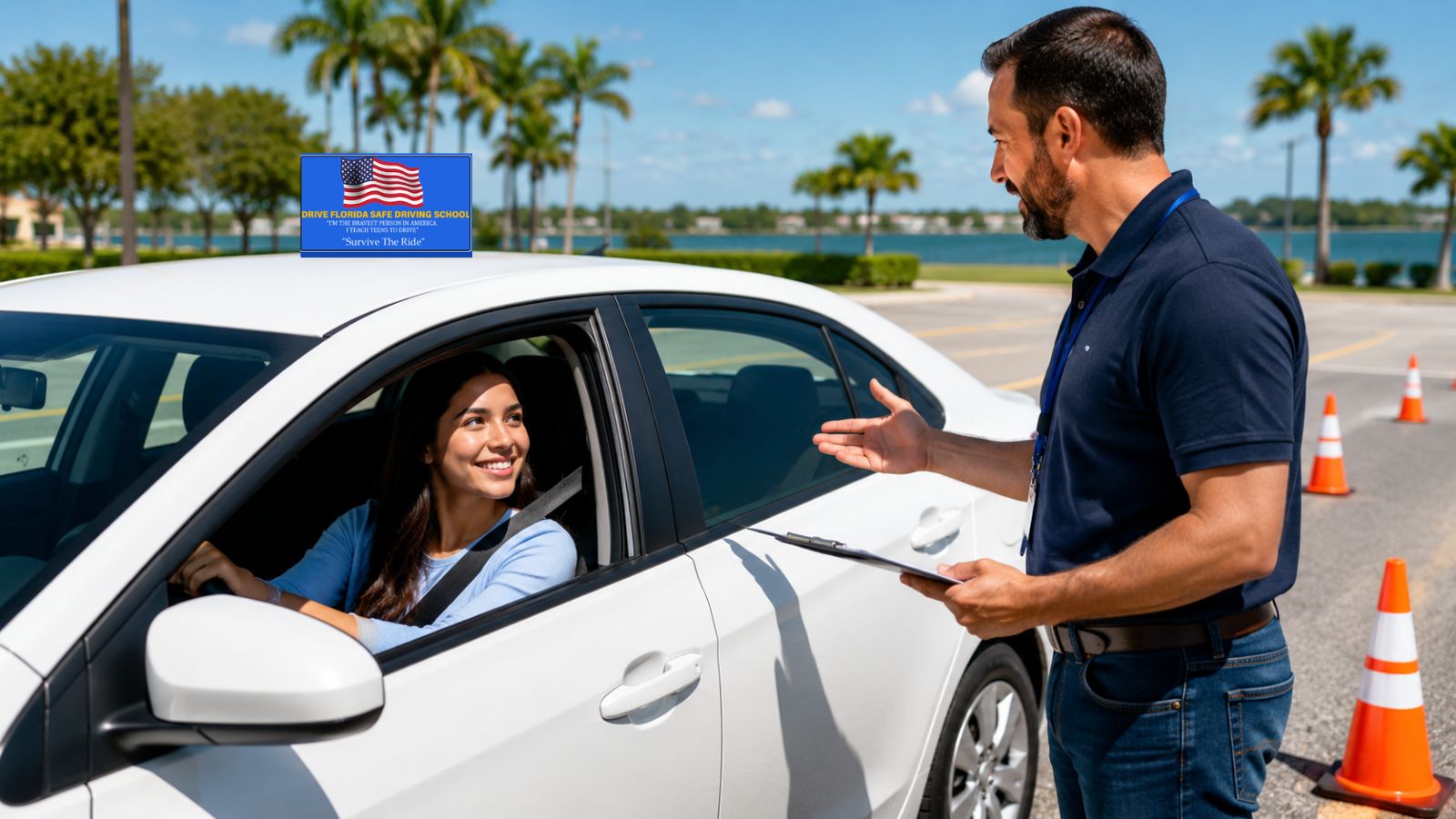
Learning to drive is about much more than passing a road test. For a new driver in Manatee County, the right training can build habits that remain valuable long after the learner’s license becomes a full driver license. With busy roads, changing traffic conditions, unfamiliar intersections, and the responsibilities that come with independent driving, choosing the right driver training in Manatee County students can rely on requires more thought than simply comparing lesson prices. The best program should develop confidence, awareness, decision-making, and safe driving habits through structured, practical instruction.
A quality driving program should prepare students for real-world situations rather than simply teaching them how to complete the maneuvers required for a driving test. Test preparation is important, but it is only one part of becoming a capable driver. Students need to understand how to observe traffic, anticipate mistakes made by other road users, maintain appropriate following distances, make safe lane changes, manage intersections, and respond calmly when conditions become unpredictable.
This is particularly important for teenagers who have limited experience judging speed and distance. A learner may understand traffic laws in theory but still struggle to recognize when another vehicle is approaching too quickly or when a gap in traffic is too small. Effective instruction bridges that gap between knowing a rule and applying it under pressure.
A strong program should also encourage students to explain their decisions. Asking a learner why they chose a particular lane, adjusted their speed, or waited before turning helps develop conscious decision-making rather than mechanical habits. Over time, the student becomes better at assessing situations independently instead of relying on constant instructions from another person.
The individual providing instruction can have a major influence on a learner’s development. A good driving instructor should be patient, observant, consistent, and able to explain mistakes without making the student feel embarrassed or overwhelmed. New drivers often make errors because they are processing several things at once, so an instructor needs to identify the underlying problem rather than simply point out the mistake.
For example, if a student repeatedly turns too wide, the problem may not be a lack of steering ability. They may be approaching the intersection too quickly, looking too late, or misunderstanding where the vehicle should be positioned before beginning the turn. An experienced instructor can break the maneuver into smaller decisions and help the learner understand what to watch for.
Communication style matters as well. Some students respond well to direct instructions, while others learn better when an instructor explains the reasoning behind a correction. A professional should be able to adapt without compromising safety. The goal is to gradually reduce dependence on the instructor as the student’s awareness and confidence improve.
Before booking lessons, parents and students should ask who will provide the training and what qualifications or certifications apply to the instruction. Florida regulations for commercial driving schools include requirements concerning instructor certification, age, licensing, driving records, background checks, and approved training. For instructors teaching students with learner or instructional permits, the applicable state rules specify that instructors must meet defined qualifications.
This does not mean a learner should judge a school solely by credentials. Qualifications establish an important baseline, while teaching ability determines how effectively those qualifications translate into learning. Ask how lessons are structured, how progress is evaluated, and how the instructor handles repeated mistakes. Those answers can reveal more about the learning experience than a promotional description alone.
A car instructor should teach more than steering, braking, and acceleration. Vehicle control is essential, but safe driving also depends heavily on observation and judgment. A learner who can smoothly operate a vehicle but does not scan intersections properly or recognize developing hazards is not fully prepared for independent driving.
One practical approach is to teach students to look beyond the immediate vehicle in front of them. They should gradually learn to observe several seconds ahead, identify possible hazards, and anticipate how traffic might change. For instance, a pedestrian approaching a crosswalk, a vehicle waiting to turn, or a car stopped unusually close to an intersection can all affect what the driver should do next.
Students should also practice making decisions without rushing. When a learner becomes nervous, they may accelerate through situations simply because they feel pressured by traffic behind them. Good instruction teaches that being temporarily delayed is usually preferable to making an unsafe decision. Confidence comes from knowing what to do, not from driving aggressively.
Defensive driving Manatee training should be viewed as a collection of habits rather than a single lesson. The purpose is to help drivers recognize potential hazards early enough to respond safely. This includes maintaining a suitable following distance, monitoring mirrors, scanning intersections, anticipating sudden lane changes, adjusting speed for conditions, and avoiding distractions.
A useful example is following another vehicle through a busy intersection. A new driver may focus entirely on the car immediately ahead. An experienced driver is more likely to look at surrounding lanes, traffic signals, pedestrians, turning vehicles, and possible escape spaces. This wider awareness provides more time to respond if something unexpected happens.
Defensive habits are particularly valuable because drivers cannot control the behavior of other people. Someone may turn without signaling, brake suddenly, drift across a lane, or misjudge a gap. A driver who consistently leaves enough space and monitors the surrounding environment has more options when another road user makes a mistake.
Teenagers often need additional practice because driving involves judgment that cannot be learned entirely from a textbook. The teen driver course Manatee families choose should therefore include opportunities to discuss risk recognition, distraction management, passenger behavior, speed control, and decision-making.
Parents can reinforce these lessons by creating calm practice opportunities outside formal instruction. Instead of giving constant commands, parents can ask questions such as, “What are you watching for here?” or “What could happen next?” This encourages the learner to develop independent awareness.
Florida’s official learner driving log guidance states that applicants under 18 must have a parent, legal guardian, or responsible adult certify at least 50 hours of driving experience, including 10 hours at night. The same guidance outlines restrictions that apply to learner-license driving. This makes supervised practice an important part of the overall learning process rather than something that should be treated as optional.
When comparing driving instructors Manatee students may have access to, local familiarity can be useful. Learning in the same general environment where a student expects to drive regularly allows instruction to become more relevant. Students can encounter different road layouts, traffic patterns, residential areas, commercial zones, and higher-speed roads as their skills develop.
Local experience does not mean that an instructor should simply repeat the same routes. In fact, relying on one predictable route can create false confidence. A learner may become comfortable because they know exactly what is coming next. A stronger training approach gradually exposes the student to different environments so they learn transferable skills.
For example, a lesson might begin in a quieter area where the student can work on basic vehicle control. Once those skills improve, the instructor can introduce more complex intersections, lane changes, heavier traffic, parking situations, and higher-speed roads. The progression should match the learner’s ability rather than being based solely on a fixed number of lessons.
Price matters, particularly for families balancing school, transportation, insurance, and other household expenses. However, choosing an affordable driving school should not mean selecting the cheapest advertised lesson without considering what is included.
Two schools can advertise similar hourly rates while providing very different amounts of value. One may offer structured instruction and progress feedback, while another may provide lessons with little explanation or continuity between sessions. Families should compare the complete package rather than looking only at the headline price.
Before enrolling, ask:
An affordable driving school Manatee families choose should provide transparent pricing and clearly explain what students receive for the cost. Affordable training is most useful when it provides meaningful instruction rather than simply reducing the number of minutes spent learning.
One of the most common mistakes is choosing a school entirely because of price. Budget is certainly relevant, but driving education is an investment in a skill that affects safety for years. A very inexpensive program may not be the best value if the learner finishes without sufficient confidence or needs extensive additional training later.
Another mistake is assuming that passing a driving test means someone is fully prepared for every real-world situation. A road test assesses specific skills under controlled conditions. Everyday driving can involve unpredictable weather, distracted road users, unfamiliar roads, heavy traffic, parking challenges, and sudden hazards.
Families should also avoid choosing a school based entirely on advertising claims. Look for clear explanations of the training process rather than promises that imply every student will become an expert after a fixed number of lessons. Good instruction recognizes that learners progress at different speeds.
Finally, do not overlook communication. If a school cannot clearly explain lesson length, pricing, scheduling, instructor qualifications, cancellation policies, or what happens when a student struggles with a particular skill, that uncertainty can become frustrating later.
Affordability should be considered alongside quality, consistency, and usefulness. A practical training program should provide enough time behind the wheel for the learner to practice repeatedly, receive feedback, correct errors, and demonstrate improvement.
A student who makes the same mistake three times in one session may not need more pressure; they may need a different explanation or a simpler environment in which to practice. Effective training recognizes this and adjusts accordingly. The objective is not to complete a checklist as quickly as possible but to build reliable habits.
Parents should also consider the value of continuity. If the same instructor works with the student over several sessions, that instructor can recognize patterns and track progress more effectively. Consistent feedback can make it easier for the learner to understand whether a problem is improving or simply appearing less frequently.
Before selecting a driving school in Manatee, prepare a short list of questions. Ask about instructor credentials, lesson duration, vehicle safety, scheduling flexibility, cancellation rules, training areas, and how the school approaches students who are nervous or inexperienced.
It is also worth asking how the program prepares students for independent driving rather than just the road test. A strong answer should involve hazard awareness, defensive habits, traffic judgment, parking, lane positioning, observation, and gradually increasing complexity.
For parents, another useful question is how they can support practice between professional lessons. Professional instruction and supervised family practice work best when they reinforce the same principles. Conflicting advice can confuse a new driver, so families should understand the techniques being taught and use consistent language when practicing together.
The learner’s preparation can make each session more productive. Arriving rested, wearing comfortable footwear, and avoiding unnecessary distractions can help the student focus. It is also useful to identify one or two skills to concentrate on rather than expecting to master everything at once.
After each lesson, the learner should consider three questions: What went well? What mistake occurred most often? What should be practiced next? Keeping simple notes can reveal patterns that are difficult to notice from one lesson to another.
Parents can also help by giving learners enough time to think. Constantly saying “brake,” “turn,” or “watch that car” may help in an immediate situation, but it does not teach independent decision-making. Once the vehicle is safe, discussing what the learner saw and why they reacted a certain way can create a much stronger learning opportunity.
Most importantly, do not rush the progression. A student who is comfortable in a quiet neighborhood may still need significant practice before managing complex traffic independently. Confidence should follow competence rather than replace it.
Finding the right driver training Manatee County learners can benefit from is ultimately about looking beyond the first lesson or the lowest advertised price. A strong program should combine qualified instruction, practical road experience, defensive driving principles, progressive skill development, and clear communication. Families should look for training that prepares a student not only to pass a test but also to recognize hazards, make responsible decisions, and handle unfamiliar situations with greater confidence.
For families comparing options, Drive Florida provides a local training option to consider when evaluating driver education. The most important decision, however, is choosing instruction that matches the learner’s current ability and provides a sensible path toward independent driving. Whether a student is completely new behind the wheel or needs additional practice, thoughtful training can make the transition to everyday driving more structured, informed, and manageable.
When comparing an affordable driving school in Manatee families can use, focus on the complete learning experience rather than a promotional price alone. Drive Florida can be considered alongside other providers while families compare lesson structure, instructor qualifications, practical training, scheduling, and overall value. The right choice should leave a new driver better prepared for real roads, real decisions, and the responsibilities that come with driving independently.
There is no universal number because students begin with different levels of experience, coordination, confidence, and road awareness. Some learners become comfortable with basic vehicle control quickly but need more time with traffic judgment, parking, lane changes, or defensive driving. The better measure is demonstrated ability rather than lesson count. A learner should be able to perform important skills consistently and make safe decisions without constant prompting before moving to more challenging environments.
Yes. Professional lessons and supervised family practice can complement one another. The instructor can introduce techniques and identify weaknesses, while parents can provide additional repetition between sessions. Florida’s learner-driving requirements for applicants under 18 include substantial supervised practice, so families should treat practice as a structured part of learning. Parents should follow the same safety principles taught by the instructor and avoid turning practice into a stressful argument.
No. Price is important, but value depends on what the learner receives. A lower price may be worthwhile if the instruction is well structured and transparent, but a cheap program is not automatically economical if students receive limited practice or inconsistent feedback. Compare lesson duration, instructor qualifications, vehicle arrangements, training structure, scheduling, and progress evaluation before deciding. The goal should be affordable, useful instruction that produces measurable improvement.
A teen should learn how to anticipate hazards, maintain safe space, scan intersections, manage distractions, adjust speed, change lanes safely, park confidently, and respond calmly to unexpected situations. They should also understand that other road users may make mistakes. Passing a test demonstrates a certain level of competency, but independent driving requires continued judgment and experience. A good training program should help learners build habits that remain useful after testing is complete.
Pay attention to communication, patience, structure, and the quality of feedback. A good instructor should explain why something was unsafe instead of simply criticizing the learner. They should also adjust instruction when a student struggles with a particular concept. Most importantly, the student should gradually become more independent. If every decision continues to come from the passenger seat after multiple lessons, the training may not be developing the learner’s own observation and decision-making skills effectively.
En Drive Florida Safe Driving School, estamos dedicados a ayudar a nuestros estudiantes novatos a convertirse en los conductores más seguros. Siempre nos esforzamos para que usted o su ser querido reciban las técnicas, los conocimientos y las normas de manejo defensivo más actualizados.



 Spanish
  English
