

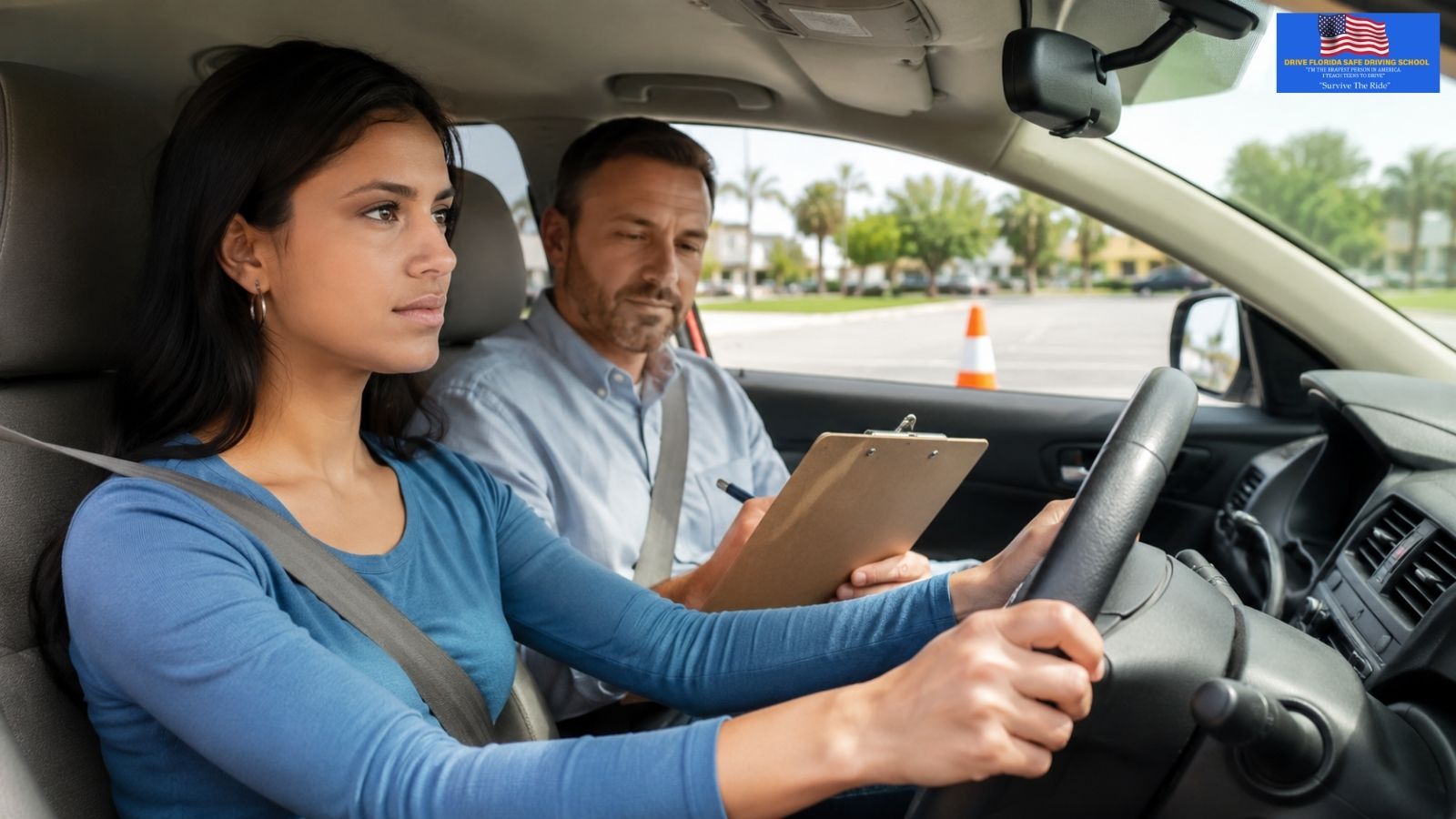
Passing the Florida driving test is not simply about knowing how to move a car. A student can understand traffic signs, know the basic rules, and still fail because of small habits that become serious mistakes during the actual driving skills test.
That is why effective Florida Road Test Preparation should focus on more than practicing the route. Students need to develop safe driving habits that become automatic under pressure.
For anyone searching for a driving school in Florida, one of the most useful questions to ask is not just, “How many lessons do I need?” but, “What mistakes are most likely to cause me to fail?”
The Florida Highway Safety and Motor Vehicles (FLHSMV) Class E driving skills test evaluates practical driving abilities including backing up, stopping at signs, obeying traffic signals, observing right-of-way, parking on a grade, passing, and signaling and turning. Applicants also need to provide a suitable vehicle with a valid license plate and insurance, and the vehicle is inspected before the test.
The good news is that most common mistakes can be corrected with deliberate practice.
This guide explains the errors instructors see most often, why they happen, and how students can prepare more effectively before test day.
Many beginners assume that if they can drive around their neighborhood without making obvious mistakes, they are ready for the test.
Real-world driving is more complicated.
During a driving exam, you are expected to demonstrate control of the vehicle while simultaneously observing traffic, signs, lane markings, pedestrians, other vehicles, speed, signals, and the examiner’s instructions.
That creates a different type of pressure.
A student may normally stop correctly at a stop sign but make a rolling stop because they become nervous. Another may know how to signal but forget because they are concentrating too heavily on an upcoming turn.
This is why structured driver training in Florida can be useful. Repetition allows correct procedures to become habits rather than decisions you have to consciously make every few seconds.
The goal is not to memorize a test route.
The goal is to become a predictable, attentive, and safe driver.
A common misconception is that the road test is primarily about whether you can steer smoothly.
Steering matters, but it is only one part of the assessment.
According to the Florida Driver License Handbook, the Class E driving skills test includes several practical maneuvers and traffic situations. These include backing up, approaching crossings, maintaining a safe following distance, obeying stop signs and traffic signals, observing right-of-way, parking on a grade, passing, and signaling and turning.
This means preparation should cover both vehicle-control skills and decision-making.
Students are expected to back up 50 feet at a slow speed while looking to the rear. The handbook specifically states that the driver should not use the rear-view mirror or rear-view camera monitor for this maneuver.
A common beginner mistake is backing too quickly.
Speed makes the vehicle harder to control and gives the driver less time to correct steering.
Practice slowly. Look where the test requires you to look, maintain control, and make small steering adjustments.
When approaching a crossing, the driver needs to be in the appropriate lane and check both directions.
Students sometimes focus only on whether another vehicle is immediately in front of them.
A better habit is to develop a scanning routine before entering an intersection.
Look for:
The examiner is looking for safe decision-making, not just mechanical vehicle control.
A strong driving school in Florida should prepare students for driving after the test, not merely teach them how to reproduce a sequence of maneuvers.
That distinction matters.
A student who learns to stop only because an examiner is watching may pass a test but still have poor driving habits.
A student who learns why complete stops, proper scanning, appropriate following distances, and controlled turns matter is developing skills that transfer to everyday traffic.
This is one of the easiest mistakes to underestimate.
A student approaches a stop sign, slows down, sees that the intersection appears empty, and continues moving.
From the driver’s perspective, it may feel harmless.
From an examiner’s perspective, it demonstrates that the driver has not made a complete stop.
The safer habit is straightforward:
Do not let an empty intersection convince you that stopping is optional.
Turn signals are simple, but nervous students frequently forget them.
The Florida handbook states that drivers should signal a turn for the last 100 feet and use mechanical or hand signals as applicable.
The problem is often not that the student does not know the rule.
The problem is task overload.
The student is thinking:
“Which lane should I enter? What is the speed limit? Is that car turning? Where is the examiner going to tell me to go?”
The signal gets forgotten.
Build the signal into your physical routine.
Before turning:
Check → signal → position → slow → observe → turn.
Practice this sequence until it becomes automatic.
Also remember to cancel the signal after completing the maneuver when your vehicle does not automatically do so.
A student may technically remain inside the lane but still demonstrate inconsistent lane control.
Common examples include:
These mistakes often come from looking too close to the vehicle.
Instead, develop a broader visual focus.
Look farther down the road while maintaining awareness of your immediate surroundings.
Your hands should make small steering corrections rather than constant large movements.
Knowing who has the right-of-way is important, but students also need to demonstrate that they are actively observing the environment.
One of the most dangerous habits is looking only in the direction the student expects traffic to come from.
Intersections can involve:
The Florida handbook specifically emphasizes observing right-of-way and allowing pedestrians to cross safely.
During Florida Road Test Preparation, students should practice scanning deliberately rather than relying on instinct.
New drivers often underestimate how much space they need behind another vehicle.
The Florida Driver License Handbook recommends maintaining a minimum following distance of three to four seconds.
Following too closely creates two problems.
First, you have less time to respond if the vehicle ahead brakes.
Second, it can make your driving appear rushed and reactive.
Choose a stationary object such as a sign or tree.
When the vehicle ahead passes it, count:
“one Mississippi, two Mississippi, three Mississippi…”
If you reach the object before completing your count, increase the distance.
This habit is useful beyond the driving test.
Parking on a hill can make students nervous because they are trying to remember several details simultaneously.
The Florida skills test includes parking on a grade, both uphill and downhill, with and without a curb.
The correct procedure should be learned through repeated practice rather than memorized immediately before the test.
Students should understand:
Practice this in a controlled environment before attempting it during an examination.
A common beginner pattern is approaching a turn at normal road speed and braking sharply just before entering it.
This can result in:
A better approach is to assess the turn early.
Reduce speed before entering the turn, select the correct lane, check for pedestrians and traffic, and then make a controlled steering movement.
Smooth does not mean slow everywhere.
It means appropriately controlled.
Pedestrian awareness is particularly important in areas with crossings, residential streets, parking areas, and intersections.
Do not assume that a pedestrian will behave exactly as expected.
Watch for people approaching a crossing and be prepared to stop when required.
A driver who is technically following the lane but fails to notice a pedestrian can create a serious safety issue.
This is one area where good driver training should emphasize judgment rather than memorization.
A beginner driving course is most useful when it provides structured repetition.
Consider a student who struggles with left turns.
Doing one left turn during a lesson may not solve the problem.
Instead, the instructor can observe several turns and identify the actual issue:
Once the underlying issue is identified, practice can become much more targeted.
This is more effective than simply driving around for an hour without a specific learning objective.
Cost matters when learning to drive, but the cheapest lesson is not necessarily the most affordable way to become test-ready.
Suppose Student A takes inexpensive lessons but spends most of the time driving without targeted feedback.
Student B takes slightly more structured lessons focused on specific weaknesses and practices those same skills between lessons.
Student B may need fewer total lessons because each session has a clear purpose.
When comparing affordable driving lessons, ask what the lesson actually includes.
Useful questions include:
The value of training is not determined by price alone.
For people interested in the professional side of driver education, a car instructor course in Florida can provide a pathway into driver instruction, subject to applicable Florida licensing and regulatory requirements.
From a teaching perspective, effective instruction requires more than knowing how to drive.
An instructor needs to recognize why a student is making a mistake.
For example, a student repeatedly turns too wide.
A weak teaching response might simply be:
“Turn tighter.”
A better instructor investigates the cause.
Perhaps the student is entering the turn too fast. Perhaps they are looking at the curb instead of the intended path. Perhaps they do not understand where the front wheels are tracking.
Correcting the underlying problem produces a more transferable skill.
This principle applies to learner training as well: the best lessons explain the reasoning behind a maneuver rather than asking students to memorize movements.
Quiet residential streets are useful for beginners.
But they cannot replicate every condition students may encounter during a road test or after receiving a license.
As confidence improves, training should gradually include appropriate combinations of:
The objective is not to overwhelm a beginner.
It is to increase difficulty progressively.
Test anxiety is normal.
The problem occurs when anxiety changes the driver’s behavior.
A nervous student may:
One of the best solutions is realistic practice.
Ask your instructor to conduct a mock examination.
During the mock test, the instructor should minimize unnecessary conversation and provide instructions in a manner similar to the real examination.
This helps the student experience the mental pressure before test day.
A student may practice perfectly but arrive for the examination in a vehicle with a problem.
That can create an avoidable issue.
FLHSMV states that the vehicle used for the driving skills test must have a valid license plate and insurance and will be inspected for safety. The handbook lists potential reasons for refusing to conduct the test, including defective brakes, tires, signals, mirrors, lights, certain visibility issues, an expired tag, and other vehicle deficiencies.
Before test day, check:
Do not wait until the appointment to discover a problem.
During the week before your test, review the following.
Do not become dependent on memorizing where a particular turn occurs.
You need to be able to perform the maneuver wherever the examiner asks.
Beginners often think that driving close to other vehicles demonstrates confidence.
It does not.
Controlled spacing gives you more time to react and makes your driving more predictable.
If you see a busy intersection ahead, do not wait until you are already entering it to decide what to do.
Good drivers anticipate.
You do not need exaggerated head movements.
But you do need to actually look and assess the environment.
Instead of asking:
“Am I ready?”
Ask:
“What are the three things I still do that could cause me to fail?”
That question usually produces much more useful feedback.
Failing does not necessarily mean you are a bad driver.
It means the examiner identified skills or decisions that did not meet the required standard during that attempt.
The important thing is to identify exactly what happened.
After an unsuccessful test, write down:
Do not simply schedule another test and repeat the same practice.
Use the result as diagnostic information.
Also check the current FLHSMV rules regarding retesting and appointments because procedures can change.
Successful Florida Road Test Preparation is about developing reliable driving habits that continue to work after the examiner leaves the vehicle.
The biggest mistakes are often surprisingly ordinary: rolling through a stop sign, forgetting a signal, following too closely, failing to check an intersection, turning too quickly, or allowing nervousness to interfere with basic vehicle control.
These problems are manageable when they are identified early and practiced deliberately.
For students considering a driving school in Florida, the strongest approach is to choose training that combines practical vehicle control with traffic awareness, decision-making, defensive driving, and realistic test preparation.
A good lesson should leave you knowing not only what to do, but why you are doing it.
That is ultimately what makes a learner safer and more confident behind the wheel.
Drive Florida can help learners approach their preparation with a practical, skill-focused mindset—so the goal is not simply to pass the road test, but to build habits that remain valuable every time you drive.
There is no single number that works for every student.
A complete beginner may require substantially more practice than someone who has already driven regularly under supervision.
The better measurement is competency.
You should be able to perform the required maneuvers consistently without constant instructor prompting. You should also be able to make safe decisions in ordinary traffic.
If you still make the same mistake repeatedly after several lessons, additional targeted practice is more valuable than simply counting the number of hours completed.
Common problem areas include incomplete stops, poor lane positioning, failure to signal, inadequate observation, incorrect right-of-way decisions, poor control while reversing, unsafe following distance, and mistakes during required parking maneuvers.
Vehicle problems can also prevent a test from proceeding. FLHSMV requires the test vehicle to meet applicable safety and documentation requirements.
The best preparation is therefore a combination of vehicle-control practice, traffic awareness, rule knowledge, and test-day vehicle preparation.
It can still be useful, particularly if you learned informally from family or friends.
A professional instructor can identify habits you may not realize are problematic.
For example, you may feel that your turns are smooth while an instructor notices that you consistently enter them too quickly or fail to check a particular area.
Professional instruction can also help you understand what the examiner expects and distinguish between merely operating a vehicle and demonstrating safe driving skills.
The difficulty depends heavily on preparation.
Students who have practiced the required skills repeatedly and can perform them without excessive prompting are generally better positioned than students who have only driven casually.
Nervousness can make a familiar maneuver feel difficult, which is why mock tests are valuable.
A useful final practice session should resemble the actual examination as closely as reasonably possible.
Avoid trying to learn completely new skills on test morning.
Instead, keep the routine simple.
Check your required documents and vehicle, adjust your mirrors and seat, review the key procedures, and arrive with enough time to avoid unnecessary stress.
If you have an instructor, a short warm-up can be useful, but it should reinforce skills you already know rather than introduce complicated new techniques.
Most importantly, do not rush.
Safe, controlled, predictable driving is more valuable than trying to impress the examiner with speed or unnecessary confidence.
En Drive Florida Safe Driving School, estamos dedicados a ayudar a nuestros estudiantes novatos a convertirse en los conductores más seguros. Siempre nos esforzamos para que usted o su ser querido reciban las técnicas, los conocimientos y las normas de manejo defensivo más actualizados.



 Spanish
  English
