

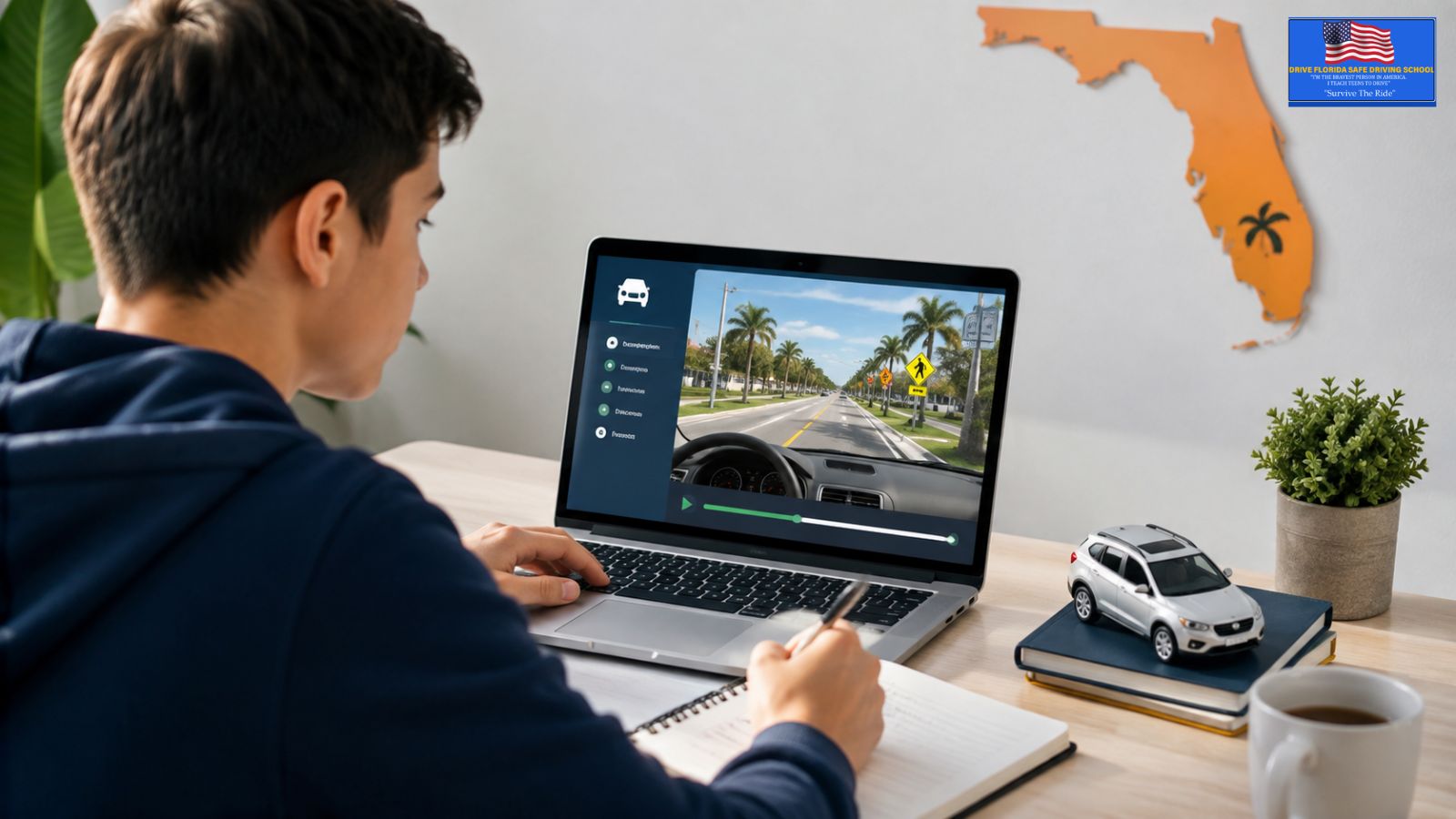
Learning to drive has always required more than memorizing traffic signs. New drivers need to understand Florida’s road rules, recognize hazards, make safe decisions, and build enough confidence to handle real traffic.
What has changed is how people prefer to learn the knowledge behind safe driving.
In 2026, more Florida beginners are looking for flexible ways to study traffic laws and prepare for the licensing process without having to attend every classroom session at a fixed time. This is one reason online driving courses in Florida for beginners are becoming an increasingly attractive option for students, busy adults, parents, and people who prefer learning at their own pace.
Online learning does not replace the importance of actual driving practice. A screen cannot teach someone how a vehicle feels when turning, braking, parking, or merging into traffic. However, a well-designed online course can make the knowledge portion of driver education easier to access, review, and understand.
Florida’s licensing requirements also make driver education an important part of the process. The Florida Department of Highway Safety and Motor Vehicles (FLHSMV) states that people who have never held a driver’s license in any state or jurisdiction must complete a Traffic Law and Substance Abuse Education (TLSAE) course before applying for a Florida driver license, subject to applicable alternatives.
So why are online options gaining attention in 2026? The answer comes down to flexibility, accessibility, technology, and the changing expectations of today’s learners.
Traditional classroom instruction still has value, particularly for students who learn best through direct interaction with an instructor. But fixed schedules are not always convenient.
A high school student may have sports, homework, and extracurricular activities. A college student may have classes throughout the day. A working adult may have only a few hours available in the evening.
Online learning can remove some of these scheduling problems.
A student may be able to study from home, review difficult material again, and fit lessons around other responsibilities, depending on the specific course provider and course rules.
This flexibility is one of the strongest reasons people are considering an online format.
Imagine a teenager preparing for a learner license while attending school during the day.
Instead of traveling to a classroom several evenings a week, an approved online course may allow the student to complete eligible coursework during available study periods.
The same applies to an adult who works a full-time job.
Rather than treating driver education as another fixed appointment, online learning can make it easier to fit required education into an existing routine.
Of course, students should always confirm that the specific online course they choose is approved for their intended licensing requirement.
Convenience does not mean taking shortcuts.
A good online course still requires students to learn the material. The difference is that the learning environment can be more accessible.
Students can often study in familiar surroundings without spending additional time traveling to a classroom.
This can be particularly useful for families managing transportation.
For example, a parent may have to drive a teenager to school, work, sports practice, and other activities. Reducing unnecessary travel for classroom-based education can make the overall licensing process easier to manage.
That practical benefit is one reason online driver education continues to appeal to modern learners.
Not everyone learns effectively by sitting in a classroom and listening to an instructor for several hours.
Some people understand information better when they can:
This is where digital learning can be useful.
A student who does not understand a particular traffic rule the first time can review the information instead of simply moving on.
That ability to revisit material can be particularly helpful for beginners who have never driven before.
The purpose of a driving course should not be simply to complete lessons.
The goal is to understand the rules well enough to apply them safely.
Beginners should develop knowledge in areas such as:
Florida’s official driver handbook covers a wide range of licensing and road-safety information, including traffic laws, driving privileges, crashes, and the point system.
A strong course should therefore help students understand the reasoning behind rules rather than encouraging them to memorize isolated answers.
One important misconception is that completing an online course automatically means someone is ready to drive independently.
It does not.
Driving has two major components: knowledge and practical skill.
Online education can help with the knowledge side. Actual driving practice is needed to develop vehicle-control skills and real-world decision-making.
For example, a student may understand the rule for changing lanes perfectly but still need supervised practice to judge mirrors, blind spots, speed, spacing, and traffic conditions.
That is why beginners should think of online education as one part of a broader learning process.
A sensible progression can look like this:
This approach helps prevent a common mistake: assuming that passing a knowledge assessment means someone is already a confident driver.
Preparing for the florida driving test should involve more than repeatedly answering practice questions.
Students should understand what the question is testing.
For example, if a question involves right-of-way, the goal should not be to remember one answer pattern. The student should understand why one driver has priority and how that principle applies to a different intersection.
Similarly, when learning road signs, beginners should understand the meaning and purpose of each sign rather than relying only on visual memorization.
This type of understanding is more useful when the learner eventually gets behind the wheel.
The phrase 4 hour driving course florida online can be confusing because several types of driver education are commonly discussed online.
For Florida first-time drivers, the four-hour requirement commonly refers to the Traffic Law and Substance Abuse Education (TLSAE) course. FLHSMV identifies TLSAE as a requirement for people who have never held a driver’s license in another state, country, or jurisdiction before applying for a Florida license, subject to qualifying alternatives.
It is important not to confuse this educational requirement with behind-the-wheel driver training.
A four-hour online course does not mean four hours of physical driving practice.
The exact requirements depend on the student’s situation and the type of license or course involved. Students should verify current requirements with FLHSMV and the course provider before enrolling.
This distinction matters because online searches often use broad phrases such as “four-hour driving course” when they may actually be referring to a specific traffic-law or substance-abuse education requirement.
Digital learning has become much more interactive than simply reading a PDF.
Modern online education can include:
These features can make complicated traffic situations easier to understand.
Consider a lesson about stopping distances.
A paragraph can explain the concept, but an animation showing how speed, reaction time, and road conditions affect stopping can make the idea more memorable.
For beginners, visual learning can be particularly valuable because many traffic situations are easier to understand when they are demonstrated rather than described.
Parents often play a major role in helping teenagers become safe drivers.
They may need to provide transportation, supervise practice, help with paperwork, and eventually assist with vehicle access.
An online education component can make the scheduling side easier.
For example, a student could complete eligible coursework during a quiet period at home, while practical driving sessions can be scheduled separately around the family’s availability.
This separation can make the entire learning process feel more manageable.
It also allows parents to focus their time with the student on actual driving practice rather than trying to teach every traffic rule from scratch.
Searching for the best online driving school Florida should involve more than comparing prices.
A low price does not automatically indicate a high-quality course, and a polished website does not automatically mean the provider is appropriate for your specific licensing requirement.
Before enrolling, consider the following:
Confirm that the course is approved for the requirement you need.
This is especially important for first-time drivers because Florida has specific education requirements.
A useful course should cover practical safety topics, not simply provide a long series of questions to memorize.
If you are using a phone, tablet, or computer, make sure the course works reliably on your preferred device.
Read the provider’s rules regarding progress, quizzes, identity verification, final assessments, certificates, and completion reporting.
If you encounter a technical or course-related problem, there should be a clear way to get help.
Be cautious about providers that imply an online course alone will make someone an experienced driver.
Good driver education should set realistic expectations.
Online driving classes Florida options can be useful for several types of learners.
Students can fit eligible coursework around school and extracurricular activities.
People with full-time jobs may appreciate being able to study during available hours.
Someone who has not driven for years may benefit from reviewing traffic rules before getting back behind the wheel.
Parents helping teenagers learn can use online education as a structured foundation before supervised practice.
Some learners simply retain information better when they can review material at their own pace.
The key is matching the learning format to the individual’s needs.
The biggest mistake is focusing only on completion.
The purpose of driver education is to develop useful knowledge.
If a learner rushes through lessons without understanding them, the course provides much less value.
Practice questions are useful, but memorizing answer patterns can create problems when a real-world situation looks different.
Learn the rule behind the answer.
A reputable online course should complement official Florida information, not replace it.
The FLHSMV handbook remains an important source for understanding Florida licensing rules and traffic information.
It does not.
A student needs actual supervised driving experience to develop vehicle-control and decision-making skills.
Trying to complete education, study for a knowledge exam, and arrange driving practice at the same time can create unnecessary stress.
Start early and build a realistic learning schedule.
Keep a short list of topics that require additional review.
For example, you might struggle with right-of-way situations, parking rules, or lane markings.
Review those topics again rather than simply moving forward.
When riding as a passenger, pay attention to traffic signs, lane markings, intersections, and driver behavior.
Ask yourself what you would do in the same situation.
This turns everyday travel into an informal learning opportunity.
If you can explain a traffic rule in your own words, you probably understand it better than if you can only recognize the correct multiple-choice answer.
Online learning can be convenient, but convenience should not become speed.
Take enough time to understand the material.
If you repeatedly miss questions about one topic, identify the underlying concept instead of simply retaking the test.
There is sometimes an assumption that online learning must be less effective than classroom learning.
That is not necessarily true.
The quality depends on the course design, instructional material, learner engagement, and whether the program meets applicable Florida requirements.
A poorly designed online course can be ineffective. A well-designed course can make information accessible, interactive, and easier to review.
The important question is not simply whether the course is online.
The better question is:
Does the course help the learner understand the information and prepare responsibly for the next stage of driver training?
That is the standard beginners should use.
As more learners look for convenient driver education options, businesses such as Drive Florida can help make the educational side of the process easier to navigate.
The important consideration for any student is to select a course that matches their specific needs and Florida requirements rather than choosing based only on convenience or price.
For beginners, the strongest approach combines structured education, careful study, supervised practice, and responsible preparation for the applicable licensing steps.
The broader trend toward online education is unlikely to disappear.
People are accustomed to learning through phones, computers, video platforms, and interactive digital tools. Driver education is naturally becoming part of that wider shift.
However, driving itself remains a physical and practical skill.
The future of driver education is therefore unlikely to be purely online or purely classroom-based. Instead, learners can benefit from a combination of digital education and real-world practice.
Online lessons can explain the rules.
Instructors can demonstrate techniques.
Parents or supervisors can provide additional practice.
And the learner must ultimately develop the judgment needed to apply everything safely on the road.
The growing interest in Online Driving Courses in Florida reflects a simple change in how people want to learn: they want education that fits into their schedules without sacrificing useful information.
For beginners, online learning can provide a convenient way to study traffic laws, understand safety principles, review difficult topics, and prepare for the knowledge side of the licensing process.
But convenience should never replace responsibility.
If you are researching online driving courses in Florida for beginners, start by confirming the course’s approval and purpose. Understand whether you are looking for TLSAE education, driver education, test preparation, or another specific requirement.
Then combine your online studies with real driving practice.
A learner who understands the rules, practices them behind the wheel, asks questions, and takes time to build confidence is better prepared than someone who simply rushes through a course to obtain a completion certificate.
In 2026, the value of online driver education is not that it makes learning effortless. Its real value is that it can make learning more accessible, flexible, and easier to fit into modern life—while giving beginners a stronger knowledge foundation before they take on the responsibility of driving.
Yes. They can help beginners learn traffic rules, signs, safety principles, and other important concepts before practical driving.
No. Online education teaches knowledge, while actual driving practice develops vehicle-control and road skills.
For many first-time drivers, the four-hour requirement refers to the TLSAE course. FLHSMV states that first-time applicants who have never held a driver license must complete TLSAE before applying, subject to applicable alternatives.
Study the official Florida driver information, understand the rules, use practice questions, and get enough supervised driving experience.
Check whether it is approved for your specific requirement, review its content, understand completion rules, and choose a provider that offers clear support.
At Drive Florida Safe Driving School, we are dedicated to assisting our novice learners to become the safest driver. We always strive to render that you or your loved one receives the most updated techniques, knowledge, and defensive driving norms.



 English
  Spanish
