

Passing a driving test is an important milestone, but it does not automatically mean a new driver is prepared for every situation on the road.
A driver may successfully complete a test by demonstrating basic control, following instructions, signaling correctly, parking, and responding appropriately to the examiner. Real-world driving, however, is much less predictable. There is no examiner telling you when a pedestrian may step toward a crossing, when traffic ahead may suddenly slow, or when another driver may enter your lane unexpectedly.
That is why Hazard Perception Matters.
For families searching for a Driving School in North River Ranch, one of the most valuable questions to ask is not simply, “Will my teen pass the driving test?” A better question is: “Will my teen learn how to recognize developing hazards early enough to respond safely?”
Hazard perception is the ability to observe the road environment, identify potential dangers, understand how those dangers may develop, and make an appropriate decision before a situation becomes an emergency.
This skill takes practice.
It involves more than looking straight ahead. Drivers must continuously scan intersections, parked vehicles, cyclists, pedestrians, traffic signals, lane changes, following distances, road surfaces, weather conditions, and the behavior of other road users.
For new drivers in North River Ranch and surrounding communities, developing these habits through structured training can make the transition from test preparation to independent driving much more meaningful.
Hazard perception is essentially anticipating what could happen next.
Consider a simple example.
You are driving through a residential area and notice a vehicle parked near the curb. Nothing appears dangerous. However, you also notice a child-sized bicycle beside the vehicle and limited visibility between parked cars.
An inexperienced driver may simply continue at the posted speed.
A driver with stronger hazard-perception skills may immediately think:
Someone could enter the roadway from behind that vehicle.
The driver can then reduce speed, increase observation, and prepare for a possible pedestrian or cyclist.
The important point is that no emergency has occurred.
Good hazard perception allows the driver to respond before the hazard becomes an emergency.
Not everything you see on the road is an immediate hazard.
A parked vehicle may simply remain parked.
A pedestrian may remain on the sidewalk.
A cyclist may continue in a predictable direction.
But each situation has the potential to change.
Good drivers continuously assess:
This is why hazard perception is closely connected with defensive driving.
A driving lesson should not become a rehearsal of the same route and maneuvers that may appear on a road test.
Test preparation has value, but effective Beginner Driver Training North River Ranch should also help students develop independent decision-making.
A new driver needs to learn how to:
These skills cannot be developed effectively through memorization alone.
A student may memorize where to stop for a particular maneuver. That does not necessarily teach them how to recognize an unfamiliar intersection that requires extra caution.
The objective should be to develop transferable driving skills.
A road test represents a limited period of driving under controlled evaluation.
Independent driving is different.
Once a new driver receives a license, there is no examiner sitting beside them.
They may drive:
The driver must make decisions independently.
That is why families should view the driving test as a minimum competency milestone, not the final destination of driver education.
A student who learns to recognize hazards early has a stronger foundation for continuing to develop after licensing.
A quality Driving School North River Ranch program should expose learners to more than basic vehicle control.
An instructor can deliberately create opportunities for students to practice observation and decision-making.
For example, instead of simply telling a student to slow down before an intersection, an instructor can ask:
“What are you looking for as you approach this intersection?”
The student might identify:
This changes the lesson from instruction-by-command to active observation.
One useful training technique is commentary driving.
The learner explains what they are observing while driving:
“There is a vehicle approaching from the side street.”
“The pedestrian is close to the crossing.”
“The vehicle ahead is braking.”
“The parked vehicles are limiting my visibility.”
The instructor can then evaluate whether the learner is identifying relevant information early enough.
Over time, the student should become capable of performing this mental process without verbalizing every observation.
Hazard perception becomes stronger when drivers learn to recognize patterns.
For example, a busy intersection may present several warning signs:
Individually, these observations may seem minor.
Together, they indicate that the driver should proceed cautiously.
Experienced drivers often perform this assessment almost automatically because they have accumulated thousands of observations.
A beginner does not yet have that experience.
Professional Driving Lessons North River Ranch can help accelerate the development of these observation habits through structured repetition and feedback.
Vehicle control is relatively straightforward to observe.
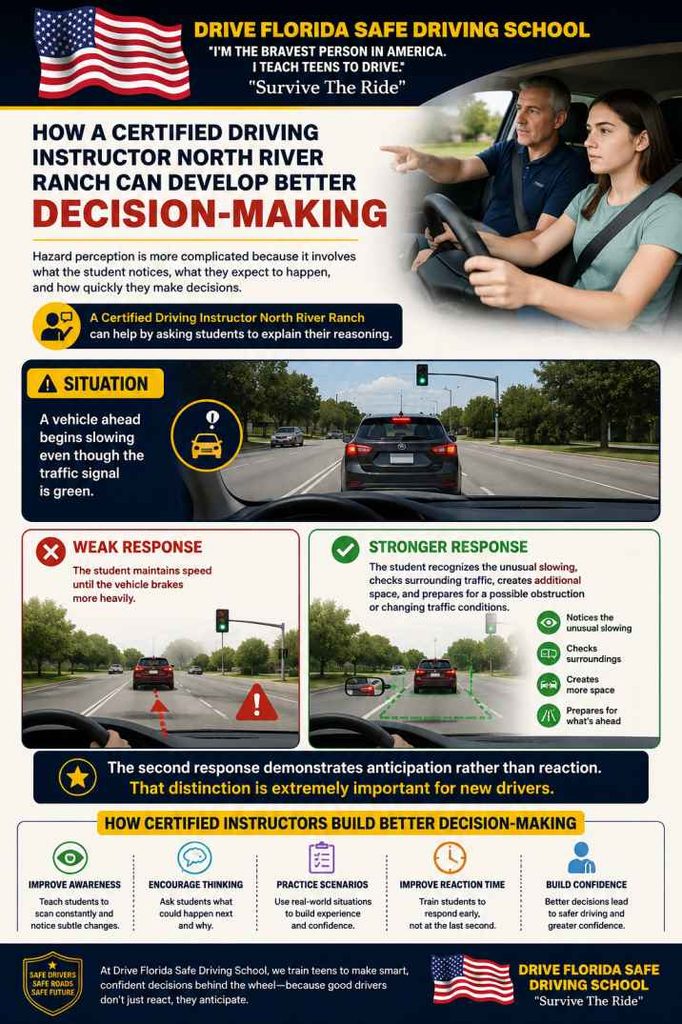
Hazard perception is more complicated because it involves what the student notices, what they expect to happen, and how quickly they make decisions.
A Certified Driving Instructor North River Ranch can help by asking students to explain their reasoning.
For example:
A vehicle ahead begins slowing even though the traffic signal is green.
The student maintains speed until the vehicle brakes more heavily.
The student recognizes the unusual slowing, checks surrounding traffic, creates additional space, and prepares for a possible obstruction or changing traffic conditions.
The second response demonstrates anticipation rather than reaction.
That distinction is extremely important for new drivers.
Many driving emergencies become serious because a driver notices the problem too late.
Imagine a driver traveling at a steady speed who suddenly sees stopped traffic ahead.
If they recognize the developing situation early, they have more options:
If they notice it only when they are close to the stopped traffic, their options become much more limited.
Hazard perception therefore creates something valuable:
time to think.
The earlier a driver recognizes a developing problem, the more controlled the response can be.
A new driver approaches a line of parked cars.
An experienced driver considers that pedestrians may emerge from between vehicles.
The correct response is not to assume someone will step out.
It is to recognize the reduced visibility and adjust driving behavior accordingly.
You approach an intersection and see a vehicle positioned as though it may turn across your path.
Even if the vehicle has not moved yet, its position provides information.
A driver should consider:
This is defensive observation.
Traffic ahead begins moving more slowly.
A beginner may focus only on the vehicle immediately in front.
A more experienced driver scans farther ahead to understand why traffic is slowing.
There could be:
Understanding the reason for a change in traffic flow helps a driver respond appropriately.
Hazard perception and speed management are closely connected.
Speed is not simply about obeying a posted limit.
A driver may need to adjust speed based on conditions such as:
A speed that feels comfortable on a clear road may provide less reaction time when visibility is reduced or traffic becomes unpredictable.
One of the most useful habits an instructor can teach is:
Do not drive at a speed that prevents you from responding comfortably to what you can see.
New drivers have limited experience processing multiple pieces of information simultaneously.
They may concentrate heavily on:
This can consume much of their attention.
As vehicle control becomes more automatic, more attention becomes available for environmental scanning.
That is one reason supervised practice is valuable.
The goal is to gradually move from:
“What am I supposed to do?”
to:
“What is happening around me, and what is likely to happen next?”
That shift represents an important stage of driver development.
Following the vehicle directly ahead is necessary, but it is not enough.
Drivers should develop a broader visual scan that includes farther traffic, intersections, roadside activity, mirrors, and potential conflicts.
A hazard does not have to be directly in the driver’s path before it deserves attention.
Early recognition creates more response options.
Familiar roads can create false confidence.
A driver who knows the route may stop actively scanning because they expect the road to behave the same way every time.
Conditions can change from one trip to another.
Smaller road users can be more difficult to see, particularly around parked vehicles, intersections, and areas with limited visibility.
New drivers should deliberately scan for them.
Tailgating reduces the amount of time available to respond when traffic ahead changes.
A proper following distance provides a valuable buffer.
A student may become highly focused on performing maneuvers exactly as practiced.
That can distract from the larger goal: becoming an independent and responsible driver.
Driver education does not stop when the lesson ends.
Parents can reinforce the same skills during supervised driving.
Instead of constantly giving commands, ask questions such as:
These questions encourage the learner to think rather than simply follow instructions.
There is an important balance.
A parent who provides continuous commands can unintentionally prevent the learner from developing independent judgment.
Give the student opportunities to identify hazards themselves, then discuss their decisions afterward.
Do not focus exclusively on what is immediately in front of the vehicle.
Looking farther down the road gives you more information about what traffic is doing.
Begin assessing an intersection before reaching it.
Look for traffic, pedestrians, turning vehicles, visibility limitations, and unusual positioning.
Static objects are generally predictable.
Changes deserve attention.
Examples include:
Good defensive driving is not about predicting every mistake another road user might make.
It is about avoiding situations where another person’s mistake leaves you with no options.
If you cannot see what is beyond an obstruction, recognize that you also cannot fully assess the risk beyond it.
Adjusting speed can provide additional time to respond.
Modern vehicles increasingly include technologies such as:
These systems can provide valuable assistance, but new drivers should not become dependent on them.
Sensors have limitations.
They may not recognize every hazard, may react differently depending on conditions, and cannot replace active observation and sound judgment.
A driver should understand these systems as driver-assistance technologies, not substitutes for responsible driving.
The real benefit of hazard perception is not limited to the first few weeks after obtaining a license.
It is a foundation for lifelong defensive driving.
As drivers gain experience, they become better at recognizing situations before they become dangerous.
They learn to notice:
This experience is valuable because safe driving depends heavily on anticipation.
A driver who continually scans and evaluates the environment is better positioned to make controlled decisions.
Learning to drive is about much more than passing an examination.
A successful test demonstrates that a learner can perform specific driving tasks under evaluation. Real-world driving requires something broader: continuous observation, anticipation, judgment, and appropriate responses to changing conditions.
That is why Hazard Perception Matters so much.
For families considering a Driving School in North River Ranch, the strongest training approach should help students progress from simply controlling a vehicle to understanding the road environment around them.
Quality Driving Lessons North River Ranch should give beginners opportunities to recognize developing hazards, evaluate risk, manage speed, maintain space, and make decisions independently. Working with a qualified Certified Driving Instructor North River Ranch can provide structured feedback while these skills are developing.
The ultimate goal is not simply to hear, “You passed.”
It is to help a new driver reach the point where they can confidently think:
“I see what is happening, I understand what could happen next, and I know how to respond.”
That is the foundation of safer, more responsible driving—and it is a skill worth developing long after the driving test is over.
Passing the test is important because it demonstrates that a learner has reached the required level of basic driving competency. However, passing alone does not represent every skill needed for independent driving.
Hazard perception develops the ability to recognize potential problems early and respond appropriately. A driver who can control the vehicle but does not notice developing hazards may still struggle in unpredictable traffic.
The two should work together: test preparation establishes fundamental skills, while continued hazard-perception practice helps turn those skills into safer real-world driving habits.
Start by deliberately scanning rather than simply looking ahead.
When approaching an intersection, ask what could change. When passing parked vehicles, consider whether someone could emerge. When traffic slows, look farther ahead to determine why.
During supervised practice, parents or instructors can ask the learner to identify potential hazards and explain their reasoning.
With repetition, this observation process becomes more natural.
Look beyond whether the school prepares students for the driving test.
Ask whether lessons include defensive driving, hazard identification, observation skills, speed management, following distance, intersection awareness, and independent decision-making.
It is also reasonable to ask how instructors assess progress and whether students receive specific feedback rather than simply being told what maneuver to perform.
Yes. Structured practice can help nervous drivers develop confidence gradually.
A good instructor can introduce increasingly complex situations rather than immediately placing a beginner in highly demanding traffic.
The objective is not to eliminate nervousness through reassurance alone. It is to build competence so the driver understands what to look for, how to respond, and when to adjust speed or position.
Yes, provided the practice is structured and appropriate.
Professional instruction establishes techniques and corrects problems, while supervised practice provides additional repetition.
Parents can reinforce hazard perception by asking their teen to identify what they see and what they expect might happen next. This helps bridge the gap between a scheduled lesson and the independent decision-making required after licensing.
At Drive Florida Safe Driving School, we are dedicated to assisting our novice learners to become the safest driver. We always strive to render that you or your loved one receives the most updated techniques, knowledge, and defensive driving norms.




 English
  Spanish
