
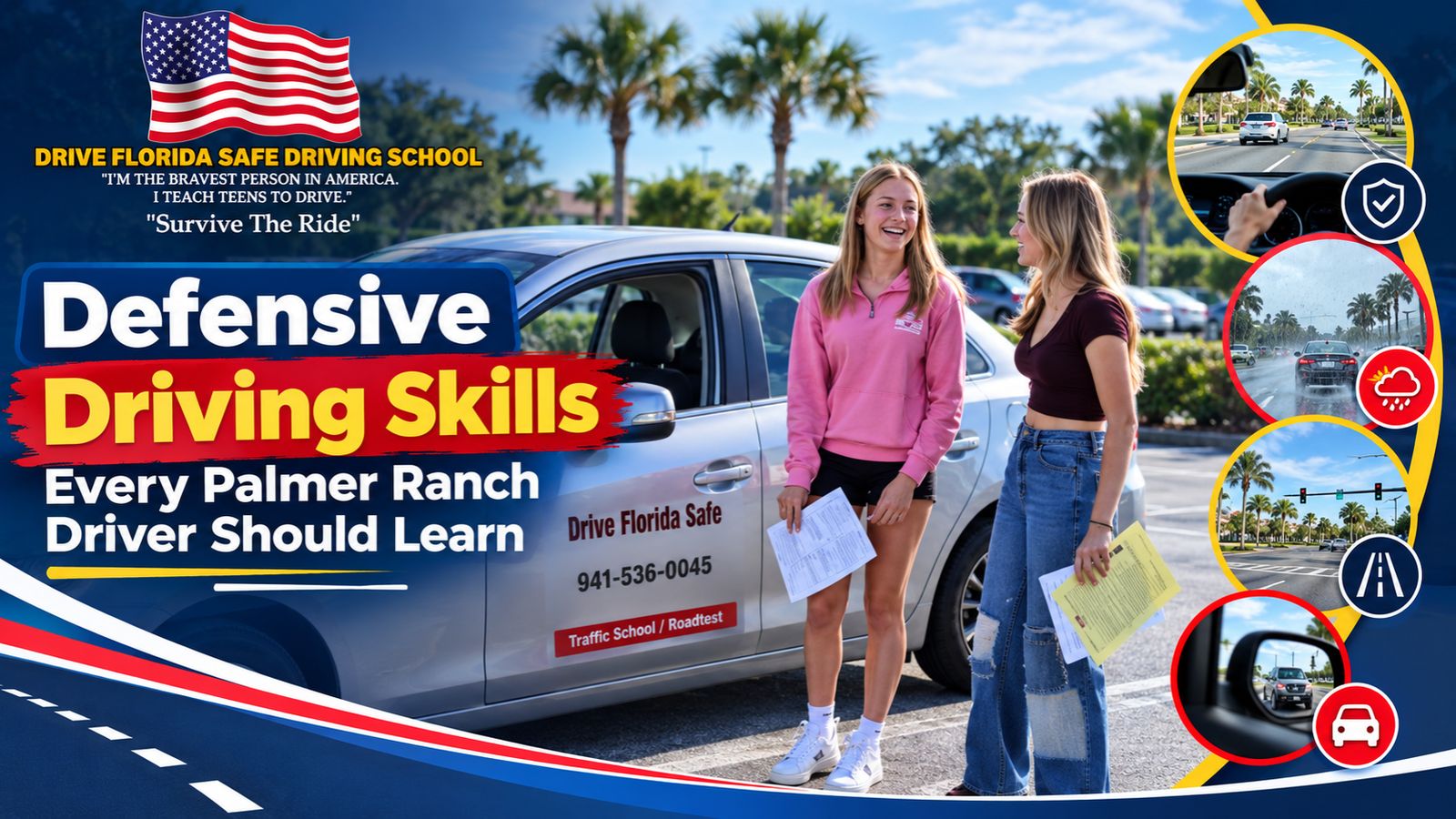
Driving safely involves much more than knowing how to steer, brake and follow traffic signs. Drivers must recognise potential hazards, anticipate the actions of others and make sensible decisions before a dangerous situation develops. Learning Defensive Driving Skills can help drivers handle everyday road conditions with greater awareness and confidence. For anyone attending a Driving School in Palmer Ranch, understanding these techniques is an important step towards becoming a responsible road user. From busy intersections to sudden Florida rain showers, defensive driving helps drivers prepare for situations that may be difficult to predict.
Palmer Ranch has residential streets, neighbourhood intersections, shopping areas, multi-lane roads and routes connecting drivers to other parts of Sarasota County. These different environments require drivers to adjust their speed, attention and positioning throughout a journey. A road that feels quiet in the morning may become busier when residents travel to work, collect children or visit local businesses.
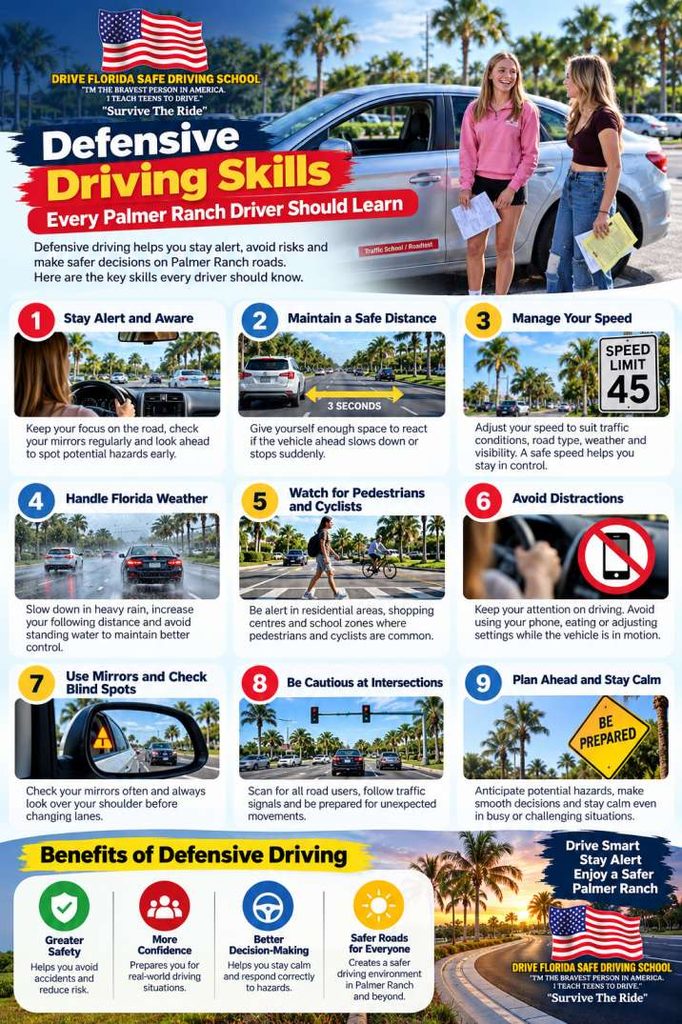
Defensive driving means identifying possible risks early and leaving yourself enough time and space to respond. It does not mean driving unusually slowly, braking constantly or assuming that every other road user will make a mistake. Instead, it involves maintaining awareness, following traffic laws and making decisions that reduce unnecessary risks.
Consider approaching an intersection where a vehicle is waiting to turn across your lane. Rather than assuming the driver has seen you, maintain a suitable speed, observe the vehicle’s position and be prepared to brake if needed. This simple habit gives you more options if the other driver moves unexpectedly.
For learners, practising these decisions during Driving Lessons Palmer Ranch can help turn road-safety principles into consistent driving habits.
Good observation is one of the foundations of defensive driving. Drivers need to understand what is happening directly ahead while also monitoring traffic behind them, vehicles approaching from the sides, pedestrians and changing road conditions. Looking only at the vehicle in front leaves less time to respond when traffic slows or a hazard appears.
Train yourself to look further along the road whenever conditions allow. This helps you notice brake lights, traffic queues, lane changes and possible obstructions earlier. At the same time, continue checking the nearer road area for potholes, pedestrians and other immediate hazards.
For example, if several vehicles ahead begin braking, easing off the accelerator early may give you more time to slow down smoothly. Waiting until the vehicle directly ahead brakes sharply can leave you with fewer options.
Mirrors help you monitor surrounding traffic, but they do not show every area beside or behind your vehicle. Before changing lanes, merging or moving away from the kerb, check your mirrors and perform an appropriate blind-spot check.
Avoid relying only on a quick mirror glance. A motorcycle or another vehicle may be travelling alongside you outside the mirror’s field of view. Combine mirror checks with direct observation, clear signalling and a lane change only when there is enough space.
Following too closely reduces the time available to react when the vehicle ahead slows down. A safe following distance gives you more opportunity to brake gradually and reduces the risk of a rear-end collision.
A useful starting point is the three-second following rule under favourable conditions. Choose a stationary reference point, such as a sign or tree. When the vehicle ahead passes it, count the seconds until your vehicle reaches the same point. If you arrive too soon, increase the gap.
More distance may be necessary in heavy rain, poor visibility, darkness or when road surfaces are slippery. Larger vehicles may also need additional space to stop safely.
Traffic congestion can make drivers impatient, but closing the gap rarely makes a journey meaningfully safer or more efficient. When another vehicle merges into your lane, allow space to develop again rather than responding aggressively.
If a driver behind you follows too closely, avoid sudden braking or confrontational behaviour. Maintain a predictable speed where safe, leave adequate space ahead and allow the following driver to pass when conditions and road markings permit.
Safe driving speed depends on more than the posted speed limit. Drivers must also consider visibility, traffic flow, road surface conditions, pedestrian activity and the distance available to stop. A legal speed may still be unsuitable when heavy rain reduces visibility or vehicles are moving unpredictably around an intersection.
Reduce speed when approaching sharp bends, busy pedestrian areas, roadworks or intersections with limited visibility. Make adjustments early and smoothly rather than braking sharply at the last moment.
For example, when approaching a shopping area, watch for vehicles entering parking spaces, pedestrians crossing between parked cars and drivers waiting to turn. A controlled approach gives you more time to recognise these movements.
Look for warning signs before a hazard becomes immediate. These may include a ball rolling into the road, a vehicle drifting towards a lane marking, brake lights appearing ahead or a pedestrian standing near a crossing.
You cannot predict every event, but you can improve your ability to recognise patterns. Experienced drivers often appear calm because they identify developing situations early, not because they can react instantly to everything.
Florida weather can change quickly, and rain can affect visibility, tyre grip and stopping distance. Water on the road may also conceal uneven surfaces or collect in areas with poor drainage. Defensive drivers prepare for these conditions before the weather becomes difficult.
When rainfall starts, reduce speed as appropriate, increase your following distance and switch on your headlights when required. Use windscreen wipers suitable for the conditions and ensure the glass remains clear. Avoid sudden steering movements, abrupt acceleration and harsh braking whenever possible.
The first rain after a dry period can make road surfaces particularly slippery as water mixes with accumulated road residue. Do not assume that a familiar road will provide the same grip in every weather condition.
Never drive through water when its depth or the condition of the road beneath it is uncertain. Water can hide hazards, affect vehicle control and create serious risks. If a route is flooded, choose a safe alternative rather than attempting to cross it.
If visibility becomes too poor to drive safely, find a suitable safe place to stop away from moving traffic and wait for conditions to improve. Do not stop in a live traffic lane simply because the rain is heavy.
Intersections require drivers to process several sources of information at once. Vehicles may turn across traffic, pedestrians may enter crossings and other drivers may misunderstand who has the right of way. Approaching with a clear plan can reduce confusion and improve safety.
As you approach an intersection, check traffic signals, lane markings, signs and the movement of other road users. Look for vehicles that may be turning, pedestrians near crossings and cyclists approaching from the side.
Do not assume another driver will stop simply because you have the right of way. Continue to follow traffic rules, but remain alert to vehicles that may enter your path unexpectedly.
Signal in advance, position the vehicle correctly and reduce speed as needed before turning. Check for pedestrians and cyclists, particularly when turning across a footpath or into a driveway. Keep your attention on the direction of travel instead of looking only at the gap you intend to enter.
Learners should practise these routines until checking, signalling and positioning become consistent habits rather than actions performed only during a driving test.
A distracted driver may miss a developing hazard even when travelling at a suitable speed. Distractions can include mobile phones, navigation adjustments, conversations, eating and repeatedly changing vehicle controls.
Before setting off, choose your route, adjust mirrors and seating, set the climate controls and secure loose items. If you need to change navigation settings or respond to an important message, stop in a legal, safe location first.
Passengers can also affect concentration, especially when a new driver is still developing confidence. Ask passengers to keep conversations manageable and avoid behaviour that distracts the driver.
Never allow a phone notification to compete with the task of driving. Even a brief glance away can mean missing a sudden stop or a pedestrian entering the road.
Defensive driving is useful for both new drivers and people who have held a licence for years. Beginners may need to develop observation routines and vehicle control, while experienced drivers may benefit from correcting habits that have become automatic.
Beginner Driver Training Palmer Ranch learners can benefit from structured practice that gradually introduces more complex road situations. Early sessions may focus on vehicle positioning, smooth braking, mirror checks and turning. As these skills improve, learners can practise handling busier intersections, merging and responding to changing traffic conditions.
A useful learning exercise is to discuss hazards after a practice drive. What did the learner notice first? Was there enough space to stop? Could the hazard have been recognised earlier? Reviewing decisions helps learners understand not only what they did, but why a different approach might be safer.
Adult Driving Lessons Palmer Ranch can help returning drivers refresh their skills after a long break or build confidence in unfamiliar conditions. An adult learner may already understand basic vehicle operation but feel uncertain about multi-lane roads, heavy traffic, parking or driving in rain.
Practice should focus on the individual’s actual needs rather than assuming that every learner starts at the same level. Gradual exposure, clear feedback and repeated practice can help adults improve without feeling pressured to manage difficult situations before they are ready.
One common mistake is assuming that defensive driving means reacting to danger at the last possible moment. In reality, the aim is to recognise hazards early and reduce the need for emergency reactions. Leaving space, scanning ahead and adjusting speed can help drivers avoid situations in which sudden braking becomes necessary.
Another mistake is treating other road users as predictable. A driver may fail to signal, a pedestrian may cross unexpectedly or a vehicle may stop suddenly. Defensive drivers allow for reasonable uncertainty without becoming aggressive or fearful.
Drivers should also avoid overconfidence. Familiarity with a route does not remove risks, and a long driving history does not guarantee that someone will notice every hazard. Continue checking mirrors, following road rules and adapting to the conditions rather than relying solely on experience.
Finally, do not confuse assertive driving with aggressive driving. Clear signalling, appropriate lane positioning and steady speed are useful. Tailgating, competing for space and retaliating against another driver increase risk and should be avoided.
A Certified Driving Instructor Palmer Ranch can help learners identify habits that may be difficult to notice when driving alone. Guided practice can focus on observation, following distance, hazard recognition, decision-making and safe responses to common traffic situations.
During a lesson, ask for specific feedback. For instance, you might ask whether you are checking mirrors early enough, choosing a suitable gap at intersections or maintaining enough space behind the vehicle ahead. Specific questions make it easier to turn feedback into an actionable practice goal.
You can also review each drive using three questions:
Use these questions to identify one or two areas for improvement rather than trying to change every habit at once. Consistent practice is generally more useful than rushing through difficult situations without understanding them.
Learning to drive safely is an ongoing process that extends beyond passing a driving assessment. Drive Florida Safe Driving School can be considered by learners who want to strengthen their observation, hazard awareness and decision-making through structured driving practice. Focusing on individual learning needs can help students understand where they are progressing and which skills need further attention.
For drivers seeking a Driving School in Palmer Ranch, the most useful learning experience is one that builds practical skills rather than relying on memorising instructions alone. Defensive driving practice should help learners recognise hazards, maintain appropriate space, follow traffic rules and make calmer decisions in changing conditions.
Beginners should prioritise observation, safe following distance, speed management, mirror checks and hazard recognition. These skills help drivers identify developing risks before they become emergencies. For example, looking further ahead can reveal slowing traffic early, while checking blind spots helps reduce the risk of moving into another vehicle’s path. Practising these habits consistently is more useful than focusing only on steering and vehicle control.
Start by approaching at a suitable speed and scanning traffic signals, lane markings, pedestrians and turning vehicles. Signal clearly, position the vehicle correctly and avoid entering an intersection unless there is enough space to proceed safely. Practise less complex intersections before progressing to busier ones. Reviewing decisions with a qualified instructor can help drivers identify missed hazards and develop a more consistent approach.
Avoid sudden braking or responding aggressively. Maintain a safe, predictable speed and leave enough space ahead to reduce the need for abrupt stops. Where safe and permitted, allow the following driver to pass. If the behaviour creates an immediate threat, prioritise reaching a safe location rather than engaging with the other driver. The objective is to reduce conflict and preserve room to manoeuvre.
Reduce speed to suit visibility and road conditions, increase following distance and use headlights when required. Avoid sudden braking, sharp steering and driving through standing water of uncertain depth. Check that your tyres and windscreen wipers are in suitable condition before driving in wet weather. If conditions make it difficult to see or control the vehicle safely, stop at an appropriate safe location away from traffic.
Yes. Experienced drivers may develop habits that reduce their attention to mirrors, following distance or changing road conditions. Refresher lessons can help identify these habits and practise safer alternatives. They may also help drivers returning after a long break or adjusting to unfamiliar traffic environments. The most useful approach is to focus on specific needs, receive clear feedback and practise improvements consistently.
At Drive Florida Safe Driving School, we are dedicated to assisting our novice learners to become the safest driver. We always strive to render that you or your loved one receives the most updated techniques, knowledge, and defensive driving norms.



 English
 Spanish

