
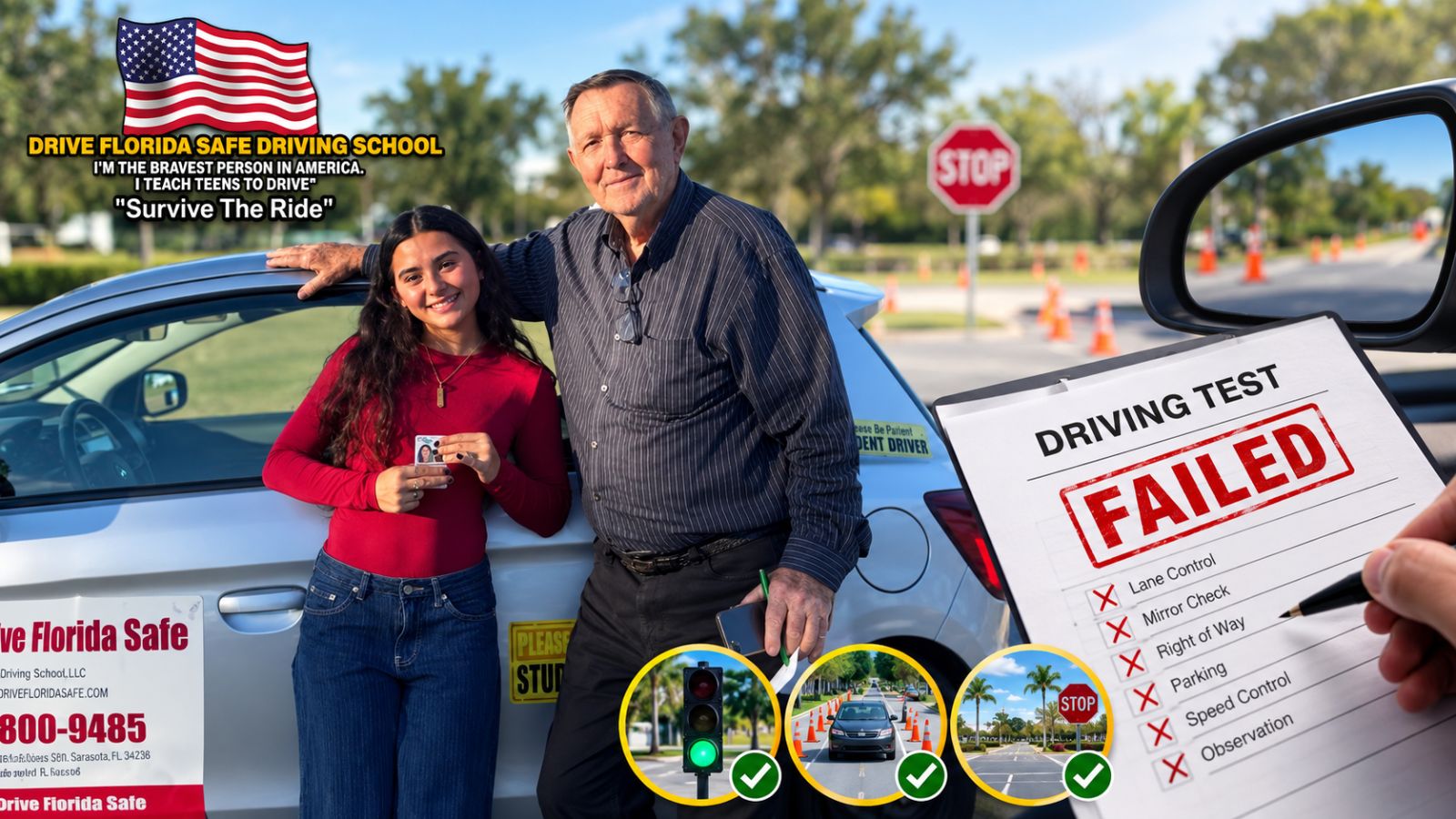
Failing a road test can feel discouraging, especially when you believed you were ready. You may have driven confidently during practice, followed your instructor’s directions, and still received a result you did not expect.
The important thing is that Failed Your Driving Test does not mean you are a bad driver. In many cases, a failed test identifies a small group of skills that need more consistency. The goal before your next attempt should not simply be to “drive the same route again.” It should be to understand exactly what went wrong, correct the underlying habit, and demonstrate safe decision-making consistently.
For learners preparing with a Driving School in Harrison Ranch, this can be an excellent opportunity to turn a disappointing result into a structured improvement plan.
Florida’s official driver handbook confirms that original Florida driver license applicants generally complete a vision and hearing screening, Class E knowledge exam, and driving skills test, subject to applicable exceptions. Driving skills examinations can be administered through state licensing locations and authorized providers.
This guide explains what to do after an unsuccessful test, which driving habits deserve attention, and how focused Road Test Preparation Harrison Ranch can help you become more prepared for your next attempt.
A road test is not simply a demonstration that you can make a car move.
It evaluates whether you can operate the vehicle while making safe, controlled and predictable decisions. A learner might be comfortable driving around a familiar neighborhood but become inconsistent when asked to change lanes, respond to traffic, maintain appropriate speed, or perform a maneuver under observation.
That distinction matters.
Someone can have good basic vehicle control but still need work on:
The solution is therefore not always “take more lessons.”
The better question is:
What specific behavior caused the test result, and what practice will change it?
That is where targeted instruction becomes more valuable than simply spending additional hours behind the wheel.
The first mistake many learners make is scheduling another test immediately without analyzing the previous attempt.
Give yourself time to review what happened.
As soon as possible after the test, record:
Memory becomes less reliable with time, so writing these details down can reveal patterns.
Ask yourself whether the problem was technical or psychological.
For example, suppose you normally check mirrors correctly but forgot during the test because you were concentrating intensely on the examiner’s instructions.
That is different from not knowing when or how to check your mirrors.
The first problem requires better test-day concentration. The second requires additional training.
If feedback was provided, treat it as useful information rather than criticism.
A professional instructor can help translate that feedback into practical exercises.
For example:
Feedback: Poor lane positioning.
Training response: Practise maintaining lane center using visual reference points, mirror checks and appropriate steering corrections.
This approach is much more productive than simply driving around hoping the issue disappears.
After an unsuccessful test, practice should become more deliberate.
Instead of driving randomly for an hour, divide your practice into individual skills.
Good driving starts with seeing what is happening around the vehicle.
A learner should develop a consistent observation routine rather than checking mirrors only when they remember.
Practise checking:
The objective is not to stare at mirrors continuously. It is to build an efficient visual scanning pattern.
An experienced instructor will often watch the driver’s head movement, mirror usage and awareness of surrounding traffic—not just whether the vehicle stays inside the lane.
Speed problems are often more subtle than simply driving too fast.
A learner may technically remain within the posted limit but still drive too quickly for a particular traffic situation.
For example, entering a turn too quickly can make steering less controlled. Approaching an intersection without reducing speed appropriately can reduce reaction time.
Practise asking:
“Is my current speed appropriate for what I can see ahead?”
That question encourages defensive decision-making instead of simply watching the speedometer.
A technically correct stop can still feel uncomfortable if braking is abrupt.
Work on:
Smooth braking demonstrates vehicle control and gives you more time to observe what is happening around the car.
A common problem with beginner practice is that learners repeat the entire driving session instead of isolating their weaknesses.
If parallel parking is the problem, spend dedicated time on parallel parking.
If lane changes are the problem, practise lane changes under progressively more realistic conditions.
If intersections are the problem, practise different intersection scenarios.
This is the foundation of effective Beginner Driver Training Harrison Ranch.
A safe lane change involves more than activating the turn signal.
Build a consistent sequence:
Mirror → Signal → Blind-spot check → Confirm space → Move smoothly → Cancel signal
Do not rush through the sequence.
The purpose of practice is to make the process predictable enough that you can perform it without becoming overwhelmed.
Many learners struggle because they approach turns too quickly or position the vehicle incorrectly.
Practise:
The goal is a controlled turn rather than simply completing the turn.
Parking requires spatial awareness, vehicle positioning and patience.
Instead of trying to memorize one steering movement, learn how the vehicle responds.
Practise identifying:
This makes parking more adaptable when the space or surroundings are different from your practice location.
One of the biggest misconceptions about preparing for a road test is that you only need to memorize where the examiner may take you.
That strategy is risky.
A test route can contain familiar types of situations, but real driving requires you to respond to changing traffic conditions.
Florida’s Class E skills-examination framework requires approved examination routes and procedures, and official materials emphasize that the skills exam is conducted according to prescribed requirements. FLHSMV
Therefore, preparation should focus on transferable skills.
A strong practice session might include:
This creates a driver who understands what to do—not someone who simply remembers where to turn.
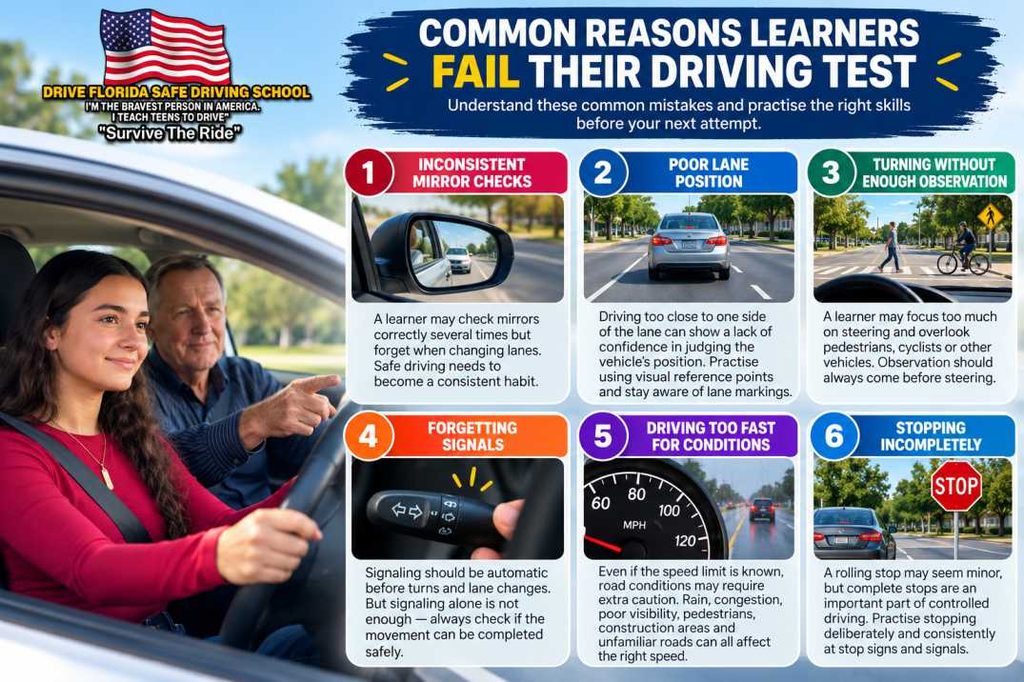
There is rarely one universal reason for an unsuccessful road test. However, several recurring weaknesses can affect performance.
A learner may check mirrors correctly five times and then forget once when changing lanes.
That inconsistency matters.
Safe driving needs to become habitual.
Driving too close to one side of the lane can indicate that the learner is not yet comfortable judging the vehicle’s position.
Practise using visual reference points and maintaining awareness of lane markings.
A learner may focus so strongly on steering that they overlook pedestrians, cyclists or other vehicles.
Remember that steering is only one part of turning.
Observation comes first.
Signaling should become automatic before turns and lane changes.
However, signaling alone does not make a maneuver safe. The driver must still check whether the movement can be completed safely.
Even when the speed limit is known, road conditions can require additional caution.
Rain, congestion, visibility, pedestrians, construction areas and unfamiliar situations can all affect appropriate speed.
A rolling stop may feel minor to a learner, but complete stops are an important part of controlled driving.
Practise stopping deliberately and consistently.
This is extremely common.
A learner can perform well during practice and suddenly make basic mistakes when someone is evaluating them.
The answer is not simply “don’t be nervous.”
Instead, practise under conditions that gradually increase pressure.
Stage 1: Drive with a familiar person.
Stage 2: Drive with an instructor giving minimal assistance.
Stage 3: Ask the instructor to behave more like an examiner.
Stage 4: Complete a mock test without unnecessary coaching.
Stage 5: Review mistakes only after the drive is finished.
This allows the learner to practise independent decision-making.
A useful rule is:
Do not practise until you can complete the task once. Practise until you can complete it consistently.
A qualified instructor provides something that family practice often cannot: an objective assessment.
Parents or relatives may know the learner well, but they may also overlook small habits because they become accustomed to them.
A Certified Driving Instructor Harrison Ranch can focus specifically on driving behavior.
For example, an instructor may notice that a learner:
These details can make the difference between general practice and targeted improvement.
The goal should not be to make the learner dependent on the instructor.
It should be to help the learner become independent.
One of the most useful questions an instructor can ask is:
“Why did you do that?”
For example:
“Why did you slow down here?”
A strong driver can explain the reason.
Perhaps there was limited visibility, a pedestrian nearby, traffic entering from another direction, or a potential hazard ahead.
That demonstrates understanding rather than memorization.
Good driver education teaches learners to recognize hazards and make appropriate decisions before the situation becomes urgent.
Repeating the same driving routine after an unsuccessful test can produce the same result.
Imagine a learner failed because of poor lane changes.
They then spend five additional hours driving straight roads but only perform a few lane changes.
They technically practiced driving, but they did not practise the problem.
A better approach is to create a weakness-first practice plan.
Problem: Weak lane changes
Practice: Controlled lane changes with mirror and blind-spot checks
Problem: Poor stopping
Practice: Stop-sign and traffic-light approaches
Problem: Parking errors
Practice: Multiple parking attempts with feedback
Problem: Missed signs
Practice: Active road-sign recognition
Problem: Test anxiety
Practice: Mock examination with minimal prompting
This makes every practice session purposeful.
Feeling confident is helpful, but confidence alone is not a reliable readiness test.
Instead, look for consistency.
You should be able to:
If one skill remains unreliable, address that skill before scheduling another attempt.
A few focused sessions can be more useful than many unfocused hours.
Not necessarily.
More driving only helps when the practice addresses the actual weakness.
No.
A road test is a snapshot of performance under specific conditions. A failed result can identify areas for improvement.
Route familiarity can help reduce uncertainty, but it should never replace genuine driving ability.
You need to know how to respond when traffic, road conditions or instructions change.
Family practice is valuable, but an independent assessment can reveal habits that family members may not notice.
There is no advantage in rushing into another attempt if the same problems remain.
Use the previous test as diagnostic information.
The beginning of the test can be stressful.
Practise settling into the vehicle, checking surroundings and following instructions calmly.
Safe and controlled driving is more important than trying to impress the examiner with speed.
If an instruction is unclear, make sure you understand it before acting when it is safe and appropriate to do so.
Do not spend the entire test thinking about whether you are passing.
Focus on the next driving decision.
One small mistake does not automatically mean the entire test is lost.
Avoid allowing one error to create three more.
If your instructor constantly tells you what to do, you may perform well during lessons without being ready for an independent test.
The instructor should gradually reduce assistance as your ability improves.
For learners who need structured support after an unsuccessful test, Drive Florida Safe Driving School can be positioned as part of the solution through targeted instruction rather than simply adding more driving hours.
The most useful approach is to identify the learner’s specific weaknesses and build practice around those areas. That might mean working on intersections, lane changes, parking, observation, speed management, or confidence under test-like conditions.
The emphasis should remain on becoming a safer and more independent driver—not merely trying to pass once.
After all, the purpose of a driving test is bigger than receiving a license. It is an opportunity to demonstrate that you can make safe decisions when you are responsible for a vehicle.
A failed test can be frustrating, but it can also provide valuable information.
Instead of asking:
“How do I pass next time?”
Ask:
“What specifically prevented me from demonstrating safe, consistent driving?”
That change in perspective can completely improve your preparation.
Identify the weakness. Practise it deliberately. Get objective feedback. Complete realistic mock drives. Then evaluate your consistency before retaking the test.
If you Failed Your Driving Test, you do not necessarily need to start from the beginning. You need to understand where your performance broke down and address that gap with focused practice.
For learners looking for a Driving School in Harrison Ranch, the right training should leave you better prepared not only for your next examination, but also for the everyday responsibility that begins after you pass.
Start by identifying exactly what went wrong. Write down the examiner’s feedback and everything you remember about the test while it is still fresh. Separate technical problems, such as poor lane positioning or parking, from test anxiety or concentration issues. Then build your next practice sessions around those specific weaknesses instead of simply repeating general driving.
There is no universal number. It depends on why you failed and how consistently you can perform the affected skills. Someone who made one isolated parking mistake may need very different preparation from a learner who repeatedly struggles with lane changes, observation or speed control. A professional assessment can help determine which skills need additional practice.
Route familiarity can be useful, but it should not become the main preparation strategy. A good Road Test Preparation Harrison Ranch plan should expose you to different traffic situations, intersections, turns, lane changes, parking situations and decision-making scenarios. You want skills that transfer to unfamiliar roads, not just memory of a particular route.
Yes. Nervousness can often be reduced through structured exposure to test-like situations. A Certified Driving Instructor Harrison Ranch can gradually reduce assistance, conduct mock tests and help you practise making decisions independently. The objective is not to eliminate every feeling of nervousness but to prevent anxiety from interfering with safe driving behavior.
Retake it when your weak areas have become consistent rather than immediately after the unsuccessful attempt simply because you want another opportunity. Complete several realistic practice drives and, ideally, a mock assessment without constant prompting. If you can consistently demonstrate safe observation, vehicle control, traffic awareness and decision-making, you are in a much stronger position for another attempt.
At Drive Florida Safe Driving School, we are dedicated to assisting our novice learners to become the safest driver. We always strive to render that you or your loved one receives the most updated techniques, knowledge, and defensive driving norms.




 English
 Spanish

