
Getting behind the wheel for the first time can feel more complicated than it actually is. Florida has specific licensing stages, testing requirements, supervised-driving rules and documentation requirements, and missing one step can mean another trip to the licensing office. If you are researching how to get a Florida driver’s license, the key is understanding the process in the right order. This 2026 guide explains what first-time drivers need to know, from eligibility and the learner’s license through practice, testing and the Class E license.
For most first-time drivers, getting a Florida Class E driver licence is a process rather than a single test. A new driver generally needs to establish identity and eligibility, complete the required education, pass the applicable knowledge and vision examinations, obtain a learner’s licence where applicable, build supervised driving experience, and eventually complete the driving skills examination.
The exact path depends on your age and circumstances. A teenager applying for a learner’s licence has different restrictions from an adult applying for a first licence. Drivers under 18 also have additional requirements concerning parental consent, supervised driving and traffic violations. Florida’s official driver handbook states that a learner’s licence applicant must be at least 15, complete the required education course, provide identification and pass the vision and Class E knowledge examinations.
That distinction matters because online advice sometimes combines the rules for teenagers and adults. Before booking a test or paying for lessons, determine which category applies to you. It prevents a common problem: completing plenty of driving practice only to discover that an administrative requirement has not been completed.
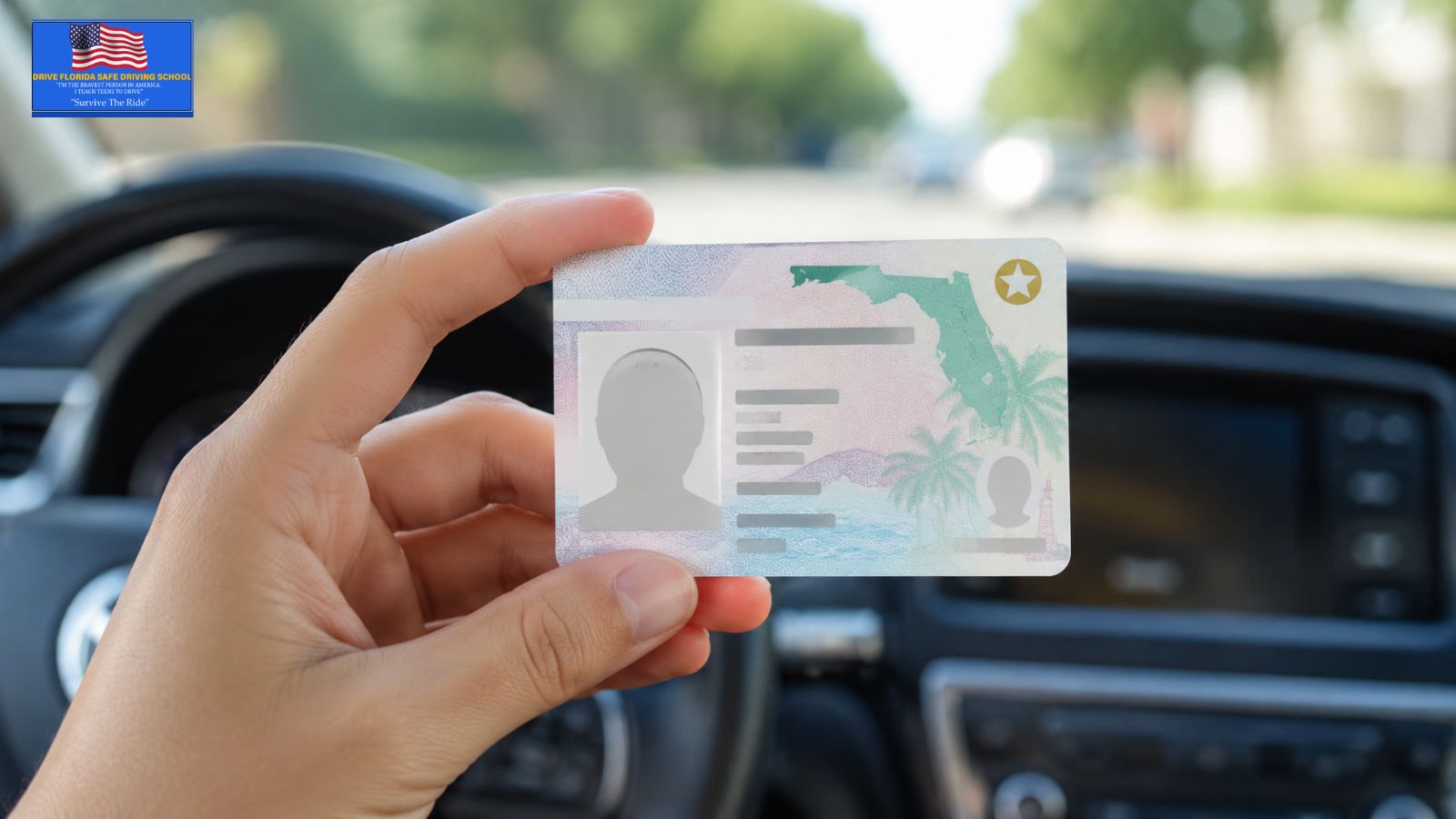
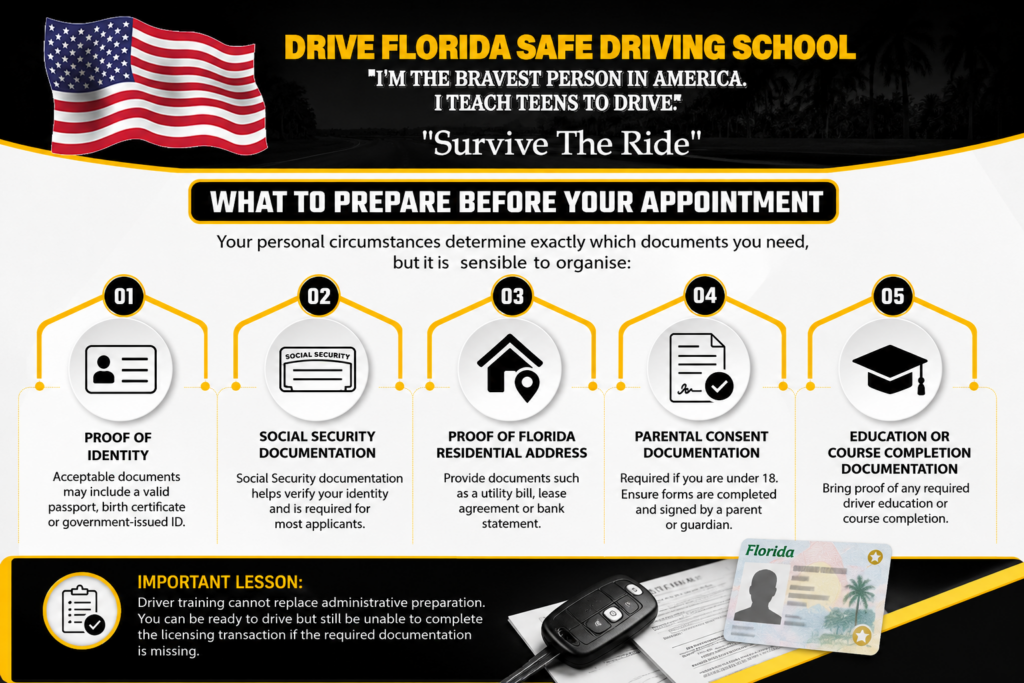
Before studying for a test, make sure you can prove who you are and satisfy Florida’s licensing requirements. The licensing process requires acceptable identification and supporting documentation. Depending on your circumstances, this can include documents establishing identity, Social Security information and residential address.
For applicants under 18, parental consent can also be required. Florida provides a specific parental consent process, and the relevant form explains that a parent or legal guardian must sign the application unless an applicable exception applies.
A practical approach is to prepare your documents before making an appointment. Check that names and dates of birth are consistent across documents, and bring originals or otherwise acceptable documentation rather than assuming a photograph or photocopy will be sufficient.
Your personal circumstances determine exactly which documents you need, but it is sensible to organise:
The important lesson is simple: driver training cannot replace administrative preparation. You can be ready to drive but still be unable to complete the licensing transaction if the required documentation is missing.
Education is an important part of the Florida licensing pathway. New drivers should understand the state’s traffic laws, signs, safe-driving principles and substance-abuse-related requirements before progressing through the licensing process. FLHSMV explains that new drivers must complete the applicable traffic-law and substance-abuse education requirement before applying for a Florida license, with certain certified driver-education programme providing an exemption from the separate TLSAE requirement.
This is also where choosing structured education can make a practical difference. A beginner driving course should not simply teach someone how to move a car forward and stop. Good instruction connects road rules with real driving decisions: judging gaps in traffic, scanning intersections, managing speed, positioning correctly and responding calmly when another driver behaves unpredictably.
For teenagers, it is particularly important to confirm the current education requirement rather than relying on older articles or advice from friends who obtained their licences years ago. Florida requirements can change, and official FLHSMV information should take priority over outdated blog posts.
The Class E Knowledge Examination tests your understanding of Florida road rules and safe-driving practices. It is not simply a memory exercise. The strongest preparation comes from understanding why particular rules exist and how they apply in everyday traffic.
A common mistake is to read the driver’s handbook once and assume that is enough. New drivers often recognise individual signs but struggle when several decisions must be made together. For example, approaching an intersection involves more than knowing who has priority. You also need to observe traffic, pedestrians, lane markings, signals and the actions of other road users.
Effective driving classes can reinforce what you study for the knowledge test by showing how road rules translate into practical behaviour. A learner who understands the reasoning behind lane positioning, following distance and right-of-way decisions is generally better prepared for real traffic than someone who memorises answers without understanding them.
If you are studying independently, break the material into manageable topics. Focus on traffic control devices, right-of-way, speed management, safe following distances, parking rules, alcohol and drug-related driving laws, defensive driving and sharing the road with vulnerable road users.
Do not rush through practice questions simply to see your score. When you get an answer wrong, identify the rule behind the mistake. That approach builds knowledge that remains useful after the examination.
For younger first-time drivers, the learner’s licence is an important stage of the process. Florida’s official handbook identifies 15 as the minimum age for a learner’s licence and lists completion of the applicable education requirement, identification, vision testing and the Class E Knowledge Examination among the requirements.
The learner’s period should be treated as structured training rather than simply a waiting period. This is when a new driver begins developing habits that will eventually become automatic. Smooth braking, consistent mirror checks, controlled steering, proper signalling and appropriate speed management all improve through repetition.
One useful strategy is to practise in progressively difficult environments. Start in a quiet area where basic vehicle control can be developed without unnecessary pressure. Move into residential streets, then busier roads, multi-lane traffic, larger intersections and eventually higher-speed routes. The aim is to increase complexity gradually rather than placing a beginner into challenging traffic before they are ready.
For drivers under 18, supervised practice is an important part of preparing for a Florida Class E driver licence. Before applying, a parent, legal guardian or responsible adult who is at least 21 years old must certify the required driving experience, and Florida also applies specific learner’s licence and traffic-violation requirements to applicants under 18.
The purpose of supervised driving should be skill development rather than simply completing a requirement. A learner needs opportunities to build safe habits, understand traffic situations and make sound decisions independently. Repeating the same familiar route may provide confidence, but it does not necessarily prepare a new driver for the variety of situations encountered on Florida roads.
A stronger practice approach introduces different driving environments and skills progressively. One session can focus on vehicle control and parking, while another can involve lane changes, intersections, merging and navigating busier roads. Learners should also practise in different weather and lighting conditions when it is safe and appropriate to do so. This variety helps develop adaptability, observation and confidence instead of relying on memorised routes.
Parents and supervising adults can make practice more effective by giving clear, constructive feedback. Rather than correcting every small movement, they should help the learner understand why a decision was unsafe and how to handle a similar situation correctly. Keeping track of the skills already practised can also reveal areas that need more attention before the learner progresses to independent driving and the Class E driving skills examination.
A driving log can reveal gaps in experience. Record the conditions, duration, skills practised and whether the session occurred during the day or at night. Florida provides a learner’s licence driving log for recording this experience.
This is particularly useful for parents. Instead of asking, “Have you practised enough?”, they can ask more meaningful questions: Have you driven in heavier traffic? Have you practised merging? Can you park confidently? Have you driven after dark? Can you remain calm when traffic behaves unexpectedly?
Family practice has value, but professional instruction can identify habits that relatives may overlook. An experienced instructor can observe steering technique, mirror use, speed control, lane positioning and decision-making without the emotional dynamics that sometimes occur between parents and teenagers.
Quality driver training in Florida should be tailored to the learner rather than delivered as an identical sequence for everyone. One student may need additional work on parking, while another may struggle with judging intersections or maintaining lane position. The instructor’s job is to identify those weaknesses and turn them into specific practice goals.
Professional instruction can also be useful before a road test. A learner who has passed the knowledge examination may still have several practical habits to correct. A pre-test assessment can provide an outside perspective on whether the driver is actually ready or simply familiar with a particular practice route.
The driving skills examination is where theoretical knowledge has to become safe, controlled driving. Florida-approved third-party administrators conducting Class E skills examinations must follow state procedures, use approved routes or examination areas and verify that the applicant has a valid Florida learner’s licence before administering the examination.
Preparation should therefore go beyond memorising a list of manoeuvres. Practise the fundamentals repeatedly:
One of the most useful pre-test exercises is to conduct a realistic mock assessment. The learner should drive without constant coaching while the instructor observes. This can reveal whether the student can make safe decisions independently rather than only when someone tells them what to do.
Failing a driving test does not mean someone is incapable of driving. It usually means specific skills or decision-making habits need more work. The worst response is to immediately repeat the test without addressing the reason for the unsuccessful attempt.
Ask what went wrong. Was it observation? Lane control? Speed? Signalling? Parking? Nervousness? If the weakness is identifiable, additional practice should focus specifically on that area.
Florida also permits authorised driver-education administrators to conduct Class E knowledge and skills examinations under prescribed procedures, so applicants should confirm testing arrangements with the relevant licensing office or authorised provider before attending.
Passing the written examination is an important milestone, but it does not demonstrate independent driving ability. A learner needs practical experience to develop observation, judgement and vehicle-control skills.
Fifty hours on one quiet residential loop does not provide the same experience as practising intersections, lane changes, parking, night driving and different traffic conditions. Variety matters because real-world driving rarely repeats the same scenario.
Last-minute practice often creates unnecessary anxiety. Driving skills develop through repetition over time. Short, regular sessions are generally more useful than one long session immediately before an examination.
No legitimate instructor can guarantee that a student will pass. A professional can prepare the learner, identify weaknesses and provide realistic feedback, but the applicant must demonstrate safe driving independently during the examination.
Searches for a car instructor course in Florida can lead to information intended for people who want to become driving instructors rather than people trying to obtain their first licence. Those are different objectives. Florida has specific requirements for commercial driving-school instructors, including instructor certification and qualifications; FLHSMV rules state that instructors must hold a valid Class E licence and meet other requirements before certification.
If your goal is simply to obtain a personal Class E licence, you generally need driver education and practical preparation—not an instructor qualification.
The most effective approach is to work backwards from the final goal. Instead of asking only, “What do I need to pass?”, ask, “What kind of driver do I need to become to handle Florida traffic safely?”
Practise observation as deliberately as steering. Before changing lanes, develop a repeatable sequence of mirror checks, signal use, blind-spot awareness and safe movement. At intersections, look beyond the vehicle immediately in front of you. During parking practice, learn to control the car slowly rather than relying on speed and last-second corrections.
If affordability is important, compare the value of affordable driving lessons, not simply the lowest advertised price. A cheaper lesson that provides little personalised feedback may not save money if the learner needs multiple additional sessions. Look at instructor qualifications, lesson structure, vehicle condition, pickup arrangements and whether the provider offers an honest readiness assessment.
Most importantly, use official FLHSMV information to verify licensing requirements before your appointment. Regulations, forms, testing arrangements and administrative procedures can change. A current government source should always outrank an old social-media post, forum answer or outdated article.
The first step is determining which licensing pathway applies to you based on your age and circumstances. For many first-time drivers, the process involves meeting identification requirements, completing the applicable education requirement, passing the vision and Class E knowledge examinations, obtaining a learner’s licence where required, practising under the applicable restrictions and completing the driving skills examination. Florida’s official handbook provides the current framework for learner’s and Class E licensing.
A driver under 18 must generally have at least 50 hours of driving experience, including at least 10 hours at night, before applying for a Class E licence. A parent, legal guardian or responsible adult aged 21 or older must certify the experience.
The important point is to make those hours meaningful. Practise different roads, traffic conditions and manoeuvres rather than repeating the same easy journey.
Professional lessons are not the same thing as the state’s licensing requirement, but they can be extremely useful. A qualified instructor can identify unsafe habits, provide structured practice and conduct a realistic assessment before the test. This can be particularly valuable for learners who have practised primarily with family members and want an independent evaluation.
Focus on controlled, observable driving rather than trying to memorise a test route. Practise complete stops, turns, lane changes, signalling, mirror checks, speed control, parking, vehicle positioning and awareness of other road users. A good mock test should also require you to drive with minimal prompting so you can demonstrate independent decision-making.
The requirements can differ according to age and circumstances, so adults should not automatically apply teenage learner restrictions to themselves. The safest approach is to confirm your specific eligibility and education requirements with FLHSMV before testing. The official handbook distinguishes learner and Class E requirements and identifies additional conditions that apply to applicants under 18.
Knowing how to get a Florida driver’s license is useful, but understanding how to become a capable driver is even more important. The strongest preparation combines accurate knowledge of Florida’s licensing requirements with consistent practical experience, thoughtful supervision and professional feedback when needed. Whether you are a teenager working toward your first licence or an adult learning later in life, the goal should be confidence built on sound judgement—not simply getting through an examination.
For learners who want structured guidance, Drive Florida can help make the practical side of learning more manageable through appropriately paced instruction and real-world preparation. The best outcome is not merely leaving the testing office with a licence; it is having the skills and judgement to use that licence safely every day on Florida roads.
At Drive Florida Safe Driving School, we are dedicated to assisting our novice learners to become the safest driver. We always strive to render that you or your loved one receives the most updated techniques, knowledge, and defensive driving norms.



 English
  Spanish
