
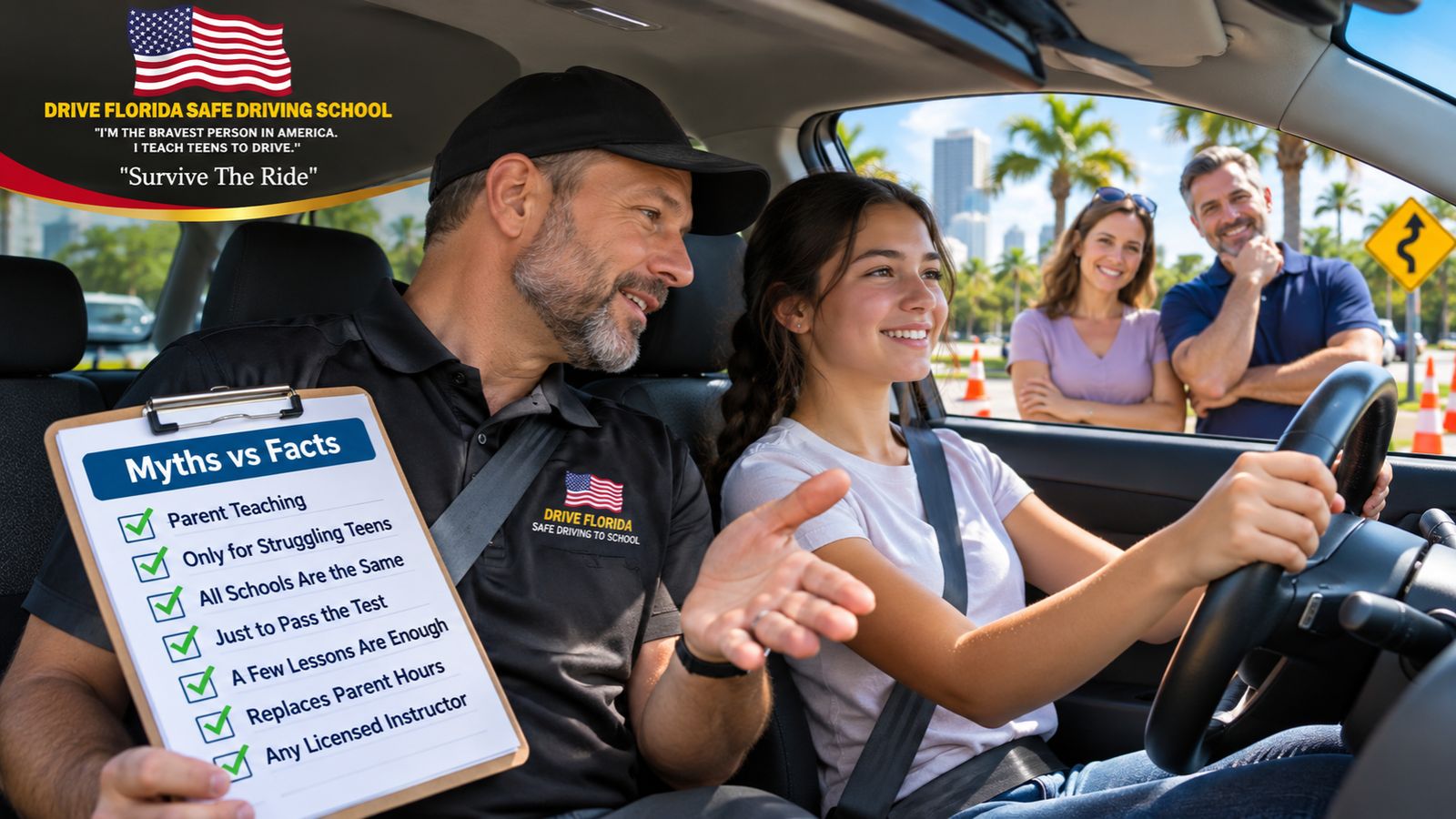
I learned from my dad, so my kid can learn from me. We hear this from parents all the time, and we understand it. Teaching your own teen feels natural, and professional lessons can seem like an extra step. But many beliefs about choosing a driving school in Florida come from a time when roads were quieter and the rules were simpler.
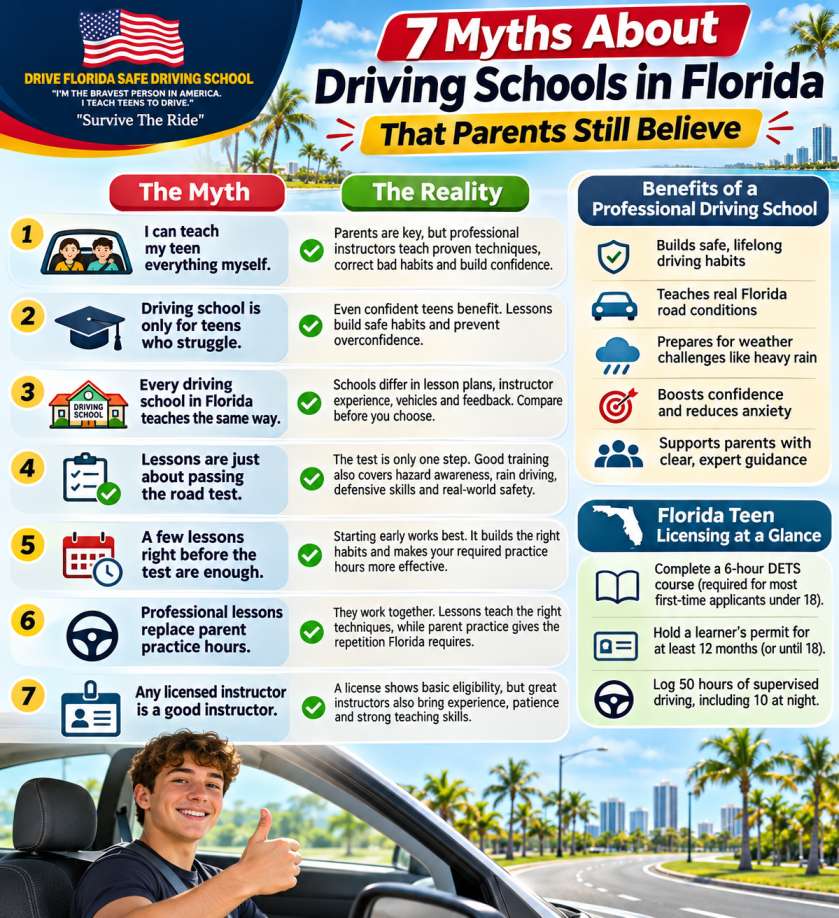
This guide breaks down the 7 Myths About Driving Schools that still shape how Florida parents decide. You will learn what is true, what is outdated, and how to give your teen the safest possible start behind the wheel.
Florida roads are busier than ever. New communities keep growing, highways carry heavy year-round traffic, and tourists add more cars that drive with little local knowledge. Sudden summer storms turn dry roads slick within minutes. A new driver who only practices on quiet streets can feel overwhelmed the first time all of these conditions show up together.
Florida’s teen licensing rules have also changed. Since August 2025, teens under 18 who have never held a license must complete a six-hour Driver Education Traffic Safety course, known as DETS, before they can apply for a learner’s permit. Teens must then hold that permit for at least 12 months, or until they turn 18, while a parent certifies at least 50 hours of supervised driving, including 10 at night. Good driver training in Florida helps families move through each stage with confidence instead of guesswork.
Each myth below comes from real conversations with parents. For each one, we explain the truth and share a typical scenario that shows why it matters.
Parents play a huge role in a teen’s driving journey, and the law relies on that role. However, most parents drive on instinct. They forget why they do certain things, so they struggle to explain them clearly. Many also carry habits they no longer notice, such as rolling stops, one-handed steering, or late turn signals. Teens copy what they see.
A trained instructor breaks each skill into simple steps and explains the reason behind every move. Picture a parent who tells a teen to “just merge” onto the highway. The teen hesitates, slows down, and panics. An instructor instead teaches the merge in stages: check mirrors, find the gap, match speed, signal, and commit. The difference shows up fast.
Many parents see lessons as a fix for a problem. In truth, confident teens often benefit the most. Confidence without correct technique can turn into overconfidence, and overconfident new drivers take more risks. Professional lessons channel that confidence into safe, steady habits before bad ones form.
This belief causes more poor choices than any other. Lesson plans, instructor skill, vehicle safety, and feedback quality vary a lot from one school to the next. A well-structured lesson plan moves in a clear order, from basic car control to neighborhood streets, busy roads, and finally highways. A poorly planned one may repeat easy skills and skip the hard ones. Before you choose a driving school in Florida, ask exactly how the lessons progress.
Passing the test matters, but it is only one moment. The real goal is a lifetime of safe driving. Strong lessons cover hazard awareness, safe following distance, driving in heavy rain, handling aggressive drivers, and staying calm when something goes wrong. These skills never appear on a checklist, yet they prevent crashes every day.
Some families book lessons only in the final weeks before the road test. By then, habits are already set, and breaking a habit takes far longer than building a good one. Starting a beginner driving course early in the permit stage works better. Each lesson then guides the supervised practice that follows, so every family drive builds on correct skills.
This myth catches many families off guard. Professional lessons do not replace the supervised hours a parent must certify for a teen license. The two work together. Lessons teach the right technique, and parent-led practice gives teens the repetition they need. Think of the instructor as the coach and the family drives as practice sessions between games.
A license shows that an instructor met basic requirements. It does not show how well they teach. Completing a car instructor course in Florida gives instructors the rules and methods, but patience, clear communication, and the ability to calm a nervous teen come from experience and care. Ask how instructors handle a student who freezes at a busy intersection. The answer tells you a lot.
Now that the myths are clear, use these practical checks when you compare options.
Even after choosing well, a few mistakes can slow progress. The first is practicing the same short route every day. It adds hours but builds little skill. The second is reacting with sharp words when a teen makes an error. Panic in the passenger seat creates panic behind the wheel. The third is skipping night and rain practice until the last month. Florida conditions change fast, so spread these drives across the full permit period.
At Drive Florida Safe Driving School, these are the tips we share most often with parents.
The 7 Myths About Driving Schools often lead parents to skip the support that makes the biggest difference. The truth is simple: professional lessons and parent practice work best together. Choose a school with a clear plan, patient instructors, safe vehicles, and honest feedback, and your teen will build habits that last far beyond test day.
At Drive Florida Safe Driving School, we build our driver training in Florida around patient teaching, real-road practice, and clear progress updates for parents. If you are ready to give your teen a confident start, reach out to Drive Florida Safe Driving School to talk about their goals and find the right first step together.
Teens under 18 who have never held a license must complete the six-hour Driver Education Traffic Safety course, known as DETS, before applying for a learner’s permit. They also need to pass the knowledge exam, complete vision and hearing checks, and bring the required identity documents with parental consent. Finishing DETS a few weeks before your teen’s birthday helps avoid last-minute delays.
No single number fits every teen. A confident student may move quickly, while a nervous beginner needs more time on basic control. Focus on milestones instead of counting lessons. Your teen should handle steering, braking, intersections, lane changes, and highway merging calmly and consistently. Ask the instructor for honest feedback after each lesson, so you know which skills still need work before the road test.
Yes. Many adults learn to drive later because of a move, a new job, or past anxiety behind the wheel. First-time drivers aged 18 and older complete the four-hour Traffic Law and Substance Abuse Education course instead of DETS, then pass the required tests. Professional driver training in Florida helps adults build confidence quickly, especially on highways and busy roads where experience matters most.
Absolutely. Instructors teach best when they know the full picture. If your teen panicked during a near miss or feels scared of highways, share that before the first lesson. A good instructor will adjust the pace, start in calmer areas, and build confidence step by step. This honesty often turns a fearful student into a calm, capable driver much faster.
Your teen should bring their learner’s permit, comfortable closed-toe shoes, and any glasses or contact lenses they need for driving. A water bottle helps on hot Florida days. Most importantly, encourage a calm, open mindset. The first lesson focuses on comfort and basic control, so there is no pressure to perform. Asking questions freely is a healthy part of learning well.
At Drive Florida Safe Driving School, we are dedicated to assisting our novice learners to become the safest driver. We always strive to render that you or your loved one receives the most updated techniques, knowledge, and defensive driving norms.



 English
 Spanish

