

Last Updated: October 2, 2026
The terms Florida West Coast and Suncoast overlap, but they are not identical, and the distinction matters once you are behind the wheel. The Suncoast is the stretch anchored by Sarasota and Manatee counties, while the broader Florida West Coast runs from the Tampa Bay area south through Naples. At Drive Florida Safe Driving School, we train drivers on these exact roads every week, and the differences in traffic, weather, and road design shape how you should drive defensively. Below, we break down what changes between the two, and how a suncoast defensive approach keeps you safer on both.
The Gulf Coast faces calmer water and a slower development rhythm than the Atlantic side. That geography shapes the driving. Gulf-facing roads often run parallel to the shoreline, which means more cross-traffic from beachgoers and seasonal visitors. The Atlantic side, by contrast, handles heavier through-traffic and denser urban corridors. For a defensive driver, the practical takeaway is simple: on the Gulf side, expect sudden turns toward the beach and pedestrians crossing mid-block. On the Atlantic side, expect faster highway speeds and more aggressive merging.
The West Coast and Suncoast share a structural problem: a limited number of north-south arterial routes carry both local commuters and seasonal visitor volume. On the Suncoast, that means I-75, US-41 (Tamiami Trail), and SR-681 do the heavy lifting between Sarasota, Bradenton, and the barrier islands, while the broader West Coast adds the Howard Frankland and Sunshine Skyway crossings into Pinellas and the Courtney Campbell Causeway between Tampa and Clearwater. When one of those links backs up, there is no meaningful parallel route, so a single crash can ripple for miles.
The seasonal swing is the second variable. Visitor and part-time-resident volume climbs from roughly late fall through early spring, which is why a stretch of Gulf Boulevard or Siesta Drive that flows freely in August can crawl in February. The practical defensive adjustment is not just a longer following gap, it is a different scanning rhythm. In peak season, expect:
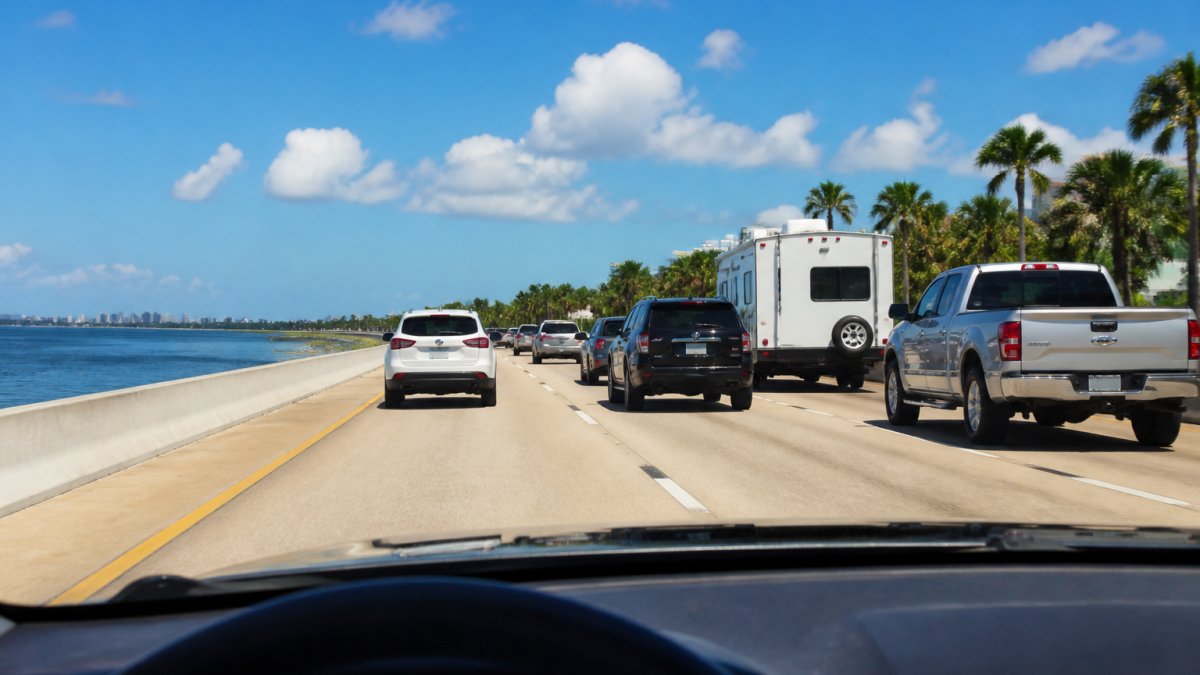
Afternoon thunderstorms are the dominant seasonal hazard on both coasts, and the mechanism matters more than the warning. During the wet season, which typically runs from roughly late May through September, the first ten to twenty minutes of a heavy cell are the most dangerous window: oil, coolant, and tire residue that have baked onto the pavement for days lift into a slick film before enough rain washes it away.
Most relocation guides stop at ‘traffic is bad in season.’ The practical version is a route plan. Before a trip, check the state’s live traffic and incident feeds, identify one alternate for each causeway or bridge crossing, and build in a buffer during peak visitor months. On the road, treat every unsignalized median cut as a potential left-turn conflict, and treat every beach-adjacent block as a pedestrian zone regardless of signage.
A Florida DHSMV approved defensive driving course is a program that meets the state’s standards for traffic safety education, which matters if you need the course for a court requirement or an insurance discount. Not every online course qualifies. Before you enroll, confirm the provider is approved, because a non-approved course will not count toward your goal.
Defensive driving course duration in Florida typically ranges from a few hours for a basic refresher to a full day for a comprehensive program. The length depends on the course’s purpose. A basic insurance-focused course is shorter, while a court-ordered or first-time-driver program runs longer. Behind-the-wheel training, like what we provide at Drive Florida Safe Driving School, adds real road time on top of classroom or online hours.
| Course Type | Typical Duration | Best For |
|---|---|---|
| Basic insurance refresher | A few hours | Drivers seeking a discount |
| Court-ordered program | One full day | Ticket or violation requirements |
| First-time driver course | Multiple sessions | New drivers building skills |
| Behind-the-wheel training | Several lessons | Real-road confidence |
The benefits of defensive driving for insurance discounts come down to reduced risk, which insurers reward. Completing an approved course signals to your provider that you are a lower-risk driver, and many carriers offer a premium reduction as a result. The exact discount varies by insurer and policy, so check with your provider directly. Beyond the savings, the skills themselves are the real payoff: better hazard perception, calmer reactions, and fewer claims over time.
Traffic safety data consistently points to driver behavior, not road design, as the leading factor in most crashes. Distraction, speeding, and following too closely account for a large share of collisions, and each is addressable through training. The National Highway Traffic Safety Administration publishes crash data that supports this, and the Florida Department of Highway Safety and Motor Vehicles tracks state-level trends.
This is the comparison most relocation guides skip, and it is the one that most directly determines how many miles you will drive, and therefore how much crash exposure you carry. The short version: transit coverage on the West Coast and Suncoast is thinner and more car-dependent than in the dense Atlantic metros, but the two regions are not identical to each other.
The practical consequences for a defensive driver are concrete:
A suncoast defensive mindset, built on scanning ahead and anticipating other drivers, matters more here precisely because you cannot opt out of driving as easily. That is the honest trade-off: the same laid-back coastal lifestyle that draws people to the region also means the car is the default, and the default is where the risk lives.
Driving the West Coast and Suncoast safely comes down to preparation, not luck. The traffic, weather, and road conditions here demand a defensive mindset, and the right training makes that second nature. Drive Florida Safe Driving School offers over nine years of instruction, personalized behind-the-wheel training, and DHSMV-approved defensive driving courses designed to build real confidence. Call us at (941) 500-9485 and get started with Drive Florida Safe Driving School to pass your road test and drive with control.
General defensive driving covers universal techniques like scanning ahead, maintaining safe following distances, and anticipating hazards. Suncoast defensive driving adds regional context: the specific traffic patterns, seasonal tourist surges, and road designs you encounter along Florida’s Suncoast. Courses tailored to this area often include practice on local highways and bridges, helping drivers apply defensive principles to the exact conditions they face daily. The core skills are the same, but the Suncoast version makes them immediately relevant to your commute.
Florida does not require a defensive driving course for all new drivers, but completing a Florida DHSMV approved course can help you satisfy certain licensing requirements and may reduce insurance costs. For teenagers, a state-approved driver education program can fulfill the classroom portion needed for a learner’s permit. Adults new to Florida or returning to driving often take a defensive driving course voluntarily to refresh skills and learn local traffic laws. Always check current DHSMV guidelines for the latest requirements.
The Florida West Coast, including the Suncoast, features a mix of calm Gulf beaches, barrier islands, and busy tourist corridors. Traffic often swells seasonally with snowbirds and vacationers, and afternoon thunderstorms can quickly change road conditions. Compared to other regions, you’ll encounter more drawbridges, coastal two-lane roads, and pedestrian activity near beaches. Defensive driving here means planning for sudden congestion, watching for out-of-state drivers, and adjusting to wet roads during summer storms.
A certified defensive driving course in Sarasota can help you earn an insurance discount, sharpen hazard perception, and build confidence on local roads like US 41 and I-75. Many insurers offer reductions for completing a state-approved course, though the exact amount varies by provider. Beyond savings, you’ll learn techniques to handle aggressive drivers, poor weather, and complex intersections. For new residents or anxious drivers, the local focus makes the training directly applicable to daily commutes and road test preparation.
At Drive Florida Safe Driving School, we are dedicated to assisting our novice learners to become the safest driver. We always strive to render that you or your loved one receives the most updated techniques, knowledge, and defensive driving norms.




 English
 Spanish

