
Last Updated: October 10, 2026
Defensive driving techniques for highway are specific skills that help you stay safe when traveling at high speeds on multi-lane roads. These methods focus on awareness, planning, and quick decision-making to avoid crashes before they happen.
The core principle is simple: you cannot control what other road users do, but you can control how you respond. Defensive driving on the highway means staying alert, keeping proper distance from other vehicles, and adjusting your speed to match conditions.
Most drivers focus only on their own vehicle. Defensive drivers scan the entire road environment, check mirrors every few seconds, notice drifting vehicles, and see brake lights ahead before traffic jams reach them. This situational awareness separates safe drivers from those who get lucky.
Before merging onto the highway, spend five minutes planning your route, identifying exits, and checking weather and road conditions using GPS or traffic reports.
Road conditions change quickly: rain reduces tire grip, wind pushes vehicles, construction forces lane changes, and darkness limits visibility. If conditions are poor, leave earlier, take a different route, or postpone the trip.
Check your vehicle before departure: tire pressure (underinflated tires fail at highway speeds), wiper blades, headlights, brake lights, mirror angles, and fuel level.
Fatigue is a silent killer on highways. If you’re drowsy, don’t drive, drowsy driving impairs judgment as much as alcohol does. Take a 20-minute nap, switch drivers, or postpone the trip.
The space between your vehicle and the car ahead is your most important safety tool, giving you room to stop if the driver ahead brakes suddenly.
The Three-Second Rule Baseline
Use the three-second rule: pick a fixed object ahead, count “one-one-thousand, two-one-thousand, three-one-thousand” as the car ahead passes it, and ensure your vehicle doesn’t reach that object until you finish counting. This time-based method accounts for reaction time and braking distance, and scales automatically with speed.
Adjusting Your Gap for Weather and Road Conditions
The three-second rule is a minimum, not a target. Real-world conditions demand larger gaps:
How to Measure and Maintain Your Gap
The three-second rule works at any speed because it’s time-based, not distance-based. You don’t need to calculate, just count.
If traffic is moving faster than you’re comfortable with, slow down and let faster vehicles pass. Maintaining a safe gap is more important than matching surrounding traffic speed.
If the driver behind you is tailgating, do not brake suddenly or slow down to punish them. Instead, maintain your speed, increase your following distance ahead, and let them pass when safe.
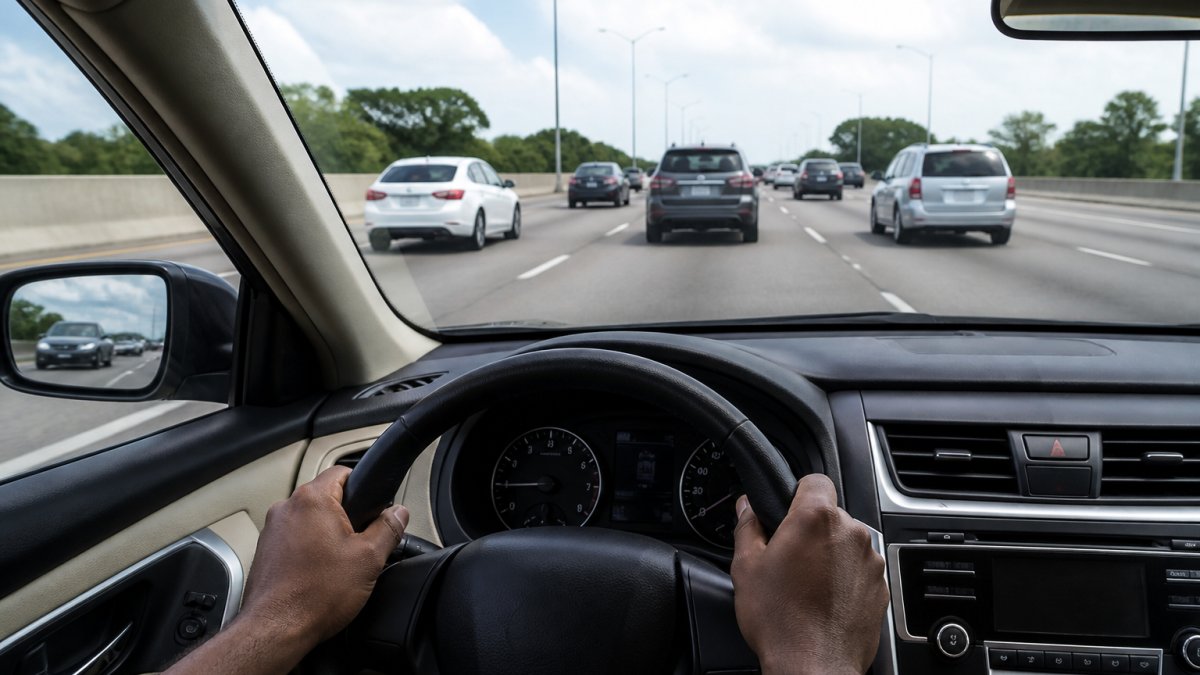
Merging and lane changes on the highway require precision. These maneuvers put you alongside other vehicles where blind spots hide entire cars. Rush them, and crashes happen.
Before you merge or change lanes, follow this sequence: (1) Signal three to five seconds early, (2) Check mirrors and blind spots by looking over your shoulder, (3) Match the speed of traffic in the target lane, (4) Smoothly steer into the new lane, (5) Keep your signal on for two seconds after the maneuver.
Never assume an open space is safe. A motorcycle or smaller vehicle might be hidden in your blind spot. Move deliberately and confirm the space is clear before you commit.
Merging onto the highway from an on-ramp requires the same care. Use the ramp to build speed, match highway traffic speed before entering main lanes, and merge at a 45-degree angle with smooth, gradual movements.
Highway hypnosis is a state where your mind disengages from driving even though your eyes are open. This is dangerous because your reaction time slows dramatically.
Hypnosis happens on straight stretches after 30 minutes of driving, causing you to drift between lanes, miss exits, or fail to notice brake lights ahead.
Prevent hypnosis with active engagement: scan 15 to 20 seconds ahead, check mirrors every five to eight seconds, vary your focus, take breaks every two hours, avoid distractions, and anticipate other drivers’ actions.
If you feel drowsy, pull over immediately. Drowsiness impairs judgment, reaction time, and vehicle control. A 20-minute nap restores alertness. Stopping is always the right choice.
New drivers often feel anxious on the highway due to higher speeds and denser traffic. This anxiety is normal and can be managed with practice and preparation.
Start on quieter highways during daylight, avoiding rush hour and poor weather. Build your experience gradually with a confident, experienced passenger.
Focus on fundamentals: maintaining safe following distance, checking mirrors, signaling clearly, and staying in your lane. Let traffic flow around you and build confidence through correct practice.
Mistake 1: Driving in truck blind spots. Large vehicles cannot see directly behind or beside them. Pass trucks quickly or stay well back.
Mistake 2: Changing lanes without signaling. Other drivers cannot read your mind. They don’t know you’re about to move. A signal gives them warning and time to adjust.
Mistake 3: Speeding in heavy traffic. Match the traffic flow, even if the speed limit is higher.
Mistake 4: Using cruise control in congested traffic. Cruise control doesn’t respond to sudden braking. You have to react manually. Manual control is safer in dense traffic.
Mistake 5: Eating, texting, or adjusting controls while driving. These distractions take your attention off the road for critical seconds. Pull over or wait until you’re parked.
Mistake 6: Driving when impaired or drowsy. Impairment and fatigue slow reaction time as much as alcohol does. Don’t drive if you’re not fully alert.
Aggressive drivers, reckless merges, and erratic behavior happen on highways. Your response determines whether the situation escalates or resolves safely. The key principle: remove yourself from danger rather than confront it.
If Another Driver Is Tailgating You
Tailgating is aggressive and dangerous. Don’t brake or slow down to “teach them a lesson”, this escalates the situation and increases crash risk.
Instead: (1) Maintain your speed and lane position, (2) Increase your following distance ahead, (3) Move to the right lane and let them pass, (4) Do not engage, keep your eyes forward, (5) Drive to a police station or public area if the tailgating is extreme, (6) Call 911 if the driver makes threats, attempts to force you off the road, or displays a weapon.
If Another Driver Cuts You Off or Merges Into Your Space
A driver may merge suddenly without signaling, cut across your lane, or force you to brake.
If a Driver Is Driving Erratically or Appears Impaired
Erratic driving includes weaving, sudden speed changes, drifting, near-misses, or driving too slowly. These behaviors suggest impairment or a medical emergency. (1) Increase your distance significantly, (2) Change lanes to avoid them, (3) Do not block or slow them down, (4) Call 911 or highway patrol with vehicle description, license plate, location, direction of travel, and specific behaviors observed, (5) Continue driving safely and let law enforcement handle it.
If Another Driver Is Driving Aggressively Toward You
Some drivers intentionally drive aggressively: blocking your lane, preventing passing, or making threatening gestures.
If You Witness Dangerous Driving Affecting Other Vehicles
You may see another driver behaving dangerously toward a different vehicle. You can help without putting yourself at risk.
The Core Principle: Safety Over Ego
Every dangerous driving situation has a safe resolution: creating distance, changing lanes, slowing down, or letting the other driver pass. Your ego, your schedule, and your desire to “teach someone a lesson” are never worth a crash. The safest choice is always the one that removes you from risk, even if it feels like you’re “giving in.” You’re not giving in; you’re surviving.
Use the three-second rule: pick a fixed object ahead (road sign, mile marker), and count the seconds it takes your vehicle to reach it. At highway speeds, this typically equals 150-200 feet. In rain, snow, or heavy traffic, increase to four to six seconds. This space cushion gives you time to react and brake safely if the vehicle ahead stops suddenly.
The core techniques include scanning ahead to anticipate hazards, maintaining safe following distance, checking mirrors frequently, signaling before lane changes, adjusting speed to conditions, staying focused and avoiding distractions, and being prepared to react to other drivers’ mistakes. These practices reduce collision risk and give you time to respond to unexpected situations on high-speed roads.
Break monotony by switching drivers every two hours, adjusting your seat and mirrors, varying your speed slightly, opening windows for fresh air, and listening to engaging podcasts or audiobooks. Avoid cruise control on long drives, active steering keeps your mind engaged. Stop every 100-150 miles to stretch, walk, and reset your focus. Recognize early signs like heavy eyelids or drifting thoughts, and pull over immediately if drowsiness sets in.
Yes. Professional instructors teach you how to interpret traffic patterns, practice merging in real traffic, and build confidence through guided experience. They identify anxiety triggers and provide immediate feedback on your technique, helping you develop safe habits before driving alone. This structured approach reduces the learning curve and helps you avoid common beginner mistakes that lead to accidents or failed road tests.
At Drive Florida Safe Driving School, we are dedicated to assisting our novice learners to become the safest driver. We always strive to render that you or your loved one receives the most updated techniques, knowledge, and defensive driving norms.



 English
 Spanish

